Actually, this is from February.
"Homelessness is a choice." - Tony Abbott
This was Abbott's response to a question asking whether a government under his direction would continue with the Rudd government's goal of halving homelessness by 2020. It was also his reflection on Matthew 26.11.
Theological fail?
Friday, March 19, 2010


Thursday, March 18, 2010
...mens eadem...

"Don't be conformed to this present evil age, but be transformed by the renewing of your mind..." - Romans 12.2
"The word of God was the sweat of [Paul's] brow, but it was also the life of his mind. Our juncture of history is rather like Paul's in one respect: it requires a Christian preacher to come to the defence of the life of the mind. As Universities daily conform themselves more closely to the school of wizardry in children's fiction, a repository of magic techniques to get startling effects, who else is left to care for how people, as individuals, think for themselves about the coherence of understanding, principle, and purpose that makes the difference between living in freedom and living in servitude? As the young flock in ever greater numbers to our Universities and colleges, who is there to talk to them seriously, and with all the resources of refined scholarly culture, about the meaning of their human existence, about how vast quantity if scatted or organised information can be distilled into something worth a humans being's while to be occupied with in his or her one and only venture in life? Of course, we shall be told that virtue cannot be taught, that the existential dimension of wisdom is something each person must discover for him or herself, not a topic for inclusion in a syllabus, to be "covered" in a tutorial. All of which is perfectly true. Yet wisdom can be present or absent as a goal and a horizon, before which everything covered in a syllabus can begin to assume its real importance. But this requires teachers who believe that learning is not simply perfecting a performance, but has to do with the terror and hope that is due to existence itself. It requires teachers who believe in the human reality of salvation and loss, who live out their academic roles as those who continually ask how they may be saved?" - Oliver O'Donovan, No End to the Word, The Word in Small Boats, 2010.
Tuesday, March 16, 2010
Quote of the Week by Lindsay Tanner
"[I'm] not really religious; I'm an Anglican.'' - Lindsay Tanner, Federal Finance Ministerh/t Alison
Monday, March 08, 2010
Peter Hitchens on faith and his brother
How I found God and peace with my atheist brother: Peter Hitchens traces his journey back to Christianity.
"Why is there such a fury against religion now? Because religion is the one reliable force that stands in the way of the power of the strong over the weak. The one reliable force that forms the foundation of the concept of the rule of law. The one reliable force that restrains the hand of the man of power. In an age of powerworship, the Christian religion has become the principal obstacle to the desire of earthly utopians for absolute power."
4 Quick Questions and 1 Strange one with...
Me. About my work with the EU and the Howard Guinness Project. Over at Jeremy's blog, Micaiah Sells Out...
Monday, February 22, 2010
Let Light Shine out of Darkness
 6
"For we do not proclaim ourselves; we proclaim Jesus Christ as Lord and ourselves as your slaves for Jesus’ sake. For it is the God who said, ‘Let light shine out of darkness’, who has shone in our hearts to give the light of the knowledge of the glory of God in the face of Jesus Christ."If there is one thing that stood out to me as during student during my time at Sydney Uni, it is the EU's commitment to the t-shirt truth that "Jesus Christ is Lord." This is the gospel we proclaim and live out on campus.
Photo: The light tower of the new law building library.
Friday, February 12, 2010
Cash Cows?
 Alison and I are both involved in ministering to International students at our church. We are really thankful for the opportunities we have to share Jesus and our lives with people. But it has made us really aware of how poorly treated international students are. They are charged an incredible amount of money come here and study, and then receive no financial assistance in terms of travel insurance or medicare. International students will often work long hours each day, and are usually underpaid. Unaware of their rights, I've heard too many stories from students in the past three years who have been taken advantage of by the employers.
Michael Spence, reflecting on the racial violence against overseas students that has made world headlines for the past year, has this to say:
"...[W]e need to get serious about the services we provide to overseas students. Each student we welcome into Australia is a person with complex needs and aspirations, unlike the volumes of coal and iron ore that have traditionally dominated our links to Asia. Students should not be perceived as cash cows to be milked at every opportunity. Sure, overseas students make a huge economic contribution but why shouldn't state governments recognise this by, for example, treating them like other students and providing travel concession cards?" - SMH
Dr Spence argues that a w
 ay forward is for universities to provide more on site or local accommodation for international students. He also notes that "our education links are often as strong as, if not stronger than, our diplomatic links." I think that I agree with him. However, I want to take it further; because it is not only institutional change that is needed. It's not only our governments and universities that see overseas students as "cash cows", but employers who work international students on 12 hour shifts and pay them a pittance. Our landlords who charge students $200 a week to share a two bedroom apartment with seven other people. What is need ultimately is a change of heart. As agents and victims of sin and evil, what we need is to be set free.
That's why I'm thankful for being involved in the overseas students ministry at church. Because as Australians and Chinese (and one Colombian guy), we can say "yet for us there is one God, the Father, from whom are all things and for whom we exist, and one Lord, Jesus Christ, through whom are all things and through whom we exist. (1 Cor. 8.6.)
Tuesday, February 09, 2010
Hope We Can Believe In?
 As part of the 2010 Sydney Festival, ABC Radio National hosted an event called Hope 2010: Crisis, Catharis, Renewal. Nine panelists were asked to talk about what they hope for in 2010. The Australian public were also able to "offer their hopes, fears and dreams for 2010."
Of interest to readers of hebel will be the contribution by Michael Spence. Dr Spence in the Vice Chancellor of Sydney University. He is also an ordained Anglican minister. I heard Dr Spence on Saturday night, and he said that his Hope 2010 speech was an opportunity for him to give 'account of the hope that is in you' (cf. 1 Peter 3.15).
You can listen to Dr Spence's address here.
Sunday, January 31, 2010
Divining the Past: Dialogues between Christianity and history
 A Call for Papers
Over at Faith and Place Meredith has launched a conference hosted by the Evangelical History Association:
"Divining the Past is a conference dedicated to the exploration of relationships between Christianity and History. How has the Christian tradition informed the theory and practice of history? How important is history to the belief and expression of Christianity? And how have Christian people, groups, movements, ideas and experiences been significant in past centuries? The conference aims to bring together a variety of perspectives on these questions. It is open to scholars associated with theological colleges as well as universities. Students doing original research in history are especially encouraged to participate.
The EHA invites proposals for papers on any aspect of the relationship between Christianity and History. We particularly welcome papers with an historiographical or theoretical focus, or that engage with the following topics:
The program will feature a panel on the theoretical and methodological links between Christianity and the discipline of history.
Please send abstracts of no more than 250 words to Dr Meredith Lake - meredithelake[at]gmail[dot]com - by 31 March 2010."
Friday, January 29, 2010
Gen Y and the Failures of the Church
"Consider your own call, brothers and sisters:* not many of you were wise by human standards, * not many were powerful, not many were of noble birth. But God chose what is foolish in the world to shame the wise; God chose what is weak in the world to shame the strong; God chose what is low and despised in the world, things that are not, to reduce to nothing things that are, so that no one might boast in the presence of God. He is the source of your life in Christ Jesus, who became for us wisdom from God, and righteousness and sanctification and redemption, in order that, as it is written, ‘Let the one who boasts, boast in the Lord.’" 1 Corinthians 1.26-31272829303"At work this week, we spent some time thinking about how to reach how to reach Gen Y with the gospel (for the purposes of this post Gen Y is anyone born between 1980-1995). We want to reach this generation in an appropriate way. As I've mentioned elsewhere, there are three main issues that concern this postmodern (in practice if not in thought) generation: authenticity, community, justice.
 These are three itches which I think the church can scratch. But before we get there, we need to remind ourselves that 'the Church' has a significant image problem with Gen Y. The image of the church that Gen Y knows is either something resembling Philip Pullman's Magisterium, or the daggy American evangelical straw man who sings kumbaya and has eight children. In the short lifetime of Gen Y, several major denominations have been caught up in significant scandals that became front page news in Australia and overseas. Beginning in the 1980's with the revelation that child abuse had been happening the church, Gen Y has been exposed to stories of Christian leaders marriage infidelities (or in the Roman church, headlines of Catholic priests and bishops fathering children), which was soon followed by stories of financial indiscretions. A new genre emerged that argues that the truth about Jesus and early Christianity had been covered up by the church. And faith increasingly mixed with politics, especially (but not exclusively) in America with the alliance between conservative Christians and the GOP.
In the 25 years of my life, the church has been presented as irrelevant, anti-intellectual, medieval, chauvinistic and homophobic. According to the new atheists, it is dangerous for you. It is increasingly portrayed in newspapers such as the SMH as being run by reactionary, self-interested grey-haired men. This is the image that the average non-Christian first year starting university this year will have in their mind.
How do you evangelize someone who thinks of Christianity like this? I'd be interested to hear your thoughts.
Wednesday, January 13, 2010
Asylum
 Four friends on the
Michael Jensen - Sink or swim? What to do with boat people
Meredith Lake -A home for the persecuted and the poor? and Boat people: a challenge to Australian sovereignty?
Alison Moffitt - Two cents on Asylum Seekers
Jeremy Smith -Christmas Island – have a read!
Tuesday, January 12, 2010
Lo, I Am With You Always

"For some centuries the idea of the Holy Roman Empire enthralled the minds of men. For a still longer period the idea of the Holy Roman See held undisturbed sway over Western Christendom. To those who take a comprehensive view of the progress of Christianity, even these more lasting obscurations to the truth will present no serious difficult. They will not suffer themselves to be blinded thereby to the true nobility of Ecclesiastical History; they will not fail to see that, even in the seasons of her deepest degradation, the Church was still the regenerator of society, the upholder of right principle against selfish interest, the visible witness of the Invisible God; they will thankfully confess that, notwithstanding the pride and selfishness and dishonour of individual rulers, notwithstanding the imperfections and errors of special institutions and developments, yet in her continuous history the Divine promise has been signally realised 'Lo I am with you always even unto the end of the world.'" - J.B. Lightfoot, The Christian Ministry.God, in his 'foolishness', shamed the wisdom of the wise in his crucified Son and Messiah. And he continues to work through weak and broken agents like us to bring everything under the lordship of Christ. Even at it's worst "the Church was still the regenerator of society, the upholder of right principle against selfish interest, the visible witness of the Invisible God".The church exists not for its own sake, but as the assembly of God, is the pillar and bulwark of truth. And as the assembly of God, Christ is with us always, "even unto the end of the world"
Monday, December 21, 2009
Plans for 2010
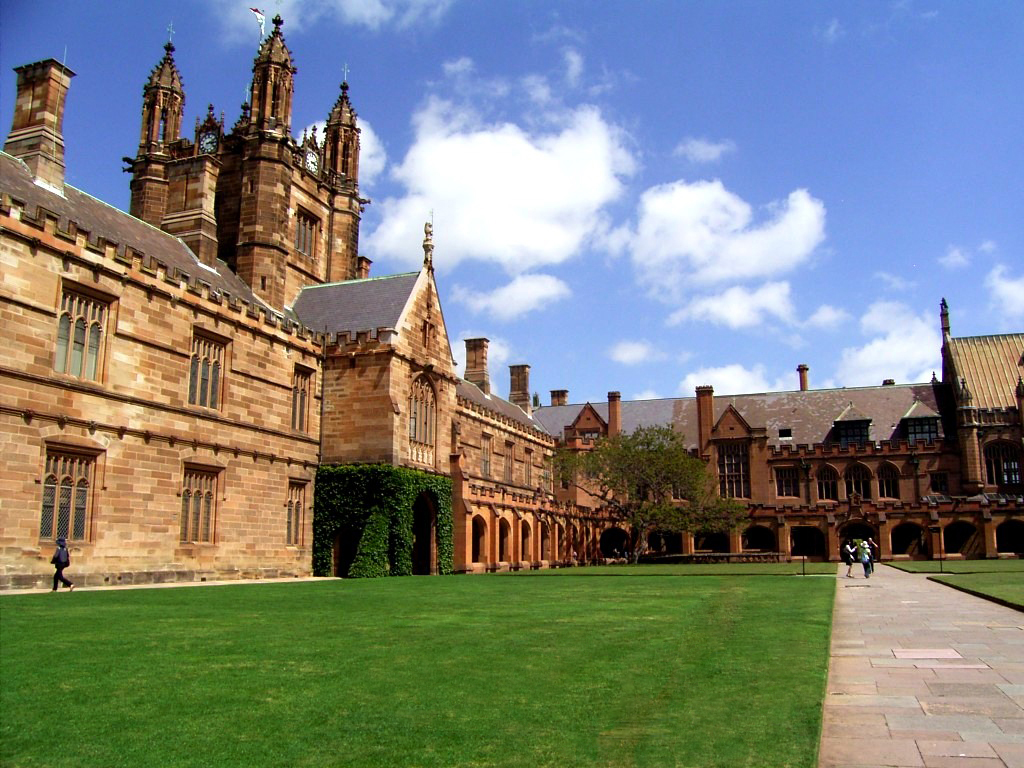 The Stars Change...
When Sydney University was established in 1850, the founders envisioned a center of learning that would be equal to the great Oxbridge traditions of which they where heirs. The stars may have changed, but the mind stays the same. Indeed, the new university would embody the great advances of modernism that Cambridge and Oxford didn't. In particular, the university would be founded without a theology department and outside the control of the church.
In 2009, Sydney University has over 50,000 students and staff. About a quarter of students are from overseas, largely from mainland China. Many of the students and staff don't know Jesus.
 In 2010 I'll begin a two-year ministry traineship (the Howard Guiness Project) through the EU Grads Fund in partnership with the Sydney University Evangelical Union (SUEU or EU). The EU is made up of between 600-1000 Christian students. 2010 will be their 80th anniversary of proclaiming Jesus as Lord to the campus and growing Christians in their faith and devotion to Jesus. I'll be working with students in Agricultural and Veterinary Science (the AgVet faculty), and also with postgraduate students from several different faculties across the university. I'll also receive training which, Lord willing, God will use for his purposes for many years to come.
"The university is a clear-cut fulcrum with which to move the world. The church can render no greater service, both to itself and to the cause of the gospel, than to try to recapture the universities for Christ. More potently than by any other means, change the university and you change the world." - Charles Habib Malik, former President of the UN General Assembly, Pascal Lectures, 1981.
 After three years of working at CMS and being exposed to the ministry of CMS missionaries around the world, I'm totally convinced of the truth of what Malik says. Part of what excites me about the next two years is the vision of the EU Grads Fund: "To flood God's church in Sydney, Australia and beyond with lay and vocational Christian leaders who are biblically and theologically mature, servant hearted, and innovative ministry strategists." Furthermore, in several years Alison and I would, Lord willing, like to serve overseas in student ministry. So we see 2010 and 2011 as a really important time for me to learn and be trained and have my mind more and more transformed into the image of Christ.
You would be interested in supporting me either in prayer o financially, please contact me: mpmoffitt [at] gmail.com.
Monday, December 07, 2009
"Reports of My Demise..."
"Anglicans lack identity..."According to Ross Cameron, former Federal MP for Parramatta (and one of several devoted Roman Catholic Liberals who came to prominence during John Howard's premiership), "we must assume the Anglican idea is fast reaching its use-by date." Cameron is quite polite in his Op-Ed piece from last Saturday's SMH: "It has, however, been a great innings". Cameron is quite ready to assign Anglicanism as the origin of everything from religious tolerance to scientific discovery. But Cameron is ready to consign Anglicanism, if not to the dustbin of history, then at least the historical retir
"I expect the meetings in Rome have begun an inexorable reabsorption of the Anglican Church into the world's oldest institution. The church created by the charismatic King Henry VIII has found its current archbishop, an undertaker, appearing to see his mission as an orderly burial."
 ement village.
Which is because of a fundamental error in Cameron's thesis. Cameron's Anglicanism has no identity because hasn't developed since the turmoils of Henry VIII. And this is an error because Anglicanism hasn't been static, and has had significant developments in expression and identity in it's five centuries (which I have previously described here). According to Gerald Bray:
"Most people seem to believe that when Henry VIII broke with Rome in 1534, he invented the Church of England and made himself its head in order to legitimise his divorce from Catherine of Aragon, and that since that time, his successors have all been bound to belong to this somewhat dubious creation, an obligation which is symbolised by the royal title ‘Defender of the Faith’. This is false." - Honi soit qui mal y pense (worth checking out for Bray's analysis on current moves to remove the exclusion of Roman Catholics from Monarchy).
 Cameron's analysis of the early history of the Anglican church is somewhat erroneous. The average Anglican in the 16th and 17th centuries would have strongly aligned themselves to the Protestant cause. And to argue that England sat on the sidelines of the "religious wars" (which according to D.B. Hart had more to do than with the rise of the nation-state against empire and church) is to ignore most historical scholarship in the area for the past 20 years (such as Jonathan Scott).
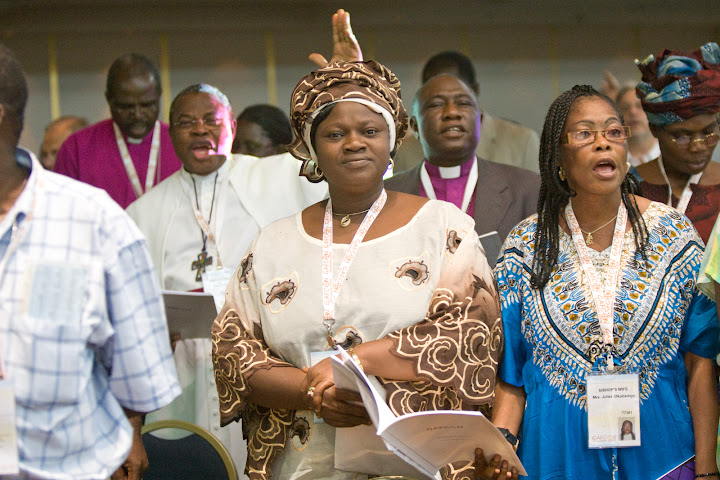
Cameron's Op-Ed is also typical of most detractors of the Anglican Church from the western world. The Anglicanism they see and present is declining in the UK, USA, Canada, Australia and New Zealand. They present it as increasingly irrelevant and being run aground by "fundamentalists". What they neglect is the phenomenal growth Anglicanism has experienced in Africa, Asia and South America. The rise of the Global South has not revitalised Anglicanism, it's the future. Cameron's assertion that Anglicanism is entering her autumn years are greatly exaggerated. Which is why I'm looking forward to the Monday night of CMS Summer School when the President of CMS, Peter Jensen, will be speaking on the role of a mission agency in the Global South.
Photos from the GAFCON website.
Subscribe to:
Posts (Atom)