Saturday, July 11, 2009

The Problem With Preaching III

The Times, They Are A Changing...

It has been said that we stand at the dawn of a new era. As we seek to communicate Jesus and connect with stories, our culture is changing at a rapid pace - and this is why presentation in preaching is important.

We are witnessing the transition between two major communication eras. This is a pretty big deal, as they've only been two communication eras up to now. Firstly, there was the oral culture of communication. Secondly, the culture of writing with the invention of the alphabet and later, the printing press. And thirdly (now), the electronic era of communications, starting with Film and Television, where image became everything. If you think about it, such a major change in communications has only happened once before in human history. So it's no wonder that there is a crisis in today's preaching (and lots of other forms of content delivery).

According to Perth author and pastor Graham Johnston: "The force of the written word has diminished. Words carry no meaning. Enter the image. Images leave the viewer, not with carefully crafted ideas and precepts but with impressions."

Johnston overstates things when he says the power of the written word has diminished - I disagree with that. But he makes an important point about image. Since the rise of television, image and perception have become much more important in communication. And if we thought television had radically changed communication - along came the Internet. Effectively in the last decade the Internet has reshaped everything. Cultural critic Lee Siegel argues: "The Internet is possibly the most radical transformation of private and public life in the history of humankind."

The Internet: it's huge. And it changes everyday.It's changing the whole arena of communication and even society itself. The Internet is changing the people the church preaches to, especially young people. Because of this the Internet presents great challenges and possibilities for preaching today and tomorrow. To throw some perspective on this, it took radio 38 years to reach an audience of 50 million people. Television took 13 years, the Internet took 4 years, the i-Pod did it in 3 years and facebook did it in just 2 years. Internet use has even surpassed television viewing.

It's because of all these major developments that we go to the Internet and learn some lessons for preaching in today's world. There is more to come...

Tuesday, July 07, 2009

The Problem With Preaching II

Presentation Matters

One of the problems with preaching today is that presentation matters. Actually, what I mean is that presentation is important, and we're neglecting it. As good Evangelicals we have a strong view of scripture: that is powerful and change peoples lives. We believe in the centrality of the word in preaching, empowered by the Spirit. We believe in good exegesis that is driven entirely by God's word. So does presentation matter?

My answer is yes, it does. In preparing our sermons we spend so much time working out our three points (preferably alliterated), a humorous introduction and some sort of application at the end that includes Jesus. And what we are producing is an half-hour essay that has been fitted into that format and read out loud. We need to do better than this.

But before I go further, I must say two things.

  1. Presentation means more than eloquent words. The Apostle Paul was quite clear that when we taught it wasn't going to be the beauty of his words that changed lives (see 1 Cor. 2.1-2). Presenting when doesn't mean we sell out to a rhetorical exercise. It's about serving God well; and some of the preaching in the church today just 'doesn't cut the mustard'.
  2. Presentation is doesn't necessarily equal spin. In a world were people are cynical of most things that they hear, preaching spin would be far more dangerous than delivering a 30 minute essay. The best preaching is personal. As I will explain in the pomo series, good presentation requires authenticity, not spin.
Some of you would have heard about the famous Joshua Bell YouTube video.


Back in 2007 Joshua went into a Washington subway with a violin. Wearing jeans and a cap, he started busking. In the 45 minutes he played, 1097 people passed by. Hardly anyone stopped and only 27 people gave money. All up he earned $32, less than a dollar a minute.

Away from the subway, Joshua Bell is an accomplished violinist - one of the modern worlds great. A couple of days earlier, playing a violin handcrafted in 1713, valued at $4 million, he’d packed Boston’s - Stately Symphony Hall to great acclaim. Tickets were $120 each. He earned $1,200 a minute!

Same bloke... same violin… same pieces of music… same brilliant performance…His presentation of himself and his performance - were the only variables.

Presentation matters! Presentation counts! Preaching a 30 minute essay isn't good enough any more. We need to prepare what not just what we say, but how we say it. If we should learn anything from the 2008 US Presidential campaign, great oratory and careful presentation is powerful. It can lead you to the most powerful office in the land (although Abraham Lincoln had already taught us the power of words: his Gettysburg Address, arguably the greatest speech in American history, was over in just two minutes). But for us who proclaim the resurrected Jesus, it's never just about great oratory. The best sermons are personal and authentic.

Preaching like this has great potential. According to the great author on preaching, Haddon Robinson:
"The effectiveness of our sermons depends on two factors; (of course)what we say – but how we say it...The age of the preacher is gone, the age of the communicator has arrived".

There is more to come...

Monday, July 06, 2009

The Problem With Preaching: What The Preachers Say

It seems that there is a crisis in preaching. How often do you hear church goers complaining about the length of the sermon? Or how boring it is? Or how irrelevant it is? I heard Leigh Hatcher talk about 'Preaching in a 'look at me' world', and I'll try and post some of his thoughts up here. But to set the scene, here are some thoughts on preaching by some well known contemporary preachers.

John Stott:
"The standard of preaching in the modern world is deplorable. There are few great preachers."
John Woodhouse:
"Much of modern preaching is deadly dull, and we long to hear preaching that is alive."
Peter Jensen:
"We need to look again at what we do in church, our reading, our prayers, (YES!!) our preaching."
Bryan Chapel:
Congregational interest in any message is a minor miracle - that no minister should ever take for granted."
Martyn Lloyd Jones, on the British experience going back to the 1960’s!!:
"Many of the younger reformed men in Britain are very good men who have no doubt read a great deal, and are very learned, but they are very dull boring preachers."
Richard A. Jensen:
"There’s a crisis - in the theory and practice of preaching."

Saturday, July 04, 2009

Pomo

Postmodernism. The word is enough to send shivers down some peoples spines. For others it's not so much a shiver but a long groan. And for others there is nothing sweeter or better than post modernity. I've believe the same attitudes are alive in the church. Same people will tell you that the greatest danger facing the church today is the rise of postmodernism - it is the great evil of the age. Others will tell you that the hope and future of the church lies down the path of the postmodernists.

Being a good Anglican, I want to avoid both extremities. I think that postmodernism has some helpful ideas that the church should grapple and engage with - the quest for justice, community and authenticity for starters. And I think that there are some things within post modernity that the church must hold fast on and say no, such as the apathy and ambiguity ingrained into today's pomo culture. And when this is all said and down, there are some valuable things that the could church to pick up- narrative, and an ally against that great enemy of the church: modernism.

There is an urgency in all this. It's very easy to dismiss pomo, and even claim that we've moved on - we're post post modern - which I think is such a post modern thing to say. What I have think has happened is that post modernism started off as an academic critique of modernism in literature, history, justice etc in the mid 20th century. From that time it has slowly worked it's way through our culture and society until today - where it now is part of our social conscience.

And the urgency is that this is no more true than in today's 'gen y' and 'gen z'. These are generations where post modernism has been ingrained into their very fibre. So over he coming weeks I'm planning to post about some helpful things in post modernism, some not so helpful things, and how the church should respond to this. And I'm keen to hear what you have to say about all this - so feel free to comment.

Friday, July 03, 2009

Marriage: quote unquote...

Here are some quotes about marriage that I thought were worth posting here. They come from St Philip's York Street's study on 'The Resurrection and the Sanctity of Marriage'. h/t Justin.

SOME QUOTES:
"In the presence of God, I take you to be my wife, To have and to hold from this day forward, For better, for worse, for richer, for poorer, in sickness and in health, To love and to cherish, till death us do part; This is my solemn vow and promise." - Wedding Vows

"Your love is your own private possession, but marriage is more than something personal — it is a status, an office. Just as it is the crown, and not merely the will to rule, that makes the king, so it is marriage, and not merely your love for each other, that joins you together in the sight of God and man. As high as God is above man, so high are the sanctity, the rights, and the promise of love. It is not your love that sustains the marriage, but from now on, the marriage that sustains your love." - Dietrich Bonheoffer

"Let your religion be less of a theory and more of a love affair." - G. K. Chesterton

"... in our present culture, sexual activity has become almost completely detached from the whole business of building up communities and relationships, and has degenerated simply into a way of asserting one's right to choose one's own pleasure in one's own way. To put it starkly: instead of being a sacrament, sex has become a toy." - Tom Wright

Friday, June 26, 2009

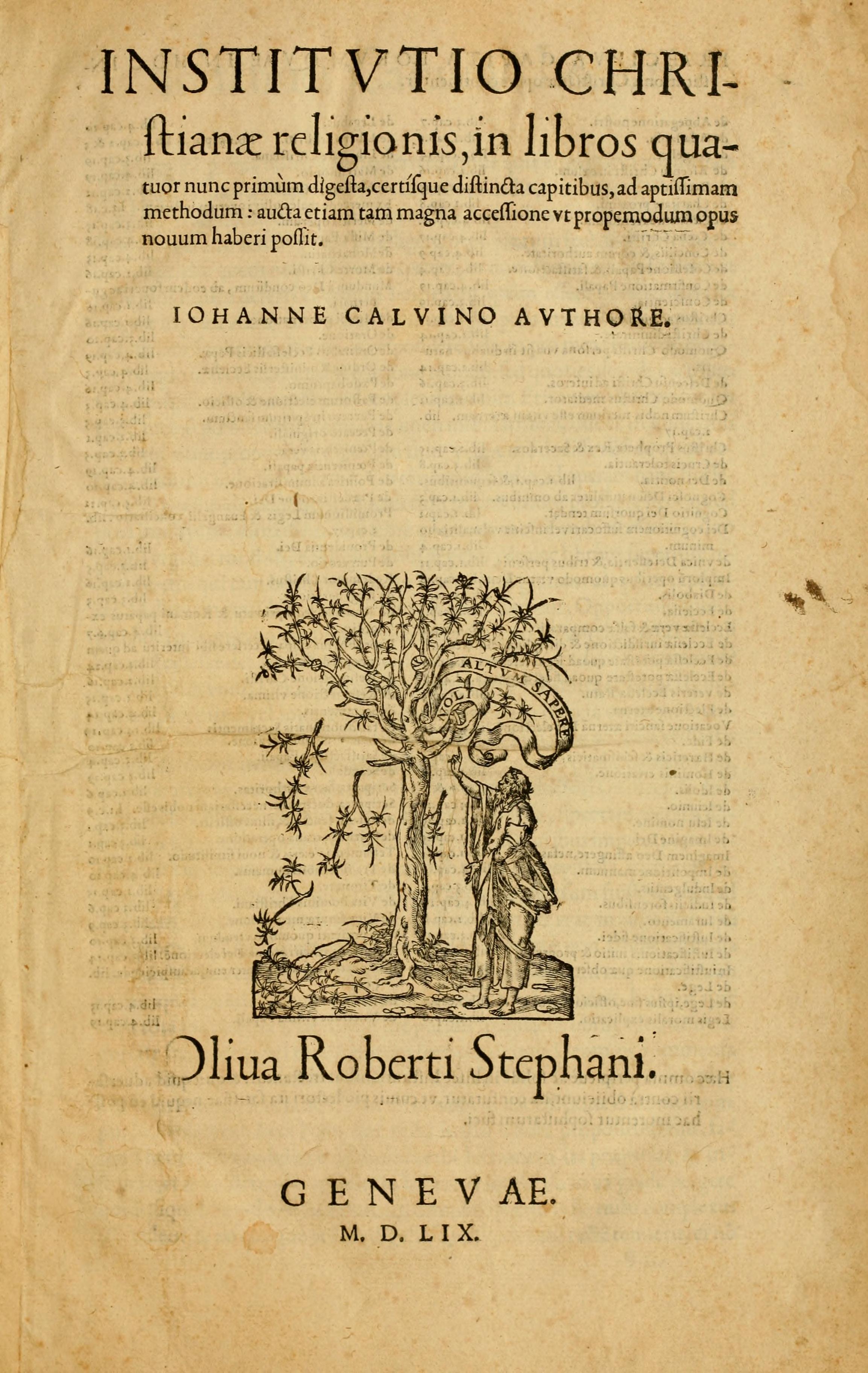
Why We're Still Talking About Calvin

In case you missed it, Michael Jensen had a great op-ed in yesterday's Australian on the decline of Calvin. The quote from Pulitzer prize-winning novelist Marilynne Robinson on Calvin's influence is worth repeating:
"Any reader of the Institutes must be struck by the great elegance, the gallantry, of its moral vision, which is more beautiful for the resolution with which its theology embraces sorrow and darkness.

...There are things for which we in this culture clearly are indebted to him, including relatively popular government, the relatively high status of women, the separation of church and state, what remains of universal schooling and, while it lasted, liberal higher education, education in the humanities. How easily we forget."
In reading Michael's op-ed, I was reminded of something I've been intending to mention for a while now. My friend Angus Courtney submitted his honours thesis last year in history. Not only is it a superb piece of work on the 17th Century English Civil and republicanism, but it provides a paradigm shifting argument against the weight of recent historical scholarship. Angus argues that although the puritans (a label many historians have conveniently avoided using when describing the republicans) were well versed in classics, they lived and breathed the bible and Calvinist theology. Here is an excerpt:
"The defining mark of the historiography of English republicanism is its insistence on the classical basis of English republican ideas. Drawing on the theorists of Greece and Rome––the argument goes––a handful of English writers in the mid seventeenth century articulated a vision of republican government infused with classical ideas and values. It is not an unreasonable argument, particularly considering that a number of English republicanism’s central writers, like John Milton, were prolific classicists who were widely familiar with ancient political theorists and historians. Just as significantly, they lived in extraordinary times that sparked an immense body of political re-examination.2 The result was to be a rich tapestry of republican thinking that was unparalleled in the seventeenth century. It was a unique (if fleeting) moment in English political history, in which ideas were developed that would become essential to eighteenth century political thought in England, the Continent, and America...But this approach makes a serious category error. The essential character of English republicanism was not classical. Although English republicans were familiar with classical texts and referred to––as Sidney put it––the ‘great masters of human reason’, these writers were rarely their primary authority, nor was their example primarily the republics of Greece or Rome. If we are prepared to take Milton at his word (as historians have been), this point is unmistakable. According to Milton, ‘The English people…were not inflamed with the empty name of liberty by a false notion of virtue and glory, or senseless emulation of the ancients.’ Rather, they formulated their republican vision and waged war against the king because of their purity of life and blameless character, in an effort to defend law and religion, rooted in a firm trust in God. At its core, English republicanism was a religious republicanism: a Puritan vision of total reformation that extended not only through the church but also to government. It was a vision inspired by Biblical Scripture, directed towards the godliness of the nation and the glory of God.

The radical nature of this proposition warrants its restatement: English republicanism was religious republicanism. Its central thrust was not towards classical republican government, but the government of God. Its purpose was not civic glory, but the godliness of the community for the glory of God. Regarding English republicanism as primarily classical is to overlook the context in which republicanism developed, the explicit goals for which it was used, and the clear biblical arguments that were used to justify its imposition. To appropriate a biblical metaphor, this overlooking of such a critical aspect is akin to having ‘strain[ed] out a gnat but swallow[ed] a camel.’ My assertion is not that classical republican ideas were absent from the English republican vision. Rather, it is that a much more significant aspect has been overlooked. This is an error in need of correction. We must recover the essential religious component of the English republican vision.

Wednesday, June 24, 2009

Disagreeing Well: Gregory the Great

Here is a wonderful example of why we still need to read books by dead people (h/t Michael - although admittedly it comes as a quote from a contemporary book). Gregory the Great (540-604) writes:
"Provided that it is in good faith, then, it is a mark of virtue to put up with superiors' faults. One should, nevertheless, if there is any prospect that the offending trait could be emended, make a humble suggestion to that effect. Yet one should take great care, when defending justice, not to go too far and cross the threshold of arrogance; not, in an ill-judged love of right, to forfeit humility, the mistress of right; not to forget that the person of whose action one happens to be critical is in fact one's senior. Subjects will discipline their minds to guard humility and avoid the swelling of pride, if they keep an incessant watch on their own weaknesses.

For we neglect to examine our own strength honestly; and because we believe ourselves stronger than we really are, we judge our superiors severely. The less we know of ourselves, the more our field of vision is occupied by those whom we aspire to criticize." - Gregory the Great (540-604) Moralia, Book 25:16:36 in From Irenaeus to Grotius" ed O'Donovan and O'Donovan p. 202.
One of the most valuable things I learned at uni was: it is very easy to be right. It's much harder to be right and still be gracious and loving. Especially in the Sydney Evangelical culture in which I live (which I love, by the way). Yet that is what Paul urges us to do:
"I therefore, a prisoner for the Lord, urge you to walk in a manner worthy of the calling to which you have been called, with all humility and gentleness, with patience, bearing with one another in love, eager to maintain the unity of the Spirit in the bond of peace. There is one body and one Spirit—just as you were called to the one hope that belongs to your call—one Lord, one faith, one baptism, one God and Father of all, who is over all and through all and in all." Ephesians 4.1-6

Monday, June 22, 2009

Mission Exists Because Worship Doesn't?

The phrase "Mission exists because worship doesn't" has been often used in recent years to give a justification for mission. John Piper coined this phrase in response to Christians who feel ashamed or embarrassed about the strong conversionism tendencies in Christianity. He writes:
Missions is not the ultimate goal of the church. Worship is. Mission exists because worship doesn’t. Worship is ultimate, not missions, because God is ultimate, not man. When this age is over, and the countless millions of the redeemed fall on their faces before the throne of God, missions will be no more. It is a temporary necessity. But worship abides forever. Worship, therefore, is the fuel and goal of missions. It’s the goal of missions because in missions we simply aim to bring the nations into the white hot enjoyment of God’s glory. The goal of missions is the gladness of the peoples in the greatness of God. (Let the Nations Be Glad, 2004, p.17).
I sympathise with piper on this point. Worship and the Glory of God definitely have something to do with mission. In Romans 1 God justly judges humans everywhere who neither thanked him or worshiped him. And a great eschatological vision in the scriptures is of "the whole earth being filled with the glory of God as the waters cover the sea" (Isaiah 11.9 and Habbakuk 2.14).

But something in Piper's statement irks me. Maybe it's a reaction against Piper's reduction of everything to glory - I'm not sure what it is, but the biblical theologian in me whats to nuance Piper's thesis. Maybe something like: Mission exists because evil does. On reflection this does sound pretty similar to Piper, but I'm trying to locate mission within the framework of the biblical narrative. (I'm not convinced that Piper does this in Let the Nations be Glad, largely because the first reference to Genesis 12 is on page 30 and is talking about the Puritans. When he does get back to Gen 12 around page 130, this foundational text only rates a passing mention). Mission is God's plan to redeem humanity and creation from the captivity of evil and sin: idolatry, hatred, famine, death, etc. In the proto-gospel, the promise is the crushing of evil: "I will put enmity between you and the woman, and between your offspring and her offspring; he shall bruise your head, and you shall bruise his heel” (Genesis 3.15). God works through Abraham and Israel and finally Jesus to make this happen. In Abraham all the nations will be blessed. Israel is a light to the nations (never mind for now that she constantly failed this) and the "nations will stream to her". And Jesus is able to totally obliterate evil cf. Colossians 2.15. My point is that mission is not just a New Testament concept, it's deeply ingrained in the story of the bible.

But then again, I'm not sure I'm entirely happy with: "Mission exists because evil does". Forgetting issues of theodicy for now, there is a sense in which mission exists because God does. God creates the world ex nihlo, making something out of nothing. He separates light from darkness, gives shape to a world that is formless and void. And just before God rests, he creates Man and Woman in his image and charges them with a mission: "Be fruitful and multiply and fill the earth and subdue it and have dominion over the fish of the sea and over the birds of the heavens and over every living thing that moves on the earth" (Genesis 1.28). I take it that this mission of reflecting the image of God into the world continues despite the 'the fall'. It's given fresh impetuous by Jesus who commanded his disciples to go and make disciples of all nations - so that everyone will hear that Jesus is King and we should reflect his image. And I take it that this will continue in some form in the new creation, after Jesus reigns unchallenged and sin and death are no more. And this to me seems to be a more complete "justification" for mission.

Friday, June 19, 2009

Podcasting and Cross Stitching

If you aren't a regular listener of the Pilgrim's Podcast, you might like to hear me be interviewed last Saturday. We ramble about blogging, CMS and many other things. You can listen here and here.

Or if Cross Stitching is more your thing, than you should check out my Mum's interesting blog. With a large international readership, it's quite successful.

Thursday, June 18, 2009

The End is Near

Guest Post by Alison Moffitt
(My wife Alison handed in her last ever university assignment today. On her live journal she has been posting about the end of her time at uni. This is the seventh of these posts, which is about Vras, my former lecturer and employer.)

One of the best things about university has been the Assoc. Prof. Vrasidas Karalis. Here is a post about him.


"You are freaking me out!"

I'm going to say right out that Vras pretty much got me through my degree. My liberal studies degree required me to pass 5 semesters worth of a language. That sounded pretty straightforward after 5 years of Japanese at high school. I chose to study Modern Greek, because it would keep my grandparents happy and get me in touch with my cultural heritage etc, etc. I would not have passed Greek without Vras.

In first year I enrolled in beginner's Greek. We had two teachers - Martina, a lovely gentle but cool young teacher, and Vras, who appeared to me to be the pinnacle of insanity. Our first week was terrifying for me. Martina and Vras stood at the front of the class room trying to weed out the fluent speakers who were too good for beginners. I don't think they got them all. It felt like most of the class, even though they weren't fluent, could still understand Martina and Vras when they accidently slipped into complicated Greek. I spent that year sitting with my friend Amanda. The four hours with Martina were fine. She would give us worksheets, explain grammar to us, ask us questions that were at our comprehensions level. The last hour of the week was with Vras. He would charge into the classroom like a whirlwind, single out one of the girls:

"My, you're looking very radiant today!"

and then sit on a desk and proceed to rant about the evils of university bureaucracy, the politics of the local Greek community or the shortcomings of that year's Eurovision contestants. Vras never seemed to have a lesson plan. He would just tell outrageously hilarious or disturbing stories about his life and occasionally link them into our language study by translating the odd word into Greek and scrawling it across the chalkboard. Then he would ask a ridiculous question that was way beyond my Greek knowledge. Amanda and I would cower in the back row, hoping that he wouldn't call on us for an answer.

"Tell me you love..."

After about six or seven weeks of uni, Vras decided to teach us the verb agapo. which means love. Vras wondered around the room pointing randomly at students crying out "Tell me you love your mother!" "Tell me you love your father!". He got to me and paused. That day was one of the first days I had been brave enough to wear my EU shirt. "Tell me you love God!" I wasn;t really sure whether he was mocking me or giving me a chance to share my faith with people. Vras was proving to be a little bit obscure with matters of faith. He would tell very obscene stories and then turn around and talk about the New Testament Greek course that he ran after our class finished. He would tell stories about the time he went on a cruise and did lots of things that he found very pleasurable, and then tell one of the boys in our class in all earnestness that he should really read the book of Matthew in the bible, because it would be good for his soul.

"Forget about it"

At the end of the year I followed him up about the New Testament Greek course and summoned the courage to ask him if he was a Christian. Vras looked at me with surprise.
"Of course!"
"Oh. Why do you tell all of those stories?"
Vras paused and then answered (I think he was trying to be cryptic)
"Sometimes a dog's bark is worse than its bite".

Whatever that meant.

We talked for awhile and it turned out that Vras was potentially some kind of amazing heretic. He had been excommunicated from the Greek Orthodox church a couple of years beforehand and was struggling to renew his Greek passport. He sent me a copy of an article he had written, a very scathing history of the Greek Orthodox church. At the time he had decided instead to go the the Anglican church near where he lived in Glebe, although I'm pretty sure he has moved on from there. He doesn't like Calvinists, and most Anglicans in Sydney fall squarely into that category.

"Do you have a friend called Zoe?"

New Testament Greek the next year was an absolute scream. I started realising that Vras had different personas depending on who he was teaching. He still liked stirring people up and freaking people out, but this time, in front of Christians, his weapon of choice was not explicit sex stories but outrageous heresy. Most of what he said went way over my head, but Matt was in that class with me, as well as our friend Ryan and both of them are very keen amateur theologians. They would push back on every point they didn't like, and also some that they just enjoyed arguing over. My friend Dan was also in that class with me. He would try to speak up too, although is preferred method of voicing his opinion was to try and answer every and any question that Vras asked of the class.

Vras' favourite method for teaching vocab was to help us link the Greek word with their English words. So, classes went something like "The word for light is phos! Do you know any English words that come from phos? Yes! Photography". Or like "The word for earth is ygis. Do you know any English words that come from ygis? Yes! Geology, Geography." Or "The word for life is zoe. Do you have a friend called Zoe?". Yes, I did, but I didn't have any friends called Thanatos, which means death.

What a difference a year made. Instead of hiding at the back that year, it was a real joy to answer Vras' questions. I was much less self conscious. Dan kept a score sheet of who volunteered the most answers or comments. If you answered a question really well, Vras would reward you with

"Ryan, you are a star."

It was the highest compliment you could receive, until one day, after a very intense round of questioning, Dan was rewarded with

"Dan, you are a constellation!"

It was during that year that Matt and I started going out and eventually got engaged. Matt used to tie my shoelaces to the desk during Vras' lectures.

The outrageous stories kept coming. His favourite one to retell was about the time that he was in Iceland and was so very depressed that he wanted to kill himself. But then he went for a walk and found a little Greek Orthodox church in the middle of nowhere, with some monks or priests inside who talk to him and made him feel better. My favourite story he often told was about his days as a student in Germany. He studied under Joseph Ratzinger (you may know him now as Pope Benedict XVI) and he would recount the theological arguments that they had. I thought it was sweet being taught by a man who has fought with the pope.

"This is off the planet."

Now even the smartest of men must have his point of weakness. For Vras it was PowerPoint software. He didn't really start using it until I took the New Testament subjects, and once he started there was no return. Every week he had learnt a new function or found a cooler template. Every week there were shouts of frustration as, once again, the PowerPoint slides had mangled his Greek text into a whole lot of boxes and squiggles. I think to this day he still hasn't realised that it is not PowerPoint's fault but the fault of the university computers that don't have his Greek font installed. But I digress. One week he had discovered the transition technique where each letter comes up one by one and every letter spins a cartwheel before settling on the screen. It took a while to get through the slides that day. We would score extra marks for including the maximum number of pictures during our tutorial presentations.

"Now I know most of you were only born a few years ago, but some of you might remember what happened in 1396."

And so it went on and on. Matt got a short gig being his research assistant, and I enrolled and enrolled and enrolled in Vras' classes, eventually passing enough MGRK courses to get my degree! Plus more to spare. Byzantium: Between East and West. Greeks in the Diaspora. Greece and the European Imagination. They all rocked, and we would spend countless hours watching B-Grade Greek films, reruns of Acropolis Now and video clips from aging Greek film stars.

"How very Freudian!"

This year one of my classmates took two hours to get through her presentation. She was analysing the representation of Greece in the musical Mamma Mia. Each time she showed us a section of dialogue of the movie, Vras would insist that we continued watching to the next song.

"Ooh! I love this one! Gimme Gimme Gimme a man after midnight! Madonna sang this one too you know."

So I will really miss being in his classes. Even though I have absolutley no memory of a structured class with Vras, he has been one of the most influential and interesting teachers I've had. I may not know how to speak Greek and I may have forgotten a lit of information about Justinian and Homer, but I have really come to appreciate the things you can learn when you question things that are assumed. Vras was very good at getting us to do that. One of the people in his appreciation group on facebook put it this way:

"He knows full well that the best way to teach someone is to get them laughing."

To sum up, I thought I'd leave you with some of the hilarious quotes that have been collected on Facebook. Enjoy!

-------------------------------------------

15 min into our exam, Vras says "Are you all finished yet?" then pushes clock forward - "Don't ask me any questions I'm conversing with Plato..."

"Those Egyptians were very nasty people! They killed and raped and ate the human flesh and blood! They were cannibals! Have you tasted human flesh?" [to an Egyptian student]

"Have you read 'War and Peace' by Leo Tolstoy...? You haven't?! Oh my goodness people, we don't live in a vacuum!"

"You have to be nice to me because I'm writing my magnus opus on violence so I need affection people!"

"The purpose of an institution like university is to produce intellectual disability"

"Look at your shoes...you can jump to your death from them" (said to a student with high heels).

Student (vehemently): The Greeks gave the light of civilization to the world! (ta fota tou politismou).
Vras (deadpan): Was it Philips or General Electric type lights?

"Justinian loved building walls around things...no doubt as a psychological reaction to his wife who was having sex with half the Empire"

(while talking about sex, Vras stops and looks at a student)
Vras: How old are you?
Student: 19
Vras: You look 14.
(someone tries to start up the sex topic again)
Vras: please, not in front of the minor.

"Elate paidia. Sit closer. Konta! Konta! I don't bite, I don't eat human flesh anymore!"

"Don't you have a friend called Theodora or Zoe?"

"Do you have a friend called Thanatos?"

Sunday, June 14, 2009

Six Principles on Reading

Here are some principles for Christians on reading:

  1. Read the Bible. And pray that the Word of God would dwell richly amongst us as we "read, mark, learn and inwardly digest" the scriptures.
  2. Read theology. I despair sometimes at people who simply refuse to read theology. Whilst no substitute for scriptural reading, good books provide a grounding in Christian knowledge and living. And reading these books introduces to a language that you would otherwise be excluded from.
  3. Read widely. Their is a treasure trove of wealth out there...sitting here in my lounge room I'm surrounded by some pure gold on my bookshelves. But it can be very easy to fall into a pattern of reading books only from a select few publishers or authors. I know, I've done it myself (and if I was still doing it I would never of read some of these books). It is important to read books that come from a variety of traditions and ideas. Because we don't read books so that we can tick them off as confirming to our theology. No way. We read books to grow in our love and knowledge and service of Jesus, his people and his world. Which means that we even read book by authors that we strongly disagree with, taking the ideas that are good and right whilst rejecting what's wrong.
  4. Related to this, we need to make sure we read books written by dead people. Right now is an exciting time to be alive as a Christian, with such a globally vivid Christian publishing world. But there are many good books written decades, centuries and millennia ago. To not read the writing of Ryle, Wesley, Calvin, Anselm, Augustine, Athanasis, Ireneaus etc. not only drowns out the voice of the church down the centuries, it silences our brothers and sisters through time. And ultimately you're robbing yourself of the wisdom they have to offer. The advice C.S. Lewis gave was to read one contemporary book, followed by an older book written by some now dead.
  5. Don't stop reading fiction. Being culturally engaged means reading great novels, because it is through fiction that society spreads an ideas and thinks through concepts. According to Kim Fabricius over at Ben Myer's blog, a great novel is a "resource for moral and spiritual formation...with its enchantment of the everyday, whether tragic or comic; its discernment of the sacred in the secular; its disinterested rather than pragmatic take on human existence; its purposive narrative structure and focus on character, virtuous and vicious. You might say that if literature without theology is empty, theology without literature is blind."
  6. Remember, keep feeding your heart and imagination as well as your head. These are not distinct, but neither are they identical. (h/t Byron)

Is there anything I've missed? What would you add? I don't think that this is a principal, but something that I've found really helpful over the years is to read in community (i.e. book clubs, reading groups). They've been really insightful and formative for me.

Friday, June 12, 2009

A Vision For Christian Theology and Life

"...a faith that is bigger and deeper than "Jesus saves": trinitarian in basis, christological in focus, cosmic in scope, graciously ethical in direction, generous in difference and with a resurrection hope." - Byron Smith


I find this to be a quite apt and exciting description of how my theology and life should be shaped.

Tuesday, June 09, 2009

Question: ecclesia reformata...

Question: does any one where the phrase 'ecclesia reformata est semper reformanda' come from? I've searched for it in Google, but couldn't find a source, although some people would argues it originates from the 17th century.

Often translated as 'reformed and always reforming', I have heard it used as a justification for change in church: "The reformers strongly believed in 'reforming and always reforming' as their heirs, we want to make that true today...so we're going to replace the pews with comfy chairs." (On this issue refer to MPJ).

Since so much weight has been given to this statement, it would be nice to now where it came from.

Also, if we're going to throw this idea around, it would be worth quoting it in it's entirety: ecclesia reformata est semper reformanda secundu Verbum Dei. Church always needs to be shaped by the Word of God, and if we forget this, then I can easily see ecclesia reformata est semper reformanda used to justify a whole range of culturally releveant but biblically prohibited things in church. Think about it.

Friday, June 05, 2009

Public Meeting Friday X

In recognition of Sunday being Trinity Sunday, this week's Public Meeting talk is Peter Jensen's 'This We Believe: The Trinity'. This was part of the EU's Book of the Year series in 2005 of talks on the EU's doctrinal statement. The 'This We' Believe' series was also part of the EU's 75th anniversary celebration.

The talk itself was great (although it did seem strangely familiar to anyone who has done Doctrine 1 in Moore's correspondence course). However, the recording is pretty dodgy...if you know of a way to fix it, please let me know.

Enjoy (if you have ears to endure):

This We Believe: The Trinity

Friday, May 29, 2009

Public Meeting Friday IX

Well, this is late, but there are still a few minutes of Friday left. The talks this week in PM Friday are some of the best talks ever given at EU. In three magisterial talks, Andrew Katay explores the key Christian characteristics (virtues?) of faith, hope and love. Enjoy:

These Things Remain: Faith

These Things Remain: Hope

These Things Remain: Love


"But since we belong to the day, let us be sober, having put on the breastplate of faith and love, and for a helmet the hope of salvation." 1 Thessalonians 5.8, one of many New Testament verses that speak of faith, hope and love.