Wednesday, January 21, 2009

YOU: A Review

YOU: An Introduction by Michael Jensen

Who am I? What does it mean to be human? Is there any purpose or meaning to life? My friends still grapple with these questions of identity, most notably when they ‘reinvent themselves’ every few years. It’s a question they face every day – studying Blade Runner in high school, deciding who to vote for (and which vision of the future they want), or the advertising world subtlety telling them who they should be (i.e. I drink Coke, not Pepsi) – what does it mean for me to be me? And how do I express this to everyone else. This is especially true of people in their teens and twenties. With so many direct and instantaneous ways of communicating – blogs, Facebook, YouTube, mobile phones – who I decide to be for the next 15 minutes can be conveyed to everyone on my friends list. We spend so much time trying to discover ourselves, and yet have never been more confused about who we are.


YOU: an introduction is a timely answer to these questions about who I am. Developed originally developed by Michael Jensen as a series of blog posts, YOU is engaging and a joy to read. In fact, one of the strengths of YOU is that it has retained the character of a blog. The chapters are brief and to the point, but the writing still feels like a conversation - at the end of each chapter are the comments from the YOU blog and you can read Michael respond to comments from bloggers.

I find YOU to be particularly culturally appropriate for people my age. The images and illustrations Michael draws are the ones me and my friends would be familiar with. Michael quotes a variety of contemporary sources as diverse as Russell Crowe and The Red Hot Chilli Peppers to Wikipedia and tattooing. This does run the risk of hastening the book’s use-by-date. However I actually think that it enhances the book, as it fits the headspace of where the reader is at.

What you get with YOU is the authenticity on the behalf of the author. YOU doesn't pretend to be the last word in anthropology. Nor does it dumb down the sometimes difficult issues. Instead, it faces the big issues head on, and invites the reader to explore what scripture has to say on the matter. The book deals with several issues of what it means to be human, such as life itself, death, gender and more. After laying down the ground work for each topic (what actually is the issue? what are some alternative answers?), Michael concludes each chapter with a snapshot of what scripture has to say on the matter.

I heartily recommend this book. YOU focuses on Jesus, the real humanity. He lived a real, en-fleshed life as the true image of what it means to be human. His death paid for the sin and evil that humanity was both involved in and enslaved to. He rose from the dead as a human and now reigns as the lord of all creation under his Father. This is the God Christians worship – the God we are introduced to in YOU.

YOU is available to purchase from Matthias Media.

Thursday, December 25, 2008

The Lord Will Come And Not Be Slow

The Lord will come and not be slow,
his footsteps cannot err;
before him righteousness shall go,
his royal harbinger.
Truth from the earth, like to a flower,
shall bud and blossom then;
and justice, from her heavenly bower,
look down on mortal men.

Surely to such as do him fear
salvation is at hand!
And glory shall ere long appear
to dwell within our land.
Rise, God, judge thou the earth in might,
this wicked earth redress;
for thou art he who shalt by right
the nations all possess.

The nations all whom thou hast made
shall come, and all shall frame
to bow them low before thee, Lord,
and glorify thy Name.
For great thou art, and wonders great
by thy strong hand are done:
thou in thy everlasting seat
remainest God alone.

- John Milton, 1648. Based of Psalms 85 and 86. Book of Common Praise (Australian Supplement).

Friday, December 19, 2008

Public Meeting Friday VI

This week hebel brings you 2004's Phillip Jensen:

The Intolerant God - Arts Faculty Based Evangelism

With Christmas and CMS Summer School coming up - this will be the last PM Friday for the next month.

Friday, December 12, 2008

Public Meeting Friday V

The talks this Friday are vintage 2008. Ian Smith, Vice Principal and Academic Dean of the Presbyterian Theological Centre gave three talks of Abraham , the Father of Faiths (an attempt to tie in with WYD). Enjoy:

Abraham, Father of Faiths: The Lord Calls (Genesis 12-13)

Abraham, Father of Faiths: The Lord Justifies (Genesis 15)

Abraham, Father of Faiths: The Lord Provides (Genesis 22)

Friday, December 05, 2008

Public Meeting Friday IV

Continuing from last week, today's Public Meeting Friday are the three talks that finished of Think Weeks in the first semester of 2006. Are speakers are Andrew Katay (Christianity and Philosophy), Chris Forbes (Christianity and History) and Gordon Cheng (Christianity and Politics).

Christianity and Philosophy: Synthesis, Antitheses or...

Christianity and History: Does the Historical Jesus Have a Leg to Stand on? Complete with slides.

Christianity and Politics: Turning the World Up-side Down

The Katay and Chris Forbes talks are particularly good - some of my favourites.

Wednesday, December 03, 2008

Fear Not...But Sanctify Christ in Your Heart

Speaking on 1 Peter 3 (particularly verses 14-15) Andrew Katay read out this quote from John Chrysostom on fear on Sunday:
"The waters have risen and severe storms are upon us, but we do not fear drowning, for we stand firmly upon a rock. Let the sea rage, it cannot break the rock. Let the waves rise, they cannot sink the boat of Jesus. What are we to fear? Death? Life to me means Christ, and death is gain. Exile? ‘The earth and its fullness belong to the Lord. The confiscation of goods? We brought nothing into this world, and we shall surely take nothing from it. I have only contempt for the world’s threats, I find its blessings laughable. I have no fear of poverty, no desire for wealth. I am not afraid of death nor do I long to live, except for your good. I concentrate therefore on the present situation, and I urge you, my friends, to have confidence...If Christ is with me, whom shall I fear? Though the waves and the sea and the anger of princes are roused against me, they are less to me than a spider’s web. Indeed, unless you, my brothers, had detained me, I would have left this very day. For I always say “Lord, your will be done”; not what this fellow or that would have me do, but what you want me to do. That is my strong tower, my immovable rock, my staff that never gives way. If God wants something, let it be done! If he wants me to stay here, I am grateful. But wherever he wants me to be, I am no less grateful."

Fields White For Harvest

Bill Dumbrell has released a new book: Fields white for harvest - An exposition of Mark, Matthew, Luke-Acts.

According to Moore Books: "Veteran Australian biblical scholar Dr William Dumbrell has applied his profound understanding of the Old Testament to the Synoptic Gospels, and the result is a one-volume commentary that gets right to the heart of Jesus' identity and message.

William J. Dumbrell (Th.D., Harvard University) was for many years Vice-Principal of Moore Theological College, Sydney where he also lectured in Old Testament. He also lectured at Regent College in Vancouver, and Trinity Theological College in Singapore. He is the author of many fine books that follow some significant biblical themes from Genesis to Revelation such as Covenant and Creation, The End of the Beginning, The Search for Order, The New Covenant and The Faith of Israel. He has also written commentaries on Galatians, Romans, and the Gospel of John in the New Covenant Commentary Series. He still teaches at several Sydney colleges and at Macquarie University, Sydney.-Editorial Review."

Tuesday, December 02, 2008

Church is...

"...a communion of holy men and works, in that it submits to sole rule by Jesus Christ, in whom it is founded, that it also aims to live solely in the fulfillment of its service as ambassador, that it recognizes its goal solely in its hope, which is its limit." - Barth
H/T Michael for this idea. I'm going to tag Byron and Justin and suggest they find another, one sentence quote by someone like Barth or Bruggermann on what the church is.

Sunday, November 30, 2008

Gunton on the Knowability of God

I've been reading On Rowan Williams - Critical Essays (edited by Matheson Russell) and several of the authors talk about Williams 'Negative Theology.' Below is how Colin Gunton finishes Act and Being, the book that introduced me to the ideas (and problems) of negative theology.
"The Man Jesus of Nazarath, crucified, risen and seated at the right hand of God in his humanity, is, to use an expression of Karl Barth's, albiet in a rather different way, the knowability God on our side. IInstead, therefore, of speaking of God's unknowability - a pagan fotm of unbelief - we should speak rather of his incognito. The Son of God comes as one who ' had no beauty or majesty to attract us to him, nothing in his appearance that we should desire him. He was depised and rejected of men, a man of sorrows and familiar with our suffering.' (Isa. 53.2-3) We cannot evade that narrow road along which we must pass if we are to know the God and Father of our Lord Jesus Christ. And yet we must gloss Isaiah's poem, for tgis man who had 'nothing in his appearance' that we should desire him, is in fact the beauty and majesty of God in action. In that incognito we trully find the attributes of our God, for there is God in action, in the richness of his utter simplicity." - Colin Gunton, Act and Being, pp. 157-158, 2002.

Friday, November 28, 2008

Public Meeting Friday III

This week's Public Meeting Friday comes from 2006. I've selected two talks that were of a two week 'Opportunity Week' in Semester 1 - Think Week - in which the university campus was challenged to think about what Christianity had to say about Philosophy, History, Philosophy, Pluralism and Islam. It is the last two topics that I've picked for listening this week. John Dickson is the speaker, and both talks were given to around 250 students each. The audience for the Islam talk was made up of a large number of Muslim students, and the lecture theatre felt very tense to begin with - but John was very gracious in his representation of Islam, which, if anything, gave him an air of credibility.

So, without further adieu, here is Dr John Dickson:

Thursday, November 27, 2008

Belonging to the State


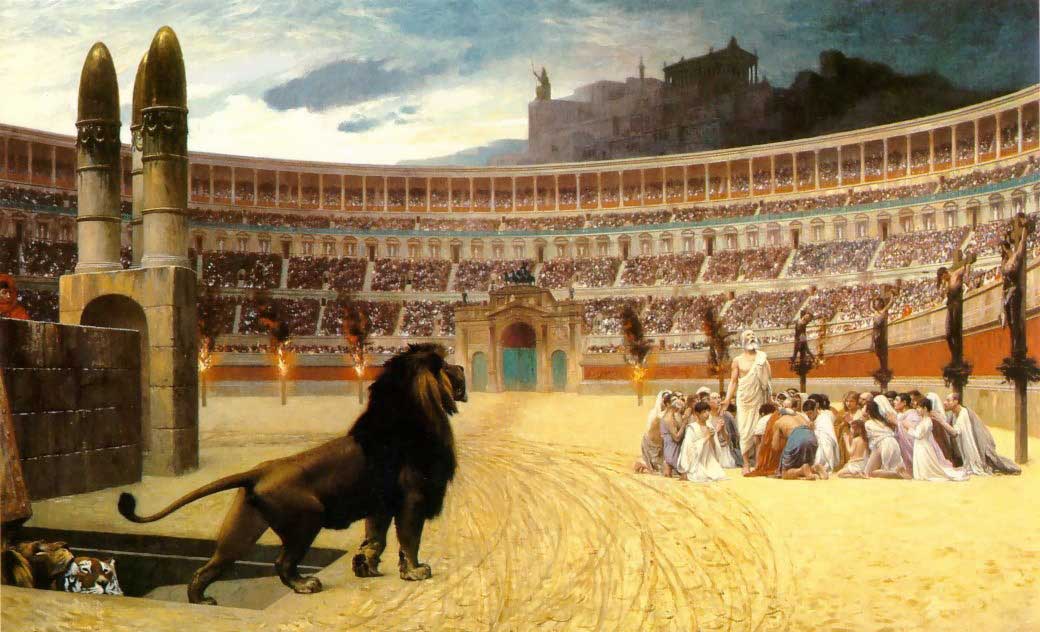
"In the accounts of the Christian martyrs, especially from the Second Century, one repeatedly comes up against one particular moment when Christians are challenged as to whether they will take part in religious veneration of the Emperor. It is the crucial question. The martyrs are the people who say they cannot. But in some of the accounts of martyrdom, there is a little bit more to it than that.One text, which comes from North Africa, in the mid-Second Century, depicts the Christians being tried in court as saying that they were perfectly prepared to pray for the Emperor, but not to him. One of them says, 'We pray for the Emperor. We pay our taxes.' In other words, this Christian was saying, we regard ourselves as loyal to the state and we take part in the processes that make the state work and, what is more, we pray for the good of the state; what we will not do is regard the state as sacred in itself.

This was seen, quite rightly, as an extremely subversive idea. It suggested that individuals, even slaves, could negotiate their relationships with the state, in some degree: they were not obliged to regard it as holy; there was another realm in which decisions might be taken and values and priorities fixed. That tension is reflected in the language that the Church used about itself.The early Christian community called itself an Ecclesia, using for itself the word normally used for an assembly of citizens in an ancient city, the assembly that reflected on public matters and took decisions together, so that, in effect, when the martyrs appear before their Roman judges, they stand for a citizens' assembly over against a Holy Empire.

Although that does not instantly create a new kind of Christian politics, it does create a very unsettling element within Roman society. Here are people claiming that, in some area of their lives, they belong outside the holy boundaries of the state and the Empire.Therefore the state begins to be seen not as a sacred comprehensive system, but as a mechanism for getting things done. The martyrs I referred to a few minutes ago promised to pay their taxes, because that makes society work, but that is the level at which their loyalty is engaged. Their deepest belonging is with the community who are citizens of some other kingdom." - Rowan Williams, Early Christianity & Today: Some Shared Questions, 2008 Gresham College Lecture.

What would it look like today for Christians to assert their identity as being outside the State whilst at the same time sustaining the State? And surely this would differ from country to country: The French Christian struggling under the weight of rigid secularism would have different issues to an American and America's 'Manifest Destiny' or a Chinese Christian where everything is suppressed for the glory of the state, or a Christian in a Muslim country where the whole state is under sharia law. And what if you were a Japanese Christian and had to sing a national anthem that praised the Emperor as a god? Pray for those around the world who live out the reality of this question every day.

Wednesday, November 26, 2008

Politics of Faith II: A Vision for Australia

In a previous post, we turned back to Kevin Rudd's 2006 article on Bonhoeffer and the rule of the church in politics. In brief, Rudd understands this to be:
'The function of the church in all these areas of social, economic and security policy is to speak directly to the state: to give power to the powerless, voice to those who have none, and to point to the great silences in our national discourse...'
Rudd continues by giving voice to what Australian politics might look like if Bonhoeffer's principles were followed:

'A Christian perspective on contemporary policy debates may not prevail. It must nonetheless be argued. And once heard, it must be weighed, together with other arguments from different philosophical traditions, in a fully contestable secular polity. A Christian perspective, informed by a social gospel or Christian socialist tradition, should not be rejected contemptuously by secular politicians as if these views are an unwelcome intrusion into the political sphere. If the churches are barred from participating in the great debates about the values that ultimately underpin our
society, our economy and our polity, then we have reached a very strange place indeed.

Some have argued that Bonhoeffer provides a guide for Christian action “in extremis”, but not for the workaday problems of “normal” political life. Stanley Hauerwas, Professor of Theological Ethics at Duke University, argues, though, that this fails to comprehend Bonhoeffer’s broader teaching on the importance of truth in politics. In fact, it accepts the “assumption that truth and politics, particularly in democratic regimes in which compromise is the primary end of the political process, do not mix”.'
Rudd has the former Howard Government clearly in his sights. In describing the churches voice on issues such as Australian values, climate change, industrial relations and global poverty, Rudd not only describes Bonhoeffer as the archetypal Christian Socialist, he uses Bonhoeffer's thesis of speaking truth to government to strongly criticize the then administration:
'Mr Howard’s politics are in the main about concealing the substantive truth of his policy program because when fully exposed to the light of public debate, their essential truth is revealed: a redistribution of power from the weak to the strong.'
Rudd concludes that the pragmatic goal of the Howard policies was to:
'...retain his incumbency at all costs, distracting the body politic from the reality of his faltering program for government. The substance of that program now makes for a less robust political message as he moves into his second decade in oμce: rising interest rates, declining housing affordability, slowing productivity growth, an Americanised industrial-relations system, a regressive consumption tax,
the skyrocketing costs of university education and the steady undermining of universal health insurance. Add to these the escalating failure of the Iraq war and the deteriorating security in our immediate region, complicated by our distraction in Iraq – all compounded by a failure to tell the public the truth on Iraqi weapons of mass destruction, Iraqi prisoner abuse and the $300-million wheat-for-weapons scandal.'
One may wonder how often the Rudd Government has distracting the body politic from the reality of his faltering program for government. Rudd's vision is for an Australia that is a 'light on a hill' (attributed to Chifley), which is to be a global leader on climate change, the Millennium Goals, and international law:
'The time has well and truly come for a vision for Australia not limited by the narrowest of definitions of our national self-interest. Instead, we need to be guided by a new principle that encompasses not only what Australia can do for itself, but also what Australia can do for the world.'
And Rudd concludes that the church must not climb into bed with the conservative political establishment. Instead, it must take up the challenge of Bonhoeffer, robustly speaking the truth to the state.
The role of the church is not to agree that deceptions of this magnitude [War on Iraq, AWA, Children Overboard, etc.] are normal. If Christians conclude that such deceptions are the stock-in-trade of the Kingdom of the State in Luther’s Two Kingdoms doctrine (and hence of no relevance to the Kingdom of the Gospel), then we will end up with a polity entirely estranged from truth. When the prime minister states that migrants should have a better grasp of the English language, while at the same time removing major funding from the program that enables them to learn English, this represents a significant prostitution of the truth. Therefore, if the church is concerned about the truth – not the politics – of social inclusion, then in Bonhoeffer’s tradition of fearlessly speaking the truth to the state, it should say so.

Tuesday, November 25, 2008

Sinai and Pentecost

So, I have a question about Pentecost.

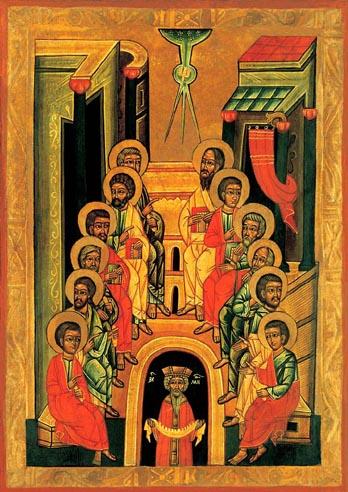
I've heard that the feast of Pentecost was a festival that was associated with the giving of the Torah (see New Testament and the People of God). Under the New Covenant, the people of God are given the Spirit, who does what the Torah was supposed to do but couldn't - bring life and 'write the law of God on peoples hearts'.

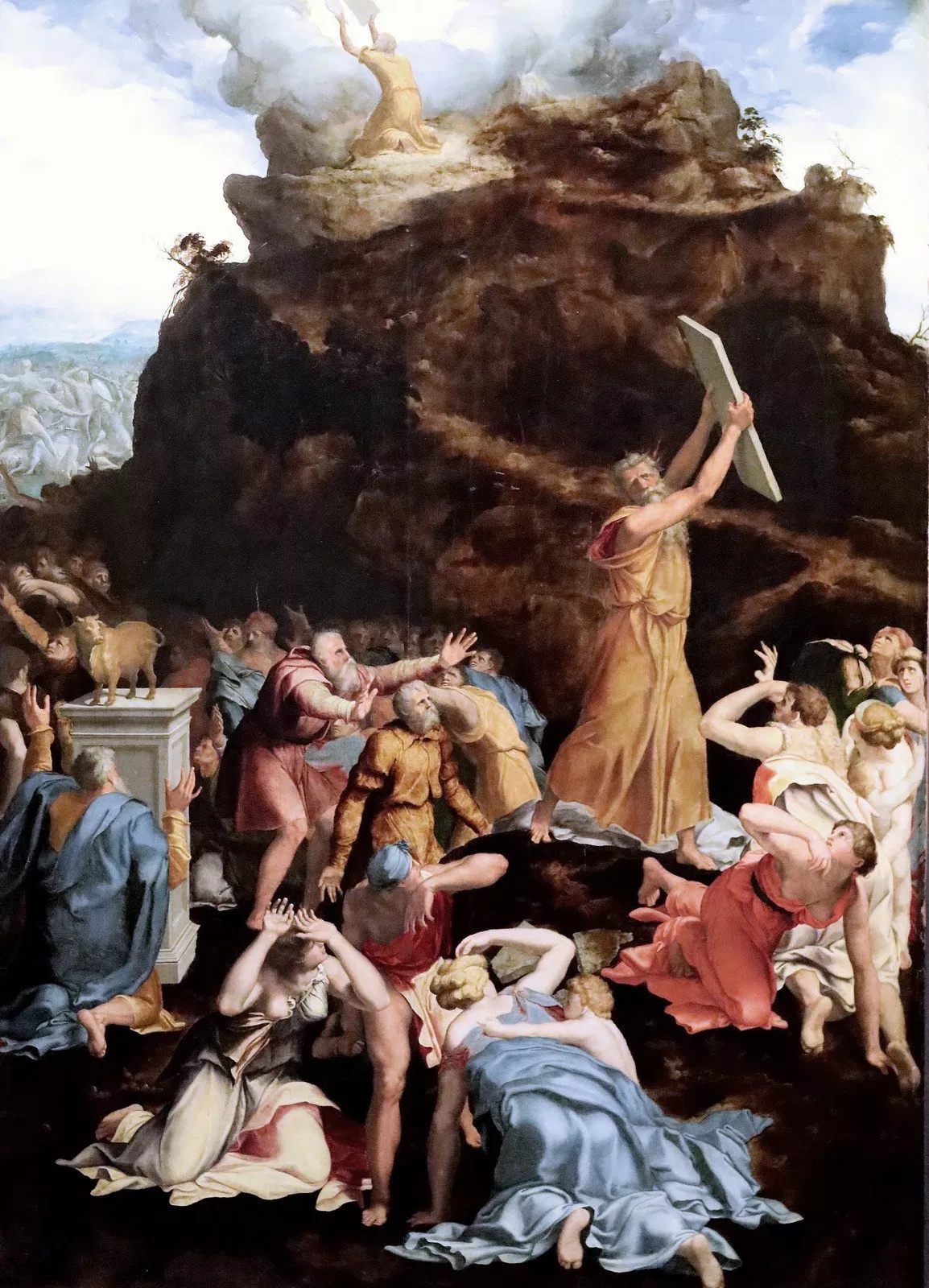
In Exodus, just as Moses is given the Torah, Israel falls into idolatry, worshiping a graven image. Israel was about to receive the God's good Torah that was meant to bring life and through Israel draw the nations to YHWH. Instead:

And when Moses saw that the people had broken loose (for Aaron had let them break loose, to the derision of their enemies), then Moses stood in the gate of the camp and said, “Who is on the Lord's side? Come to me.” And all the sons of Levi gathered around him. And he said to them, “Thus says the Lord God of Israel, ‘Put your sword on your side each of you, and go to and fro from gate to gate throughout the camp, and each of you kill his brother and his companion and his neighbor.’” And the sons of Levi did according to the word of Moses. And that day about three thousand men of the people fell. And Moses said, “Today you have been ordained for the service of the Lord, each one at the cost of his son and of his brother, so that he might bestow a blessing upon you this day.” - Exodus 32.30-34.
3000 people die. Then in Acts, on the day when the Spirit is sent to the people of God at Pentecost, and instead of death, the Spirit brings life, particularly through the baptism of 3000 people:

Now when they heard this they were cut to the heart, and said to Peter and the rest of the apostles, “Brothers, what shall we do?” And Peter said to them, “Repent and be baptized every one of you in the name of Jesus Christ for the forgiveness of your sins, and you will receive the gift of the Holy Spirit. For the promise is for you and for your children and for all who are far off, everyone whom the Lord our God calls to himself.” And with many other words he bore witness and continued to exhort them, saying, “Save yourselves from this crooked generation.” So those who received his word were baptized, and there were added that day about three thousand souls. - Acts 2.37-41.
Is it right to draw this connection?

Friday, November 21, 2008

Public Meeting Friday II

Parables that Shock
Last week was the launch of Public Meeting Friday on hebel when I post up the link to old EU Public Meeting talks. We started of with Andrew Katay speaking on Colossians.

This week, let me take you back to the second semester of 2003, when the EU had just launched its third Public Meeting on Thursdays. Justin Moffatt is our guest speaker (he was around when PMs went from being once to twice a week) and he unpacks the parables from Matthew 13-20ish.

  1. Parables That Shock: The Parables of the Soils
  2. Parables That Shock: The Forgiveness-Forgetting Servant
  3. Parables That Shock: Grace Before, During and After Lunch