Friday, August 16, 2013

Body of Liturgy II


Whilst scripture generally discourages the practice of consulting the advice of demons (1 Timothy 4:1), we may allow an exception in this instance: 

“At the very least, they can be persuaded that the bodily position makes no difference to their prayers; for they constantly forget, what you must always remember, that they are animals and that whatever their bodies do affects their souls.” - C.S. Lewis, The Screwtape Letters, 16.
The truth that Screwtape refers to is that humans are fully embodied creatures (Genesis 2:7). We are not merely cognitive beings; humans are whole-persons composed of mind, body, soul, desires, emotions, etc. The anthropology that emerges in the Bible is that humans are an intended part within the good creation, made in the image of God and for communion with God (Genesis 1:26-31).[1] Our purpose is liturgical in the sense that we live for the praise of God.[2] The antithesis of this reality is humanities failure to worship God, described by Paul a refusal to glorify or thank God (Romans 1:21).

Humans cannot be reduced to their soul, mind or worldview because we are liturgical beings. “To be human is to love, and it is what we love that defines who we are.”[3] The question then is: ‘What do we love?’ If Smith’s is correct in assessing that there are a whole range of secular liturgies nurturing people’s love and their imagination of human identity, then we are loving and being shaped by things that lead us to deny God the glory and thanksgiving that is his due. Keller articulates this as whatever captures our desires and imagination also captures our heart, becoming an idol.[4] However, Smith’s suggestion is that whilst liturgies can confirm our idolatry, they can also be used to nurture our attachment to the Kingdom of God and our love for Jesus. Not only can our love be aimed away from God, it can be aimed towards God.[5] The particularly Christian approach to this has been through liturgy, or worship. Liturgy is so effective in forming the whole-person – head, heart and hands – because of its bodily practices. Kneeling, standing, singing, head bowing, clapping, tasting bread and wine, all these embodied actions stoke the imagination for the Kingdom of God.

“Worship forms us and aims us because its concrete, material practices catch hold of our imagination. This is why worship is more like art than science, more like literature than logic. Worship is fundamentally aesthetic.”[6]
The necessity of liturgy was recognized by Broughton Knox, who wrote that without it congregations are reduced to an audience.[7] But if these liturgies are to have any effect, they must not be artificial or spectacle, otherwise they fail to be liturgical. All liturgies are not just symbolic and ritualistic; they are enacted stories that are (1) repeated and (2) participatory. Christian liturgy re-enacts the gospel, bringing body and mind together.[8]


[1]Kevin Vanhoozer, ‘Human Being, Individual and Social’ in The Cambridge Companion to Christian Doctrine (ed. Colin E. Gunton; Cambridge: Cambridge University Press, 1997), 164.

[2] Vanhoozer, ‘Human Being, Individual and Social’, 166-167.

[3] Smith, Desiring the Kingdom: Worship, Worldview and Cultural Formation (Grand Rapids: Baker Academic, 2009), 51.

[4] Timothy J. Keller, ‘Talking About Idolatry in a Postmodern Age’. n.p. [cited 29 May 2013]. Online: http://thegospelcoalition.org/resources/a/Talking-About-Idolatry-in-a-Postmodern-Age

[5] Smith, Desiring the Kingdom, 54-59.

[6] Smith, Desiring the Kingdom, 144.

[7] D. Broughton Knox, ‘The Biblical Concept of Fellowship’ in D. Broughton Knox Selected Works: Volume II - Church and Ministry (ed. Kirsten Birkett; Kingsford: Matthias Media, 2003), 82-83.


[8] Cf. Timothy J. Keller, ‘Reformed Worship in the Global City’, in Worship by the Book (ed. D. A. Carson; Grand Rapids, Zondervan, 2002), 214-217.

Wednesday, August 14, 2013

Resurrecting the Gospel - Redux


Back in 2009 I wrote an article for the magazine Salt, a publication of the Australian Fellowship of Evangelical Students (AFES).


AFES have republished my article, which you can find here.


Body of Liturgy

For sometime now there has been a Hauerwas' quote floating around the internet about the value of liturgy. It goes like this: 
"One reason why we Christians argue so much about which hymn to sing, which liturgy to follow, which way to worship is that the commandments teach us to believe that bad liturgy eventually leads to bad ethics. You begin by singing some sappy, sentimental hymn, then you pray some pointless prayer, and the next thing you know you have murdered your best friend." — Stanley Hauerwas, The Truth About God: The Ten Commandments in Christian Life, p.89.
I first came across this quote seven years ago, and at the thought it was overstatement and hyperbole. But recently, thanks to James K.A. Smith and the Journal of Biblical Counseling, I think I now understand how it could be true. What we do with our bodies matters. As embodied beings, our habits and practices are training our hearts and our minds in particular ways.Smith defines liturgy as the habit-forming practices that shape and mould our love and desires:

“Liturgies—whether ‘sacred’ or ‘secular’—shape and constitute our identities by forming our most fundamental desires and our most basic attunement to the world.” James K.A. Smith, Desiring the Kingdom, 25.
This is a broader definition of what liturgy is, which usually describes what happens in corporate worship. These include the customary patterns of church, but also include the habits of daily life, including sitting in front of the television for three hours each evening, or visiting the shopping mall. Smith defines liturgies as the habitual practices which have power to shape what one ultimately loves. Inasmuch as liturgies are the embodiment of our desires, they are pedagogical stories told by – and told upon – our bodies, thereby embedding themselves in our imagination, becoming part of the background that determines how we perceive the world. Our habits train our desires, and nurture our love towards something. For example, one does not wake up and suddenly decide to ignore one’s family; it is an attitude that has been formed by years of tardiness and missing family meals.

Habitual actions matter in our sanctifcation, whether  seemingly  mundane  (brushing  your  teeth),  or  seemingly  unproblematic (going to the mall), or presumably serious (participating in worship). “Our heart’s desires are shaped and molded by the habit-forming practices in which we participate daily and weekly."


Friday, July 19, 2013

Balance

Douglas Moo defines the New Perspective on Paul
One of the difficulties with grappling with the New Perspective on Paul (NPP) is coming to terms with the variegated nature of the movement. Despite the build-up of the NPP as one large, monolithic bloc affecting Biblical studies, doctrine, and early church history, the reality is far more complex. Although the leading lights of the NPP share a same interest in research and methodology, their origins and conclusions are quite diverse. This must lead to a chastened humility when outlining the NPP on general terms.

Nevertheless, Douglas Moo’s essay in Justification and Variegated Nomism: Volume 2 – The Paradoxes of Paul offers a profitable introduction to both perspectives: the claims of the NPP and misgivings of the Old Perspective on Paul (OPP). In ‘Israel and the Law in Romans 5-11’, Moo observes that what NPP has attempted is in effect “a rotation of Paul's central theological axis”. That has lead to a flip from a vertical to a horizontal orientation. What does this look like? According to Moo it means an ethnocentric rather than anthropocentric reading, privileging the background over the foreground and the corporate rather than the individual. For Moo this is witnessed in an emphasis of ecclesiology over soteriology or union with Christ over imputation, or a macro reading over the micro. At the risk of caricature, this last point is seen in some NPP’s love of describing the big picture, but failure to engage in close exegesis.

 I find Moo’s description helpful because I don’t want to place the weight at the one end of these dichotomies. I don’t want to emphasize the horizontal over the vertical, or focus on the background and neglect the foreground. If Moo is right, this is a helpful corrective of the NPP.

However, I think Moo’s definition also shows-up some of the problems with what I’ve generally  described as the OPP. By placing things in such a dichotomised way merely moves the problem towards the other end of seesaw. What arose from the OPP in 19th and 20th century liberal Protestantism is people who could provide a theologically apt account of salvation, but then turn around and deny the historicity of Jesus. Surely this is a problem? Surely it’s a problem when Christianity is reduced to a timeless philosophy or morality? But this is what has tended to happen when people have bought into an ‘either or’ dichotomy. Instead of neglecting either the horizontal or the vertical, don’t we want both? Don’t we want both soteriology and ecclesiology (which Calvin’s doctrine of ‘union with Christ’ provides by the way)? Can’t we have both the foreground and the background? Without the background we lose the historical, social, religious and theological context/worldview that the foreground arose in. And without the foreground, the background loses relevancy. Why can’t we have both? Instead of arguing for the anthropocentric over the ethnocentric, does not a reading of Paul push theocentricism center of stage? Likewise the individual verses the corporate; aren’t the two brought together in Christ? He loved me and gave himself for me at the same time that he ransomed for God a kingdom from every nation and tribe and language.

Moo’s definition is very useful in grappling at general terms with the shortcomings of the NPP. But by resorting to such dichotomies, I’m not sure that he leaves us in a better position. Indeed the NPP arose out of the OPP’s reduction of Paul and the gospel to individualism and tendency away from ecclesiology and context. Instead what is needed is balance. Balance because the announcement that Jesus Christ is Lord results in both vertical and horizontal – you might say cosmic – reconciliation. Balance because the gospel was announced in a particular context means it is even more meaningful when it is announced today.  Balance because the news that you are saved by grace (Ephesians 2:8) fundamentally alters who you relate to your siblings (Ephesians 4:32). Balance, because Christ came to preach to those who far off as well as those who were near, reconciling them both in his body under the on Father.

Wednesday, June 12, 2013

How to Guard the Gospel

The gospel of the crucified, risen and ascended Messiah - Jesus - is a precious gift from God. As Paul explains to Timothy, it is a deposit that it to be unashamedly guarded:
Follow the pattern of the sound words that you have heard from me, in the faith and love that are in Christ Jesus. By the Holy Spirit who dwells within us, guard the good deposit entrusted to you. - 2 Timothy 1:13-14.

The truth entrusted is to be guarded against erroneous and strange doctrines. According to Paul's instruction to Timothy, the gospel is something that is to be suffered for (1:8, 12). It is something that is to be proclaimed, and therefore taught and preached without embarrassment (1.11). And finally it is something to be guarded from unsound teaching. It is to be held fast too, without variation or departure.     

But there is a particular shape to guarding the gospel. That is, Paul not only gives Timothy instructions on what to do - guard the gospel, but how to do it. Verse 13 says "in the faith and love that are in Christ Jesus." Timothy's theological convictions and catechism of others is, even in the context of the hostility outlined in verses 15-18, to be done in faith and love.

Amongst evangelicals, one of the most frequent rallying cries is: "Guard the gospel!" We talk about the ease of losing the gospel, of generational change and slippery slopes. So we want to guard the good deposit, fight the good fight, and entrust the gospel. But I am not sure if I have ever heard the connection explicitly drawn between guarding the gospel, and doing so "in the faith and love that are in Christ Jesus". Without this link, defending the gospel quickly descends into a climate of bullying, group-think and uniformity.

I stand within a tradition that has gallantly guarded the gospel: within the cloisters of the university, within our para-church organizations, within denominations, and within parishes and churches. It is a heritage that has done much to preserve the faith once for all delivered to the saints from erroneous and strange doctrine.

Yet my observation is that other motivations besides guarding the gospel creep into people's behaviour - especially when the guarding is divorced from the faith and love of Jesus.

In seeking to guard the gospel, we forget to guard our own hearts. We are  motivated by a fear of change and difference; or an immaturity to rest confidently in what Paul says in verse 12 God is able to do. As I've observed this, I've noticed that guarding the gospel without faith and love isbeen characterised by:
  • A lack of theological depth in being able to handle both the unity and diversity of the body of Christ. This is particularly evidenced in people only reading books that they will agree with.
  • A lack of epistemic humility is the consequence; an inability to understand difference and relate generously to those who are different to you as your brothers and sisters in Christ.
  • This is followed by tribalism, as we draw ever smaller and smaller circles around who is 'in' and 'one of us', and who is 'out' and suspicious.
This runs something like 'we need to guard the gospel, otherwise the church/institution will slide into error. And we cannot be gracious in the way that we deal with this, because being gracious and generous is part of the problem.' Except that to some extent, if you guard the gospel without being gracious, you have in effect lost the gospel (see for example, 1 Corinthians 13). Because it matters how you guard the gospel. The combination of these characteristics seems to allow for Christians to act like jerks in their ministry. That is, they are pastors who hurt people by justifying ungodly practices.

Graciously guarding the gospel fits with the New Testament trajectory of not arrogance, but humility and gentleness, patience and kindness, love, joy, peace and self-control. Graciousness is not the slippery slope that will lead to, say liberalism (cf. The Dying of the Light by James T Burtchaell). Graciousness is the fulfillment of guarding the gospel in the faith and love in Christ. This is not laying down the gospel and leaving it open for attack. Instead, this is resting humbly but confidently in the gospel. This confidence in the gospel allows you, in the power of the Holy Spirit, to get on with the business of guarding the gospel. Carson describes it in this way:
"You do not finally guard the gospel by raising the mote, circling the wagons, going into defensive mode alone, so as not to be contaminated by the interaction with the world. You preserve the gospel by gospelizing. That’s why any form of apologetics that becomes primarily defensive is finally spelling its own demise." - Don Carson
The way to get on with guarding the gospel in faith and love is not through closed sets, but through proclamation and training. Through passing on the good deposit, growing people in the gospel of Jesus Christ, and confidently proclaiming it. As Carson puts it, you guard the gospel by giving it away, by training people in it. This means neither denying or hiding the gospel, or making everything the gospel, but confidently holding to the core. Graciously guarding the gospel likes this does not create a culture of fear that exists around the slippery slope to liberalism. Graciously guarding the gospel likes this is confident that Christ will build his church. Hence graciously guarding the gospel like this allows you to (with thanks to Byron Smith):

  • Recognize differences between Christians without declaring everyone who disagrees with you to be an enemy of the gospel.
  • Avoids an anti-intellectualism that assumes that others - even those I disagree with - have nothing to teach me.
  • This leads to a hermeneutic of trust. That is, generosity to all others who call on the name of the Lord - our first move is towards them, rather than suspicion or distancing yourself from them.
  • Avoids tribalism; guru-ising those we agree with and demonizing those with don't.
  • Prevents an arrogance that assumes that 'God is lucky to have us'.
Graciously guarding the gospel is the refusal to use power in a way that subverts the gospel. It's the refusal to resort to ungodly patterns of relationships, but seeks to be above reproach as the word of Christ is taught and dwelt richly in.  Now that is guarding the gospel in the faith and love that are in Christ Jesus.

Tuesday, April 02, 2013

Guest Post: Precious Remedies Against Satan's Devices

Originally posted by Alison here.

I bought Matt a CD for Christmas last year. It was a bit of a gamble. I had never listened to it before, I was banking on the fact that we own a previous album from the band and we both love it. The gamble paid off. Late summer and autumn has been spent settling into the music, then soaking it up and basking in its greatness as we listened to it over and over again. I think it's going to be one of my favourite albums ever. Welcome to this review of The Welcome Wagon's Precious Remedies Against Satan's Devices For those who haven't yet come across The Welcome Wagon, the outfit is made up of a husband and wife, Monique and the Rev Vito Aiuto, accompanied by a killer band and choir and produced by Asthmatic Kitty Records. Vito's full time job is as a Presbyterian pastor, Monique is an artist. Neither are musically trained but somehow they have pulled off an amazing second album which, by my reckoning, is even better than their first. The beauty of the album comes not from new lyrics - Most of the songs are 'covers', adapted music and lyrics from The Cure, David Crowder, King David, Charles Wesley... No, the beauty of the album lies in its friendly musical style. The sounds and content evoke an image of brothers and sisters coming together in simple worship, which I gather was the Welcome Wagon's main aim. At the album's release Vito explained that Precious Remedies has a liturgical structure, plainly seen as the album ebbs and flows between confessions of sin, declarations of forgiveness, bold announcements of what Jesus has done, moments for Christ's people to share in love and support and even a sending out at the end. 

The Welcome Wagon themselves are the epitome of Christian hipster with their aesthetic, their embracing of old traditions, their glockenspiel, their celebration of community. The fact that they are Presbyterians. In New York. Guys. Did you see the Breakfast-At-Tiffany's animal mask in that video!? But then, even coated in five hundred hipster cliches, this album is amazing. I don't care whether they were hipsters before or after it was cool. I hope they don't either. They sound fantastic and they turn our attention to Jesus, which is definitely the best part of their music. This album has been a huge blessing in the lead up to Easter. I am really looking forward to playing Precious Remedies again on Easter morning and singing along to all my favourite songs with Matthew in our living room.


Track list I'm Not Fine ("I told you I was sorry, doesn't feel like it's enough") My God, My God ("Please be not far away from me, I have no source of help but thee") I Know That My Redeemer Lives ("He lives, my Prophet, Priest, and King") Rice and Beans ("Worn through shoes, cheque may bounce") High ("When I see you take the same sweet steps you used to take") Remedy ("He is the one who has come and is coming again, He is the remedy") Would You Come and See Me In New York? ("I'm not mad, the past is through") My Best Days ("Those are my best days when I shake with fear") Lo He Comes With Clouds Descending ("The tokens of his passion still his dazzling body bears") Draw Nigh & Take the Body of the Lord ("Offered was He for greatest and for least") The Strife is O'er, the Battle Won ("Hallelujah!") God Be With You Until We Meet Again ("With his sheep securely fold you") Nature's Goodnight ("Trees now dressed in faded brown")

The album is available for purchase here, it's a steal at US$8 for the mp3s or US$10+shipping for a physical album to be delivered to your front door. I know that my redeemer lives. Happy Easter.

Tuesday, February 19, 2013

A Christian Doctine of Creation


“That God is the Creator of the world is accepted even by the those very persons who in many ways speak against Him, and yet acknowledge Him, styling Him the Creator...all men, in fact consenting to this truth.” – Irenaeus, Against the Heresies 2.9.1
In the first chapter of his book The Triune Creator, Colin Gunton argues that Christian theologians have often claimed that belief in creation is universal in the human race. Cultures throughout have history have given account of why there is something instead of nothing, why there is a meaningful universe.

There is a common idea of creation. However, Gunton argues that the Christian account of Creation is distinctive. Unlike other explanations, such as Plato’s Timaeus, which describe the creation of something out of ore-existent reality, what we find in the pages of scripture is different.

“Far from being one ancient myth among many, this was unique in saying things no other ancient text was able to say.”
Partly this is an awareness within Christianity not only of the universality of creation accounts amongst humans, but also a universal inability to know God through his creation:

“...pagan thought totally fails to understand the true nature of things. Its chief mistake is in confusing the creature with the creator, but there is also a general human to recognise God for what he truly is”.
As Calvin would put, we are idol factories. Humans exchange the truth about God for a lie; we cannot truly comprehend ourselves and the world around us.

For Gunton, the Christian account says things that have not elsewhere been said because the doctrine of creation is ‘bound up with beliefs about Christ and redemption’. Firstly, for Christians the doctrine is creedal, and hence ‘part of the fabric of Christian response to revelation. This doctrine is not self-evident or attainable through cold reason, but only is revealed by ‘God the Father, maker of Heaven and Earth.’ Secondly, although is not unambiguous within the scriptures, the unique contribution of the Christian doctrine is that God creates out of nothing (cf here). He is not one of the primordial gods of other creation myths who makes out eternal matter, and is then worn out by the process.

“In general, Greek though held that matter was both eternal and inferior to mind or spirit. The intellectual breakthrough of second-century Christian theology came from contending against both these doctrines, in teaching that matter both had a beginning and, for that reason was not inferior but intended by a good creator.”
Thirdly, creation is the work of the whole Trinity: Father, Son and Holy Spirit.

After these three concepts, Gunton then offers seven distinctive features of the Christian doctrine of creation that set it apart from other creation accounts:

    1. Creation was out of nothing. God relied on nothing outside of himself to create the world, which makes the world an act of personal willing that there be something other. Creation is an act of divine sovereignty and freedom. It also means the cosmos is neither eternal (as it has a beginning), nor infinite.

    2. Therefore, creation was not arbitrary. It derives from the love of God, not simply its will. And it was designed with a purpose. Which is where the Trinitarian shape of the Christian account is important; creation is contingent. Preexisting creation in a communion of persons existing in loving relationships, we are able to say God wills the existence of something else simply for its own sake, and is given a value as a realm of being in its own right. The created order is itself ‘very good.’

    3. Creation remains in close relation to God, and yet is free to be itself. The created order is not overwhelmed by God; it is not god itself. Here we are able to understand how God works in and towards the world, through what Irenaeus called the two hands of God: Christ and the Spirit. Creation is structured to and through Christ, the very one who became incarnate and remains in loving relation with it. And for Basil of Caesarea, it is the Holy Spirit who enables the created order to be truly itself; he is the perfecting cause of creation.

    4. As God work in and towards creation through Christ and the Spirit, our understanding of the divine work of creation is not limited to its beginning and end. God continues to uphold and care for his creation – he is not the god of deism who leaves the work of creation half finished. And God also provides for the needs of the creation, and enables it to achieve the end that was purposed for it from the beginning.

    5. Because all that God creates is good, that means that evil must be something ‘extraneous to or parasitic upon creation as a whole.’ If the world was created good and with a telos in view, then evil is what thwarts the divine purpose for it. Central to this problem is human sin, which is some way involves the whole created order in evil.
    "Its existence [evil] means that creation's purpose can be achieved only by its redirection from within by the creator himself...Given the all-polluting power of evil and its centre in human sin, redemption can be achieved only by the one through whom the world was created becoming incarnate, dying and rising as the way through which the creation can be redeemed (brought back) from its bondage to destruction."
    Within the Christian tradition there have been a range of views of the relation between creation, the fall and redemption.

    a) Restoration: For Origen and Augustine, the creation was so completely finished in the beginning, that the fall is a move away from perfection, and redemption can then only mean a return to that perfection.

    b) Evolution: A more recent view shaped by Hegel and Darwin would see the fall either as minor impediment or an essential step on the way to perfection. The fall then becomes the means by which creation reaches its perfection. But this view tends to minimise the problem of evil, and the achievements of Jesus’ death.

    c) Transformation: Gunton’s preferred view is that creation was made to go somewhere, but that goal can only be reached through a radical redirection, because sin and evil have reshaped its direction. This is the movement towards an end greater than the beginning, and redemption is the defeat of evil and the restoration of the created orders original direction.

    6. No theology of creation is complete without giving an account of humanity. Humans are created in God’s image, and for Gunton this is humans existing in relation to God, other humans and the rest of the created order. The relating to the created order is described as dominion:
      “...a calling to be and to act in such a way as to enable the created order to be itself as a response of praise to its maker. However, the distinctive place of human creation cannot be understood apart from Christology. Genesis makes the human race both the crown of, and uniquely responsible for, the shape that creation takes. By speaking of Jesus Christ as the true image of God, the New Testament shows that this responsibility is realised only in and through him.”

        7. If God’s purpose is for the redemption and perfection of the whole creation, "then all [italics original] human action" will involve the human response to God we call ethics. Ethics encompasses not simply principles of action but a whole way of being in the world, which makes it integral to a Christian doctrine of creation. This will be shaped by both how we view the world, and our eschatology.

          Monday, February 11, 2013

          Moments of Recapitulation

          Here is an interesting and novel thought: what the Church does in ministry should reflect what the gospel is. I've been spurred along in this idea recently by Tim Keller, who argues that the gospel should fundamentally shape our doing of ministry. Following DA Carson, Keller argues that the gospel consists of three moments in Jesus life: 
          1. The Incarnation (what Keller describes as the upside-down aspect of the gospel) where Jesus, though he was rich, became poor, and made himself the servant of all. This creates a community of service, where people live out an alternative way of being human, seeking neither moral, financial or social superiority.
          2. The Atonement (the inside-out aspect of the gospel), which speaks of the way we are justified by grace and not by works. Grasping this changes the way we relate to God, to others and ourself.
          3. The Resurrection (the forward-back aspect of the gospel); Jesus is reigning now, and Christian live in the light of this reality, looking forward to the day when Jesus ushers in the new creation. So now we live by faith, hope and love, especially love.
          Few churches will follow through on the implications of the gospel: the upside-down, inside-out, forward-back kingdom. But for Keller, the gospel is the Christian life, and the church that comprehends the Gospel of Jesus Christ will "champion and cultivate" all three aspects of the gospel.

          Oliver O'Donovan proposes a similar idea in The Desire of the Nations, that the Church's life and ministry is a recapitulation of Jesus's own life and ministry. And what we see in the sacraments is a visual reflection of Jesus own kingdom announcement. O'Donovan traces God's political authority within Israel. The Lords reign is, first, an exercise of power that gives Israel victory or salvation; it is, second, the execution of judgment or justice within Israel; and it is, third, the establishment of Israel's communal identity as a people existing over time (an identity connected at first with the land and, later, with possession of the law). These three aspect summarize what it means to say that the Lord rules as king in Israel, and a fourth aspect is added by O'Donovan. The Lords rule is acknowledged—though not established—in the praise Israel, as a worshiping community, offers (which incidentally, provides a stinging critique of liberalism's view of authority).

          These four aspects of God's kingship are recapitulated in the career of Jesus. He does mighty works of power that bring salvation; he proclaims the judgment of Israel; he reforms the understanding of the law upon which the identity of a restored Israel is based. The praise that acknowledges Gods rule corresponds now to faith that recognizes the reign of God in Jesus.These four moments are 
          1. the advent of Christ to save 
          2. the passion of Christ in which the judgment of the world is given
          3. the restoration of Christ, which affirms Israel's new identity in its representative
          4. the exaltation of Christ, the coronation of the one who has triumphed over the powers that oppose Gods rule.
          Christ is the head over the church, and O'Donovan argues that these moments of his Kingship are recapitulated within the church's life. They structure the church:
          "The church represents God's Kingdom by living under its rule, and by welcoming the world under its rule. It recapitulates the Christ-event  in itself, and so proclaims the Christ-event to the world. The Christ-event, then, is the structuring principle for all ecclesiology, holding the key both to the church’s spontaneous ‘catholic’ existence and to its formal structure."

          As Chris Swann has noted before, their are four moments that enact the distinctive shape of the church’s identity:

          1. Advent – gathering community – Baptism. Marked by the sign of baptism, the Church now gathers to herself those who acknowledge Jesus as Lord
          2. Passion – suffering community – Eucharist. Marked by the sign of the Eucharist, the Church now suffers—paradigmatically in her martyrs, but in countless other ways as well.
          3. Resurrection – glad community – Keeping the Lord’s Day. Marked by the sign of her keeping of the Lords day as a little Easter, the Church now rejoices in the restoration of the creation.
          4. Exaltation – community that speaks the words of God – Laying on of Hands. Marked by the sign of the laying on of hands, the Church now speaks Gods word in prophecy and prayer.
          O'Donovan is in agreement with Keller, that churches have often been tempted to understand themselves in terms of one of these “moments” alone—as marked by mission alone, by suffering alone, by triumph alone, or by social responsibility alone. But such truncated understandings cannot recapitulate the narrative coherence of the moments in the story of Christ.

          It's quite a big claim, "the structuring principle for all ecclesiology". And it's different to other accounts I hear of the Church's life and mission. Yet I find it quite compelling, that the life and ministry of Jesus Christ, the true Israel, orders the Church, giving it cohesion and definition.

          Postscript
          At this point it may seem that O'Donovan sees fours in everything, as O'Donovan also offers a tantalizing, though fleeting, correlation between these four moments of recapitulation and the order of ministry within the church:

          1. church gathers – ministry of recognising Christians – primatial bishop
          2. church suffers – ministry of suffering service – deacon
          3. church recovers creation order – ministry of instruction – presbyter-bishop
          4. church as prophet – ministry of diverse administration to build up the community – lay charism

          Thursday, November 15, 2012

          20 Centuries in 20 Posts Part V - Appendix

          The Coming of Christendom Appendix: The Arian Controversy

          9th Century Image of the
          Council of Constantinople


          Intro | Part I | Part II | Part III | Part IV | Part V a | Part V b |Appendix
          Readers of the previous post in this series may have been surprised when they noticed a sizable gap in the history of the third and fourth centuries. While there important political developments that occurred after Constantine’s rise to power in the early 300’s, some famous theological achievements also occurred to. Punctuated at either end of the century by the first and second ecumenical councils, the fourth century had been described as the achievement of orthodoxy. Indeed you are more than likely familiar with the narrative; that in the year 318 “a wicked Alexandrian presbyter called Arius chose to propound a doctrine of relation of the Son to the Father which was completely unorthodox and heretical, and which was condemned by the first General Council of the church in Nicaea in 325, but that by various means the base and crafty supporters of this heretical doctrine managed to keep the orthodox out of influential positions and to continue to propagate their wicked ideas for another 60 years after Nicaea, until, almost wholly through the selfless efforts of a noble and courageous champion of orthodoxy, Athanasius bishop of Alexandria, the their politics were frustrated, their heterodoxy exposed, and the truth enshrined” in the creed of the Council of Constantinople in 381 (Richard Hanson, The Achievement of Orthodoxy in the fourth century AD).

          The problem with this account of history is that it bears no resemblance to what happened. Orthodoxy had been passed down for the proceeding three hundred years through the rule of faith, the Roman baptismal creed (which has most likely come to us as the Apostles Creed), the scriptures – primarily the fourfold Gospels, and the gospel itself. But across those preceding centuries emerged different strands relating to the theology of the person of Jesus: North African theologian Tertullian developed an idea of the ‘economic trinity’; Alexandrian Origen talked of the eternal generation of the Son. Even the language used to describe the relation between the Father and the Son – ousia, hypostasis, substantia, persona etc. ¬ had different meaning depending on whether you spoke Greek or Latin. The Arian controversy was one that resulted in determination of orthodoxy, rather than one consisting solely in the defense of orthodoxy.

          When Arius’ teachings in Alexandria were brought to attention in 318, he found many supporters, such as Eusebius of Caesarea and the powerful Eusebius of Nicomedia, who understand him standing in one of these “orthodox” traditions. Arius’ doctrine may have been motivated by a rivalry between him and his bishop, Alexander. But at the heart of Arius’ struggle was an attempt to grasp with the metaphysical and soteriological implications of the New Testament’s witness of a suffering God. Exploiting the Hellenic philosophical heritage of the ancient world, the Arian answer to this issue was to postulate the existence of two gods: one high impassable God, and a lesser God who suffered for him. According to the eminent historian of this period Richard Hanson:
          “The Arians were among the few theologians of the early church who seriously understood the scandal of the cross. But the price which they thought it necessary to pay for this theology was too high.”
          As a lower God, the logos was of a different essence and status to the Father. Using philosophical logic, the Arian position reasoned that the Son, as the first born over creation (Colossians 1:15) was an emanation of the Father. He was important, but in the words of one Arian song of the day "There once was a time when the Son was not".

          Nicaea was intended to end several years of back and forth between Arius and his supporters and Alexander and his supporters. Arius was exiled, the doctrine of Alexander and his young deacon Athanasius upheld, and almost all present at the council signed the Creed under Constantine’s pressure for one unified church and empire. But the words of the Nicene Creed only added to the confusion. It taught the Son was ‘from the substance’ of the Father, ‘consubstantial’ with him, and condemning anyone who taught that the Son was ‘from another hypostasis or ousia’. But what these two words meant could be interpreted by different sides. The word homoousios (same substance) was also inserted into the Creed because it had been specifically rejected by Arius. But given it’s etymology in Gnosticism, it too was disputed by the Arian supporters who continued on the fight after Nicaea – the subordinates led by Eusebius of Nicomedia. In its place was proposed the word homoiousios (like substance).

          The Nature of the Debate

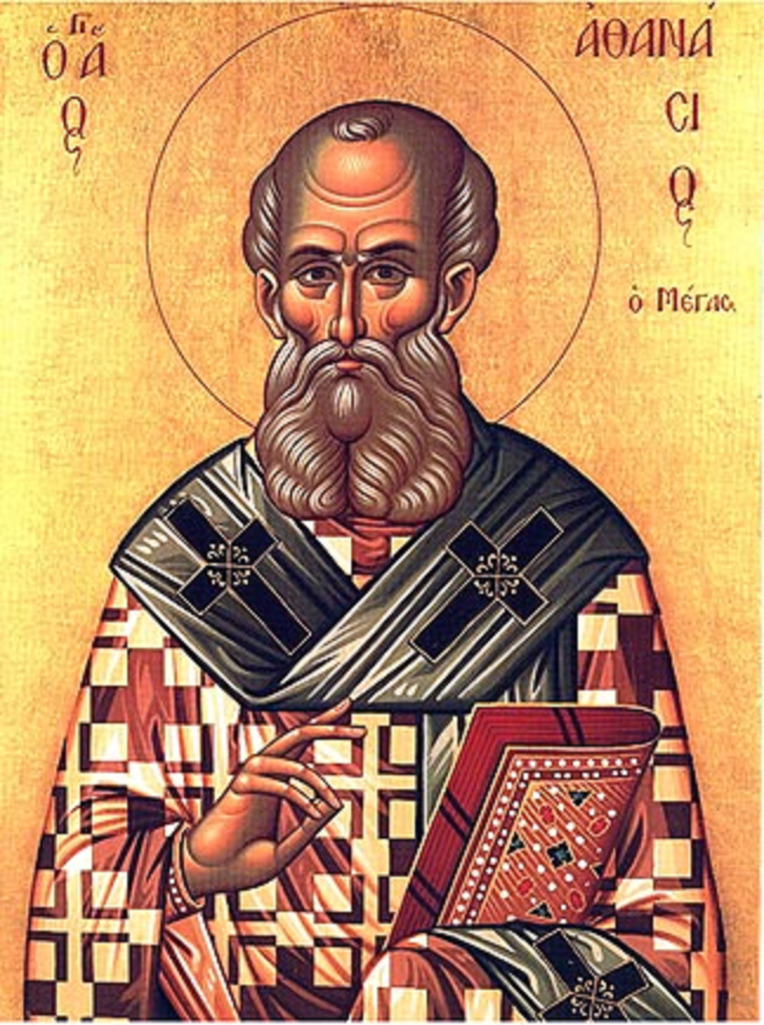
          Athanasius
          Patriarch of Alexandria
          Debate continued for the next several decades over the interpretation of the words in the Creed. Athanasius (296-373) succeeded Alexander as Bishop of Alexandria in 328. He is famously said to have stood alone against the world in his defense of the Nicene position. Athanasius was exile five times over the course of his episcopacy with the rise and fall of theological parties at the Imperial court in Constantinople (although he was also ostracised for a period of twenty years for his abuse of power and use of violence in suppressing his enemies in Egypt). It was a debate that was largely conducted in Greek philosophical categories. All sides appealed to the Scriptures, and biblical language was used by both sides. Both sides then were driven to using the only alternative vocabulary at their disposal: Stoicism, Middle Platonism and Neo-Platonism. There was none other available. But it was language that was used for theological purposes rather than for strictly philosophical ends.

          It was a debate that was carried out in the political sphere as well. Each party attempted to bring Constantine and his successors on side.
          “And inasmuch as the peace and stability of the Empire was to some extent bound up with the peace and stability of the church, it was virtually unavoidable that the Emperor should become involved. But because the secular power was involved, it does not follow that the controversy was simply a story of man grasping at secular power under the mask of theology” – Hanson.
          The majority of the theologians of the fourth century were bishops. They all had pastoral responsibility, charged with the spiritual welfare of their flocks, the men and women who held them account. “They were conscious of a praying and worshiping church” (Hanson). And the words they used to describe orthodoxy come from the word eusebia, which besides meaning ‘true’ and ‘correct’ meant ‘devout’ and godly’. It is a mistake to consider the debate of the fourth century as either an abstracted intellectual exercise, or the political machinations of a few. At the heart Christianity stood both monotheism and the worship of Jesus Christ (rather than the cult of a deified man). This was the faith for which thousands of Christians had in the preceding years died for. The two convictions needed to be reconciled.

          Neo-Nicene movement towards 381

          The process of reconciliation began in 362. The new pagan Emperor attempted to cause disruption to the church by recalling all exiled bishops. Athanasius returned to Alexandria and used the opportunity to gather Christians from both the Nicene and Subordinate parties. The Council of Alexandria allowed the term homoiousios to be reconciled with homoousios. This provided for people of orthodox persuasion to use homoiousios legitimately when describing the co-equal relationship of the Son to the Father. This was affirmed again at a council in Antioch in 363, and in a letter to the eastern churches from Pope Damasus. This new found unity moved the debate away somewhat philosophical concerns and back to the language to salvation and revelation.
          “God become man, so that man might become God” – Athanasius, On the Incarnation
          Gregory of Nazianzus
          Patriarch of Constantinople
          The long term effect of all this was to re-establish the prominence of the term homoousios, and a dispelling of the ambiguity which had been inherent in the term at Nicaea. And so emerged a new ‘Neo-Nicene’ orthodoxy—a fuller and more robust version of the theology which had initially been outlined at Nicaea. This Neo-Nicene faith was embodied primarily in the Cappadocian Fathers (Basil of Caesarea, Gregory of Nyssa, and Gregory of Nazianzus). It was their doctrinal acumen, with the support of Emperor Theodosius that laid the ground work for 381 by shifting the emphasis and grounds of debate. They denied that neither the Son nor the Spirit are subordinate to the Father, but are share an equality that is unaffected by the order with the Trinity. By doing so, they able to argue forcibly for the full humanity and full divinity of Jesus Christ:
           “The unassumed is the unredeemed” – Gregory of Nazianzus
          The Council of Constantinople met from May-July 381. The most prominent feature of the Council of Constantinople was the adoption of a creedal statement, reaffirming and clarifying the Nicene position. Constantinople retained the inclusion of homoosiuos, and unequivocally stated the Jesus – and the Holy Spirit – is fully God: one ousia in three hypostases.  This was the solution to questions that had long vexed the church. It gave rise to other problems, such as the incarnation, but it excluded the Arian formulation of a high God beyond suffering and a lower God who may experience pain. Athanasius and the Cappadocian Fathers excluded the use of the pre-incarnate logos as a philosophical device to explain how a transcendent being could come into contact with transience and human experience without compromising himself. Jesus is either wholly God or he is not God at all. This is still the confession of the church through the Nicene‐Constantinopolitan Creed today.
          “Athanasius above all recognised that if we take the New Testaments seriously we must concluded that Christ is not a safeguard God the Father involving himself with human affairs, but a guarantee that he has done so” – Hanson .

          APPENDIX: Comparision of the Creeds of Nicaea and Constantinople*


          The Nicene Creed (325) The Nicene‐Constantinopolitan Creed (381)
          We believe in one God, the Father, Almighty, Maker of all things visible and invisible;

          And in one Lord, Jesus Christ, the Son of God, begotten of the Father, only begotten, that is from the being of the Father, God from God, light from light, true God from true God, begotten not made, consubstantial with the Father, through whom all things came into being, things in heaven and things on earth, who because of us men and because of our salvation came down and became incarnate, becoming man, suffered and rose again on the third day, ascended to the heavens, will come to judge the living and the dead;

          And in the Holy Spirit.

          But as for those who say, ‘There was when He was not,’ and ‘Before being begotten He was not,’ and that He came into existence out of nothing, or who assert that the Son of God is of a different substance or being, or is subject to alteration or change—these the catholic and apostolic Church anathematises.
          We believe in one God, the Father Almighty, Maker of heaven and earth, of all things visible and invisible;

          And in one Lord, Jesus Christ, the only begotten Son of God, begotten of the Father before all ages, light from light, true God from true God, begotten not made, consubstantial with the Father, through whom all things came into being, who because of us men and because of our  salvation came down from the heavens, and was incarnate from the Holy Spirit and the Virgin Mary and became man, and was crucified for us under Pontius Pilate, and suffered and was buried, and rose again on the third day, in accordance with the Scriptures, and ascended to the heaven, and sits at the right hand of the Father, and will come again with glory to judge the living and the dead, of whose kingdom there will be no end;

          And in the Holy Spirit, the Lord and life‐giver, who proceeds from the Father, who with the Father and the Son is together worshipped and together glorified, who spoke through the prophets; in one holy catholic and apostolic church. We confess one baptism for the remission of sins; we look forward to the resurrection of the dead and the life of the age to come. Amen.
          * Changes in the Nicene‐Constantinopolitan Creed italicized.


          Further Reading:

          Athanasius, On the Incarnation.
          Basil of Caesarea, On the Holy Spirit.
          Richard Hanson, The Achievement of Orthodoxy in the fourth century AD, The Making of Orthodoxy, ed. Rowan Williams, 1989.
          Richard Hanson, The Search for the Christian Doctrine of God, 1988.
          Rowan Williams, Arius: Heresy and Tradition, 2001.