Thursday, October 22, 2009

Swimming Up The Tiber

The Roman Catholic church this week has announcemed that it has created a structure to welcome home 'traditional' Anglicans unhappy with the 'rampant liberalism' (ACL) in the Anglican church. Whether this will have the apocalyptic consequences for the Church of England that The Times says it does remains to be seen (Ruth Glendhill talks about this leading to the disestablisment of the CofE, and reclaiming of churches and cathedrals by Roma Catholics “'stolen' from them at the Reformation'). Oliver O'Donovan, commenting on the nineteenth article in the 39 Articles of Religon ("so also the Church of Rome hath erred..."), had this to say on ecumenism and institutional unity:
"Ecumenism is one of the ways in which the institutions of the church must be shaped and re-shaped to express the truth of the church itself more adequately than they do. But, of course, not any form of institutional unity will be appropriate. It must be a kind of unity which corresponds to the unity which the Holy Spirit gives, a unity which can comfortably embrace the diversities of gifts, operations and services within the united confession that 'Jesus is Lord'. Unity of the wrong kind will fail, just as disunity fails, to make the church institutions an effective sign of the gospel." - Oliver O'Donovan, On The Thirty Nine Articles - A Conversation With Tudor Christianity, 1986.

Wednesday, October 21, 2009

CPX interview Miroslav Volf

The folks at the Centre for Public Christianity have interviewed theologian Miroslav Volf. "A victim of intense and sustained interrogation by the government of then communist Yugoslavia, Volf's work focuses on forgiveness and reconciliation and remembering wrongs sustained in the past. He maintains that the Christian vision of the world entails the possibility of overcoming the past for both the victim and the perpetrator of wrongs." He is described by Rowan Williams as "one of the most celebrated theologians of our day". You can watch part one of the interview (on forgiveness) below:


Part I The Gift of Forgiveness

Part II Loving Enemies - dangerous and absurd

Part III - Justice, Christianity and Reconciliation

Part IV - Religion and Violence

Part V - Faith, Community and Identity

Southern Cross Letter II

Here is the letter that, as I mentioned previously, has been published in the October edition of Southern Cross.*


Ridley College’s Peter Adam has found himself at the centre of a nation-wide controversy. Peter Adam was in Sydney on 10 August as a guest of the Baptist Union of NSW/ACT to deliver the second annual John Saunders Lecture at Morling College. His lecture, Australia – Whose Land?, gained national attention with a carefully crafted and well considered analysis of the treatment of Indigenous Australians. It was a fine example of bringing Christian ethics to a significant national issue. For Sydney Anglicans it provides several avenues for thought and action.

It was a lecture that pulled no punches. Adam called for Australian Christians, and the wider Australian community, to repent and make just recompense for past wrongs. The wrongs, or sins, that Adam had in mind were the theft of Aboriginal land since 1788, and the large-scale murder and genocide that has accompanied it. What particularly caught the imagination of the media was Adam’s suggestion that all post-1788 arrivals in Australia should, in order to make recompense through restitution, offer to leave so the land can be returned to the Indigenous people. However, recognising how difficult this would be, Dr Adam’s suggestion was that if we can’t leave, we should make some form of recompense that would appropriately rectify the wrongs committed against indigenous people.

I won’t try to argue the practicality of Adam’s proposal. You should read the lecture, available on the Ridley College website. This is an important issue that requires serious thinking and action, and I’m really glad that Peter Adam has taken a lead on this issue. He has offered a vision for true reconciliation. Here are five steps we can take in response to Peter Adam’s comments:

  1. We should repent. Repenting is the Christian thing to do. According to Dr Adam, while we may not have been personally involved in the dispossession of Aboriginal land and murder of Aboriginal people, we have all benefited from it. The land on which our homes, schools, workplaces and even our churches are built is land that indigenous Australians have unjustly been dispossessed of since 1788. We are effectively enjoying stolen property. Adam described this as a failure to treat those who are made in the image of God justly; a failure to love our neighbours as ourselves.

  2. We also need to pray. It would be very easy to start working towards reconciliation. But mere activism is not Christian. We need to pray for wisdom for our church and its leaders to understand the issue at stake, we need to uphold our wronged Indigenous brothers and sisters in prayer, and we need to pray that we will have to strength and faith to respond in a way that gives God all glory.

  3. We need to be informed and try to understand the gravity of what Indigenous people have suffered. The most moving part of the evening was after the lecture when people were invited to ask questions or make comments. Several Indigenous brothers and sisters spoke up, some in tears, and shared their experiences of being part of the stolen generation. They also expressed relief and excitement that the rest of the church, who they rightly described as “our brothers and sisters”, might finally recognise the issues they face. The Anglican Church must do more to understand the stories of Indigenous people within our churches and the wider Sydney community so that we can truly love and serve them. This will include taking up the pen and writing to our Governments. Advocating on behalf of our Indigenous brothers and sisters is one way that we can serve them.

  4. Non-Indigenous Australian Christians must continue to minister to Indigenous Australians. This will involve continued support for the training of Aboriginal Christians in ministry and theology. There is an urgent need to develop Indigenous leaders in the church. Non-Indigenous Australian Christians must also take up the challenge of connecting with both Christian and non-Christian Indigenous Australians.

  5. Perhaps it is time for the Anglican Church to discuss ‘acknowledging country’. This is different to a ‘welcome to country’. Acknowledgment of country is a statement of recognition of the traditional owners of the land. I’ve found one Sydney Anglican church that acknowledges country on their website. Should we have plaques at the entry to our church buildings acknowledging country? Should we do it at the start of major church gatherings, Synod, and the start of our conferences? It’s a difficult discussion to have, but that is by no means a reason not to start the debate.
God has called his people to be salt and light in the world. We should never shy away from seeking justice and showing mercy, even if it means speaking into a tense and complicated political issue. We follow a Lord whose humiliation and crucifixion have made him the head of a church where we know true love and reconciliation. It is tempting to assume that Kevin Rudd’s apology has ended the problems that Indigenous people face – it hasn’t.

Can I encourage you to listen to the case that Dr Adam has made and think about the ramifications it has for you, your church and the wider Christian community.


*Having tonight compared what I sent with what has been published, I have noticed that what is posted here and what appears in Southern Cross is slightly different.

Monday, October 19, 2009

The Problem With Bible Reading II

A Question of Authority

Coincidentally after my previous post which quoted John Blanchard on the power of public Bible reading, Anglican Bishop Rob Forsyth has also written on this issue: The Marginalisation of Scripture. Rob quotes Oliver O'Donovan's lecture in April (mentioned on hebel here) to describe the place of scripture within our churches, and particularly how it has been sidelined in recent years. Rob argues that: "It can be easily be overwhelmed by the other elements: the music, the singing or, even more likely in our culture, the preaching."

Several years ago I heard a sermon that said that the most important of church is hearing the bible read out loud. How can the public reading of the Bible be central to our church gatherings? According to O'Donovan and his friend and contemporary Tom Wright, it comes down to authority. O'Donovan's account on this authority is superb. According to Wright:
"...[I]n public worship where the reading of scripture is given its proper place, the authority of God places a direct challenge to the authority of the powers, not least those who use the media, in shaping the mind and life of the community. But the primary purpose of the readings is to be itself an act of worship, celebrating God's story, power and wisdom and, above all, God's son. That is the kind of worship through which the church is renewed in God's image, and so transformed and directed in it's mission. Scripture is the key means through which the living God directs and strengthens his people in and for that work. That, I have argued throughout this book [Scripture and the Authority of God], is what the the shorthand phrase 'the authority of scripture' is really all about.

Indeed, what is done in the classic offices of Morning and Evening Prayer by means of listening to one reading from each Testament, is to tell the entire story of Old and New Testaments, glimpsing the broad landscape of the scriptural narrative through the two tiny windows of short readings. To truncate this to one lesson, or to a short reading simply as a prelude to the sermon (and perhaps accompanied with half an hour or more of 'worship songs'), is already to damage or deconstruct this event, and potentially to reduce the power and meaning of scripture, within this context , simply to the giving of information, instruction or exhortation. Equally, to have a reading that lasts about 90 seconds, flanked by canticles that last five or ten minutes (the practice in some 'cathedral-style' worship), conveys the same impression as a magnificent sparkling crystal glass with a tiny drop of wine in it. The glass is important, but the wine is what really matters." - NT Wright, Scripture and the Authority of God.
Or as O'Donovan argues:
"It is simply that without a proper value assigned to the corporate exercise of public reading of Scripture, private reading must look like an eccentric hobby. No collective spiritual exercise, no sacrament, no act of praise or prayer is so primary to the catholic identity of the church gathered as the reading and recitation of Scripture. It is the nuclear core. When Paul instructed his letters to be passed from church to church and read, it was the badge of the local church’s catholic identity. This is not to devalue preaching, praise, prayer, let alone sacramental act; these all find their authorisation in reading." - Oliver O'Donovan, The Reading Church: Scriptural Authority in Practice.

The reading of the bible at church is a means through which God speaks to his gathered people. Not only is it meant to be a transformative and profound moment, is it an act of worship by Christians to our God. Which is why we should strive to do it well. Not because we are professionals, but because we value excellence in our ministry, because we believe that it honours God and inspires people. I'll be blogging on this later in the week...

How to Think About Politics

"Political authority, if it recognises itself to be a response to man's fallen nature with a limited non-redemptive task, can serve to contain the threat of chaos and the power of sin. It cannot, however, eliminate these. Once those seeking and holding political power try to use that power to achieve more than politics' ordained and limited end of restraining sin through upholding justice in society and serving the common good, political life soon becomes a new idol. Like all idols it feeds off people's devotion, but instead of meeting their real needs, simply creates more chaos. Christians, who know the true place of political authority in God's purposes, are devoted to serving the crucified Christ as Lord and are praying for the coming of God's own kingdom, must therefore encourage those engaged in political life to acknowledge its limited role and significance. They must warn any society when they discern its political life falling prey to the real dangers of idolatry leading to chaos." - Andrew Goddard, Thinking Christianly about Politics.

Thursday, October 15, 2009

Southern Cross Letter

Following up from Jeremy Halcrow's suggestion, I have a letter published in this month's Southern Cross (the Sydney Anglican newspaper) discussing some of the issues raised in the John Saunders lecture by Peter Adam.

You'll find it on page 24 of Southern Cross.

If you would like to read it but a) don't live on Sydney, b) aren't Anglican, c) Can't wait until I post the letter here, let me know and I'll email it to you.

Wednesday, October 14, 2009

Barth on the Devil

Or Laugh at the Devil and he will flee from you...

I found this piece of gold on Byron's blog. Enjoy:
“How can we make clear the victory of Christ? In this way: when speaking of sin, demons, darkness, by not speaking of them in too tragic a manner—like the German theologians, all so serious! The further north you go in Germany, the more they are concerned with the realm of darkness. And if you move to the Scandinavian countries, all is darkness: God against Satan, and vice versa! ... It is not wise to be too serious.”

—Karl Barth’s Table Talk, ed. John D. Godsey (Edinburgh: 1963), pp. 16-17.

Friday, October 09, 2009

Wealth

"Come now, you rich, weep and howl for the miseries that are coming upon you. Your riches have rotted and your garments are moth-eaten. Your gold and silver have corroded, and their corrosion will be evidence against you and will eat your flesh like fire. You have laid up treasure in the last days. Behold, the wages of the labourers who mowed your fields, which you kept back by fraud, are crying out against you, and the cries of the harvesters have reached the ears of the Lord of hosts." - James 5:1-4
In 2007 Australians gave $487 million to foreign aid.

In 2007 Australians spent $487 million on plasma screen TVs.

Oh boy.

Karl Barth: An Introduction

An introduction to Karl Barth, the Smoking Church Father.


h/t Ben Myers

Tuesday, October 06, 2009

The Crusades: God's Battalions

Long term readers of hebel might remember that one of my earliest post's was on the real history of the Crusades. American sociologist Rodney Stark has just released a new book on the crusades that I read over the October long weekend.

God's Battalions: The Case for the Crusades is Stark's attempt to redress the imbalance in Crusader history. Stark not only reviews the several major Crusades from 1095 to 1291, he also explores the history of the Muslim occupation of formerly Christian lands in the Middle East since the seventh century. The status quo in Crusader historiography is to explain the Crusades as the beginning of European colonialism. Barbarian Christians from the 'dark ages' victimized the cultivated and tolerant Muslims of the Middle East in the European quest for land (especially all those un-landed second sons), treasure and converts.

In contrast, Stark argues that the Crusades arouse out of a deep devotion from the Christians in response to centuries of Muslim aggression towards Christian nations and pilgrims. His central thesis is:
"The Crusades were not unprovoked. They were not the first round of European colonialism. They were not conducted for land, loot or converts. The Crusaders sincerely believed that they served in God's battalions."
Stark also wants to argue that the 'Dark Ages' were much more technologically and culturally advanced than we often recognize. He also contends with the idea that ancient wisdom and philosophy was passed down to the West from Islam. It is both convincing and balanced. Philip Jenkins, author of The Lost History of Christianity (reviewed by me here) writes:
"Through his many books, Rodney Stark has made us rethink so much of what we had assumed about the history of Christianity and its relations with other faiths, and now God's Battalions launches a frontal assault on the comfortable myths that scholars have popularized about the Crusades. The results are startling. His greatest achievement is to make us see the Crusaders on their own terms."
With so much Islamic and atheist propaganda directed towards the Crusades, where Christians are portrayed as brutal colonizers, this 248 page book is worth picking up and engaging with our history.

Thursday, October 01, 2009

The Problem With...Bible Reading

An Excursus

I've been blogging about the problem with preaching. In my Australia evangelical context, I think this is a reaction to i. the polished "professionalism" of pentecostal churches; and ii. the sacramentalism of Roman Catholicism. And so in our preaching we've opted for something that is amateurish compared to the tele-prompted, "Britney microphone" kitted charismatic preacher.

This is also systematic of our church services. And nowhere is this more true than in the Bible readings at church. It can often feel like the first time the reader has looked over the text is when they're standing at the lectern doing the reading.

I want to share with you something I read when I first started leading church services etc. It inspired me, and hopefully it will inspire you too.
"There are times when I have felt that the Bible was being read with less preparation than the notices - and with considerably less understanding. I hesitate to use the following illustrations because of my part in it, but I do so a reminder to my own heart of the seriousness of the issue. A year or two after my conversion I was appointed as a Lay Reader in the Church of England , to Holy Trinity, Guernsey. There were two other, more senior Lay readers on the staff, with the result that on most Sundays the responsibilities could be evenly shared out. As it happened, the Vicar almost always asked me to read the Lessons, following a Lectionary which listed the passages appointed to be read each Sunday of the year. My wife and I lived in a small flat at the time, but I can vividly remember my Sunday morning routine. Immediately after breakfast I would go to the bedroom, lock the door, and begin to prepare reading the Lesson that morning. After a word of prayer I would look up the Lesson in the Lectionary, and read it carefully in the Authorized Version, which we were using in the church. Then I would read it through in every other version I had in my possession, in order to get thoroughly familiar with the whole drift and sense of the passage. Next I would turn to the commentaries. I did not have many in those days, but those I had I used. I would pay particular attention to word meanings and doctrinal implications. When I had finished studying every passage in detail, I would go to the mantelpiece, which was roughly the same height as the lectern in the church, and prop up the largest version of the Authorized Version I possessed. Having done that, I would walk very slowly up to it from the the other side of the room, and begin to speak, aloud: 'Here beginneth the first verse of the tenth chapter of he gospel according to St. John' (or whatever according the passage was). Then I would begin to read aloud the portion appointed. If I made so much as a slip of the tongue, a single mispronunciation, I would stop, walk back across the room, and start again, until I had read the whole passage word perfect, perhaps two or three times. My wife would tell you that there were times when I emerged from the bedroom with that day's clean shirt stained with perspiration drawn from the effort of preparing one Lesson to read in the church. Does that sounds like carrying things too far? Then let me add this: I was told that there were times when after the reading of the Lesson people wanted to leave the service there and then and go quietly home to think over the implications of what God has said to them in his Word." - John Blanchard, quoted by R. Kent Hughes, 'Free Church Worship: The Challenge of Freedom', Worship by the Book, ed. D.A. Carson, 2002.
Extreme? I wish I could read the Bible in church like that.

Sunday, September 27, 2009

4 Quick Questions and 1 Strange One...

Alison has been interviewed by our friend Jeremy about her work and the demographics of Sydney.

You can check it out here.

The day Thou gavest...

The day Thou gavest, Lord, is ended,
The darkness falls at Thy behest;
To Thee our morning hymns ascended,
Thy praise shall sanctify our rest.

We thank Thee that Thy church, unsleeping,
While earth rolls onward into light,
Through all the world her watch is keeping,
And rests not now by day or night.

As o’er each continent and island
The dawn leads on another day,
The voice of prayer is never silent,
Nor dies the strain of praise away.

The sun that bids us rest is waking
Our brethren ’neath the western sky,
And hour by hour fresh lips are making
Thy wondrous doings heard on high.

So be it, Lord; Thy throne shall never,
Like earth’s proud empires, pass away:
Thy kingdom stands, and grows forever,
Till all Thy creatures own Thy sway.

I heard this hymn quoted in a talk by Glenn Davies last night on the central coast. It does its time: the sun never sets on the British empire church. But I think it carries a lovely sense of the whole church and that somewhere on earth prayer and praise is always ascending to God.

Monday, September 21, 2009

The Problem With Preaching IV

The Value of Oral Communication

Having laid out some of the problems facing preaching in church, it would be tempting to just do away with it. The common lament I hear is preaching is dry, boring and painful. And with the rise of the internet and the massive social changes that come with it, maybe preaching has had it's day.

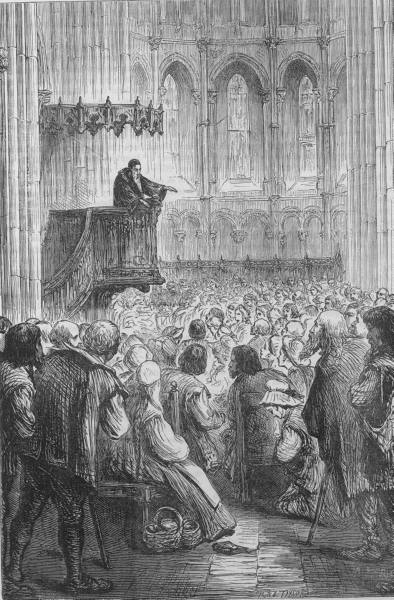
However, being a good Anglican, I want to suggest that the way forward is the via media. I want to find some middle ground. I don't think we need to stop preaching. Instead, we need to preach better, we need to 'preach smarter'. It was encouraging to read Peter Adam describe John Calvin's preaching. Adam goes on to argue that it was Calvin's sermons rather than The Institutes and the Commentaries that were his most significant contribution: "[I]t was more through his preaching than through any other aspect of his work that he exercised the extraordinary influence everyone has acknowledged him to have had" (R.S. Wallace).
Calvin helped create a powerful pattern of vernacular expository preaching. His aim was to let God have his say, to project God's eloquence, to help the congregation to hear the voice of God. Calvin's sermons, heard in Geneva, written down, published, translated and published again, helped to reform Europe. We need to recover the health and vigour of engaged and lively expository preaching for the maturity and usefulness of the people of God, for the conversion of the world, for God's glory. We have much to learn from Calvin's preaching. - Peter Adam, "'Preaching of a Lively Kind' - Calvin's Engaged Expository Preaching", Engaging With Calvin, ed. M Thompson, IVP 2009.
If we want to preach better, or "preach smarter", then we need to recover the health and vigour of engaged and lively expository preaching for the maturity and usefulness of the people of God, for the conversion of the world, for God's glory. Preaching can be powerful when it is done well. Speech is powerful. Calvin's sermons transformed not just one city, but large swathes of a continent. Sure, the sixteenth century was a far more oral society than at the start of the twenty-first century.

But even today a good speech can move people. We've seen that in the past year with Barak Obama's election to the American Presidency. Never before had an election campaign harnassed the power of the internet. Facebook, YouTube, Twitter. You name it, Obama was on it. But it was the power of speech that captured a nation's imagination. Let us consider what this wordsmith has to offer us regarding preaching...

Holy, Holy, Holy...

I'm feeling pretty tired as I write this. Our congregation just had it's weekend away down at Gerringong. It was a great time of fellowship, rest and community. Michael Jensen also gave three outstanding talks on God: The one-ness of God; The Pleasure of God; and The Wisdom of God. If it ever makes it into a book, it will be a great follow-up to YOU: An Introduction.

On the trip home we had the ipod on surprise (also known as shuffle. This is fairly normal for Alison and me). The best part was when Sufjan Steven's version of Holy, Holy, Holy came on. What a treat!