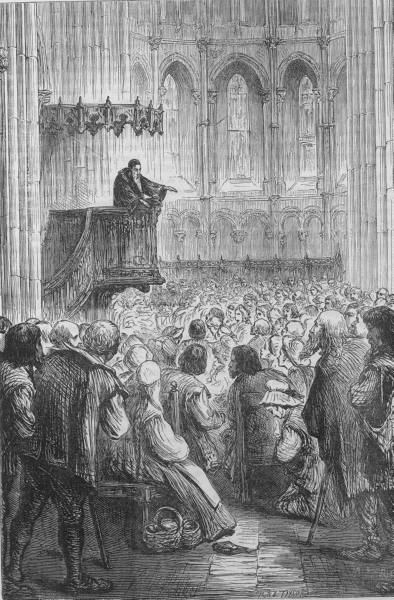
Showing posts sorted by date for query problem with preaching. Sort by relevance Show all posts

Monday, August 26, 2013

Parish Matters


Geography and Creation
At heart, the decline of the parish system is a neo-Platonic view of the world that has shadowed Christianity for two millennia. The modernist project of reducing humans to their mind and reason jettisoned Christianity’s anthropological conviction that we are embodied creatures, leaving in its wake a church with nothing to say about the emotions, about beauty, and about place. This is part of what Canadian philosopher Charles Taylor refers to as the excarnation; a disembodied Christianity that seperated the "physical" from the "spiritual".

Admittedly there are mitigating circumstances for this development. The transitions of cities from the original space you could move around by foot to suburbia, not only allowed for the sprawl of mountains beyond mountains of suburbs with no end in sight, but also gave people for the first time freedom to chose where they work, live and play. At the same time as the 20th century saw the construction of countless miles of freeways, customary geographical loyalties began to breakdown. No more were you bound to buy bread from the shop around the corner. No more were you bound to play sport for the team of your local area, let alone support them. I grew up supporting the Balmain Tigers in Rugby League, without ever living within traditional Tiger territory.
Churches adjusted to this commuter consumption, competing against each other to have the better preaching, the better children’s ministry, the better whatever itch I want scratched. And in the process they frequently severed the connections with the local community, drawing upon an ever expanding area to draw members from. One consequence of this was the emergence of homogenous congregations based around age, culture, or occupation. 

The result was that at a time in Western history when the church was becoming increasingly marginalised from society, individual churches sat in an uneasy relationship with their local community. And whether intentionally or unintentionally, what this mode of church communicated was a disinterest in space, in place, in locality. As if life in the Christian community and mission could be conducted without any reference to these three things. It exhibits a staggeringly unreflective attitude towards matter, having more to do with a disembodied dualism that one would struggle to find in Scripture: the Christian is focused upon the God who is named as the maker of all things, the same God who took on flesh and blood, becoming incarnate when his creation was placed in bondage. This same God triumphed over his enemies that had sought to oppress and destroy his good creation, rising from the grave and sending his church out into all the world, making disciples of all gentiles. And the Christian hope is firmly fixed on the day when God will come and dwell amongst his people and creation is set free from sin, death and evil once and for all. Thus New Testament scholar Richard Bauckham can describe the Christian narrative as driven towards the universal realization of God's kingdom in all creation.
“God identifies himself as the God of Abraham, Israel and Jesus in order to be the God of all people and the Lord of all things. Moreover, in the narrative world of the Bible the people of God is also given its identity in this movement from the particular to the universal, an identity whose God-given dynamic we commonly sum up in the word 'mission'. God, God's people and God's world are related to each other primarily in a narrative that mediates constantly the particular and the universal."
The often heard objection to the parish system is that locality is irrelevant. The argument is made that in today’s mobile and transaction world, people are more closely tied to social and professional networks beyond their local neighbourhood. However this is a highly contested assertion amongst sociologists and demographers; researchers have found that in contemporary western societies social networks are still significantly embedded in local places.[1] Geography is a massively important feature of people's experience of life (cf. Bauckham). The local neighbourhood remains a central space for community. 

The Parish and Creation
Stanley Hauerwas has recently stated that “The parish is the ecclesial form that has tied the church to place.” The assumption behind the parish system was the belief that “There is not one square inch of the entire creation about which Jesus Christ does not cry out, ‘This is mine! This belongs to me!’” Working from this assumption, the whole world was organised into dioceses and parishes. The purpose behind this was not territorialism or factionalism; that was be a disaster. Christ's victory includes a victory of the principalities and powers, the elementary forces of the world that divide and enthral humans. The parish system was neither about dividing up the world for the sake of drawing boundaries on a map. The intent of the parish system was that in every part of the world, there would be a church responsible for proclaiming the gospel in that area and ministering to local the community – the cure of souls as it was once described. 

There have many problems with the parish system over the years. This has been particularly true when (the sometimes arbitrary) lines on a map are treated as sacrosanct for all time, like the law of the Medes. But even then, this problem is symptomatic of the failure of churches to trust one another and work together. Nevertheless, the parish system was a design intended to point the church outwards to the world. It has stood as a reminder that churches do not exist for themselves, but are a part of God’s mission to bring all things under the lordship of Christ. It is a design that reminds us that salvation is for all people; that, at least in the Anglican context in which I come from, we are not attempting to reach only the rich, the poor, the cool, the young, the old, the professional, the tradie, the culturally homogenous etc. The diversity of any particular parish church would reflect the diversity of the church universal, and in doing so reflect the unity of both the universal and local church that confesses on Lord and one God. Reflecting on the Sydney Diocese's Connect09 campaign, Andrew Nixon had this to say:
"I know the parish system (or more accurately parochialism) presents many difficulties for our diocese. Whenever you form people into tribes and draw lines on maps you just know that sin will be crouching at the door. Yes, there are problems. But I pray that we can address and overcome them together...What is wonderful about the parish structure is that it is suited to local mission; it covers everyone. It says that together, we will take responsibility for every soul in our area, every square inch of our city. Even the hard places."
Surprisingly, the word parish has its origins in Koine Greek. The word as we have it today is first attested to in the thirteenth century, derived from medieval French paroisse, which in turn from Latin, paroecia. But there is good evidence that parish was first introduced into England during the late 600’s by eighth Archbishop of Canterbury Theodore of Tarsus. Theodore referred to Anglo-Saxon towns as paroikia, a term which comes directly from the Septuagint and the New Testament (πάροικος – adjective; Acts 7:6, 29; Ephesians 2:19; 1 Peter 2:11. παροικία – noun; Acts 13:17; 1 Peter 1:17). In the New Testament πάροικος and παροικία are both used by the Apostle Peter to describe the identity of Christians. They are aliens and strangers to those they live alongside, living as exiles in the world. This transient nature of Christian living feels as far removed from the sense to parish as you could get. Yet πάροικος carries with it a sense of permanence about it too. It is the word used in Acts to describe Israel's 400 year stay in sojourn in Egypt before entering the promised land. Likewise Peter’s description is not of temporary aliens; the Christians he writes too are long-term sojourners in a foreign land. That is how the term was used in early Christian literature, such as 1 Clement: 
“From the παροικοσα of the Church of God at Rome, to the παροικούσῃ of the Church of God as Corinth…”
The early Christians saw themselves as colonies (that is the word used for παροικοσα in the Stamforth translation) of heaven, living in the world in anticipation of the new creation. 

In fact, this is at the heart of classic Anglican missiology. Although unmentioned by the Articles of Religion and The Ordinal, and generally assumed by the Book of Common Prayer, the parish system remains the Anglican missiology – seeking to serve all people. This is part of Paul Barnett’s “Ten Elements of Historic Anglicanism, namely that "‘historic Anglicanism’ affirms both creation and society. It is concerned with the common good, for the ‘welfare of the city,’ to use Jeremiah’s words.” The parish system grounds the church’s mission in the creation that is groaning, awaiting the unveiling of the children of God. It stands as a reminder that churches do not exist for themselves, but are a part of God’s mission to bring all things under the lordship of Christ.


[1] cf. Oldenburg (1999), The great good place: cafes, coffee shops, bookstores, bars, hair salons, and other hangouts at the heart of the community. On this point I am indebted to conversations with Alison Moffitt.

Thursday, April 21, 2011

Celebrating Easter


So how can we learn to live as wide-awake people, as Easter people? ...I have come to believe that many churches simply throw Easter away year by year; and I want to plead that we rethink how we do it so as to help each other, as a church and as individuals, to live what we profess...
But my biggest problem starts on Easter Monday. I regard it as absurd and unjustifiable that we should spend forty days keeping Lent, pondering what it means, preaching about self-denial, being at least a little gloomy, and then bringing it all to a peak with Holy Week, which in turn climaxes in Maundy Thursday and Good Friday . . . and then, after a rather odd Holy Saturday, we have a single day of celebration.

All right, the Sundays after Easter still lie within the Easter season. We still have Easter readings and hymns during them. But Easter week itself ought not to be the time when all the clergy sigh with relief and go on holiday. It ought to be an eight-day festival, with champagne served after morning prayer or even before., with lots of alleluias and extra hymns and spectacular anthems. Is it any wonder people find it hard to believe in the resurrection of Jesus if we don’t throw our hats in the air? Is it any wonder we find it hard to live the resurrection if we don’t do it exuberantly in our liturgies? Is it any wonder the world doesn’t take much notice if Easter is celebrated as simply the one-day happy ending tacked on to forty days of fasting and gloom? It’s long overdue that we took a hard look at how we keep Easter in church, at home, in our personal lives, right through the system. And if it means rethinking some cherished habits, well, maybe it’s time to wake up. That always comes as a surprise.

And while we’re about it, we might write some more good Easter hymns and take care to choose the many good ones already written that celebrate what Easter really is rather than treating it as simply our ticket to a blissful life hereafter. Interestingly, most of the good Easter hymns turn out to be from the early church and most of the bad ones form the nineteenth century. But we should be taking steps to celebrate Easter in creative new ways: in art, literature, children’s games, poetry, music, dance, festivals, bells, special concerts, anything that comes to mind. This is our greatest festival. Take Christmas away, and in biblical terms you lose two chapters at the front of Matthew and Luke, nothing else. Take Easter away, and you don’t have a New Testament; you don’t have a Christianity; as Paul says, you are still in your sins. We shouldn’t allow the secular world, with its schedules and habits and parareligious events, its cute Easter bunnies, to blow us off course. This is our greatest day. We should put the flags out.

In particular, if Lent is a time to give things up, Easter ought to be a time to take things up. Champagne for breakfast again—well, of course. Christian holiness was never meant to be merely negative. Of course you have to weed the garden from time to time; sometimes the ground ivy may need serious digging before you can get it out. That’s Lent for you. But you don’t want simply to turn the garden back into a neat bed of blank earth. Easter is the time to sow new seeds and to plant out a few cuttings. If Calvary means putting to death things in your life that need killing off if you are to flourish as a Christian and as a truly human being, then Easter should mean planting, watering, and training up things in your life (personal and corporate) that ought to be blossoming , filling the garden with color and perfume, and in due course bearing fruit. The forty days of the Easter season, until the ascension, ought to be a time to balance out Lent by taking something up , some new task or venture, something wholesome and fruitful and outgoing and self-giving. You may be able to do it only for six weeks, just as you may be able to go without beer or tobacco only for the six weeks of Lent. But if you really make a start on it, it might give you a sniff of new possibilities, new hopes, new ventures you never dreamed of. It might bring something of Easter into your innermost life. It might help you wake up in a whole new way. And that’s what Easter is all about. - NT Wright

Thursday, October 14, 2010

The Periphery of Intellectual Existence

Is there such a theology of the university? Or does the university fit into the Christian worldview? One of the things I've found myself doing this year as I work alongside the EU's Post Grad faculty is to read books that try to answer these questions. As I've prayed and dreamed about where this growing ministry might go in the future, there have been a number of books I've found helpful in imagining the vocation of Christian academia.

Admittedly, most of these books are American. They appear to be written out of some American angst in solving the dilemma of having both Christian and secular universities.

One name has repeatedly popped up this year: Charles Habib Malik. A former President of the UN General Assembly, Malik was himself a giant in the mid to late 20th's public forum. Malik was a brilliant thinker who studied under Heidegger and Whitehead; he also possessed a generous orthodoxy in loving and welcoming Catholics and Protestants as well as other Orthodox Christians. Amongst contemporary Christians he perhaps most famous for this quote:
"The University is a clear-cut fulcrum with which to move the world. The problem
here is for the church to realize that no greater service can it render both
itself and the cause of the gospel than to try to recapture the universities for
Christ, on whom they were all originally founded. More potently than by any
other means, change the university and you change the world."
I've recently been reading Malik. Like most of what I've read about Christian scholarly witness, what I've found in Malik is a love for the God and Father of Christ Jesus that is displayed in part through a love for the university, and more generally for knowledge and learning. He had a great vision for the university as a place that is captured for Christ. He prayed for a university that would use it's wisdom that would serve Jesus. Malik believed that it would be Evangelicals who had the most opportunity to make this happen. Here is his charge to them:
The problem is not only to win souls but to save minds. If you win the
whole world and lose the mind of the world, you will soon discover that you have
not won the world. Indeed it may turn out that you have actually lost the
world.In order to create and excel intellectually, must you sacrifice or neglect
Jesus? In order to give your life to Jesus, must you sacrifice or neglect
learning and research? Is your self-giving to scholarship and learning
essentially incompatible with your self-giving to the scholarship and learning
essentially incompatible with your self-giving to Jesus Christ? These are the
ultimate questions, and I beg you to beware of thinking that they admit of glib
answers. I warn you: the right answer could be the most disturbing
....
People are in a hurry to get out of the university and start earning money
or serving the church or preaching the gospel. They have no idea of the infinite
value of spending years of leisure in conversing with the greatest minds and
souls of the past, and thereby ripening and sharpening and enlarging their
powers of thinking. The result is that the arena of creative thinking is
abdicated and vacated to the enemy. Who among evangelicals can stand up to the
great secular or naturalistic or atheistic scholars on their own terms of
scholarship and research? Who among the evangelical scholars is quoted as a
normative source by the greatest secular authorities on history or philosophy or
psychology or sociology or politics? ...For the sake of greater effectiveness in
witnessing to Jesus Christ himself, as well as for their own sakes, the
evangelicals cannot afford to keep on living on the periphery of responsible
intellectual existence.
Malik offers a caution against the anti-intellectualism that had the potential to characterise evangelicalism in the 20th century. And if we truly believe in lives transformed by Christ, we need to seek not just the conversion of souls, but the conversion minds, hearts and hands (on which see here). As I reflect on what this might look like for EU's Post Grads, my hope is that they will bring every part of their lives under the Lordship of Christ. In him are hidden all the treasures of wisdom and knowledge. My hope is that they will be the best post grads in the university, because they're using their intellect to serve Jesus and his church and his world; because they're engaging with other academics from across the university; because they want take every thought captive to obey Christ.

Monday, October 19, 2009

The Problem With Bible Reading II

A Question of Authority

Coincidentally after my previous post which quoted John Blanchard on the power of public Bible reading, Anglican Bishop Rob Forsyth has also written on this issue: The Marginalisation of Scripture. Rob quotes Oliver O'Donovan's lecture in April (mentioned on hebel here) to describe the place of scripture within our churches, and particularly how it has been sidelined in recent years. Rob argues that: "It can be easily be overwhelmed by the other elements: the music, the singing or, even more likely in our culture, the preaching."

Several years ago I heard a sermon that said that the most important of church is hearing the bible read out loud. How can the public reading of the Bible be central to our church gatherings? According to O'Donovan and his friend and contemporary Tom Wright, it comes down to authority. O'Donovan's account on this authority is superb. According to Wright:
"...[I]n public worship where the reading of scripture is given its proper place, the authority of God places a direct challenge to the authority of the powers, not least those who use the media, in shaping the mind and life of the community. But the primary purpose of the readings is to be itself an act of worship, celebrating God's story, power and wisdom and, above all, God's son. That is the kind of worship through which the church is renewed in God's image, and so transformed and directed in it's mission. Scripture is the key means through which the living God directs and strengthens his people in and for that work. That, I have argued throughout this book [Scripture and the Authority of God], is what the the shorthand phrase 'the authority of scripture' is really all about.

Indeed, what is done in the classic offices of Morning and Evening Prayer by means of listening to one reading from each Testament, is to tell the entire story of Old and New Testaments, glimpsing the broad landscape of the scriptural narrative through the two tiny windows of short readings. To truncate this to one lesson, or to a short reading simply as a prelude to the sermon (and perhaps accompanied with half an hour or more of 'worship songs'), is already to damage or deconstruct this event, and potentially to reduce the power and meaning of scripture, within this context , simply to the giving of information, instruction or exhortation. Equally, to have a reading that lasts about 90 seconds, flanked by canticles that last five or ten minutes (the practice in some 'cathedral-style' worship), conveys the same impression as a magnificent sparkling crystal glass with a tiny drop of wine in it. The glass is important, but the wine is what really matters." - NT Wright, Scripture and the Authority of God.
Or as O'Donovan argues:
"It is simply that without a proper value assigned to the corporate exercise of public reading of Scripture, private reading must look like an eccentric hobby. No collective spiritual exercise, no sacrament, no act of praise or prayer is so primary to the catholic identity of the church gathered as the reading and recitation of Scripture. It is the nuclear core. When Paul instructed his letters to be passed from church to church and read, it was the badge of the local church’s catholic identity. This is not to devalue preaching, praise, prayer, let alone sacramental act; these all find their authorisation in reading." - Oliver O'Donovan, The Reading Church: Scriptural Authority in Practice.

The reading of the bible at church is a means through which God speaks to his gathered people. Not only is it meant to be a transformative and profound moment, is it an act of worship by Christians to our God. Which is why we should strive to do it well. Not because we are professionals, but because we value excellence in our ministry, because we believe that it honours God and inspires people. I'll be blogging on this later in the week...

Thursday, October 01, 2009

The Problem With...Bible Reading

An Excursus

I've been blogging about the problem with preaching. In my Australia evangelical context, I think this is a reaction to i. the polished "professionalism" of pentecostal churches; and ii. the sacramentalism of Roman Catholicism. And so in our preaching we've opted for something that is amateurish compared to the tele-prompted, "Britney microphone" kitted charismatic preacher.

This is also systematic of our church services. And nowhere is this more true than in the Bible readings at church. It can often feel like the first time the reader has looked over the text is when they're standing at the lectern doing the reading.

I want to share with you something I read when I first started leading church services etc. It inspired me, and hopefully it will inspire you too.
"There are times when I have felt that the Bible was being read with less preparation than the notices - and with considerably less understanding. I hesitate to use the following illustrations because of my part in it, but I do so a reminder to my own heart of the seriousness of the issue. A year or two after my conversion I was appointed as a Lay Reader in the Church of England , to Holy Trinity, Guernsey. There were two other, more senior Lay readers on the staff, with the result that on most Sundays the responsibilities could be evenly shared out. As it happened, the Vicar almost always asked me to read the Lessons, following a Lectionary which listed the passages appointed to be read each Sunday of the year. My wife and I lived in a small flat at the time, but I can vividly remember my Sunday morning routine. Immediately after breakfast I would go to the bedroom, lock the door, and begin to prepare reading the Lesson that morning. After a word of prayer I would look up the Lesson in the Lectionary, and read it carefully in the Authorized Version, which we were using in the church. Then I would read it through in every other version I had in my possession, in order to get thoroughly familiar with the whole drift and sense of the passage. Next I would turn to the commentaries. I did not have many in those days, but those I had I used. I would pay particular attention to word meanings and doctrinal implications. When I had finished studying every passage in detail, I would go to the mantelpiece, which was roughly the same height as the lectern in the church, and prop up the largest version of the Authorized Version I possessed. Having done that, I would walk very slowly up to it from the the other side of the room, and begin to speak, aloud: 'Here beginneth the first verse of the tenth chapter of he gospel according to St. John' (or whatever according the passage was). Then I would begin to read aloud the portion appointed. If I made so much as a slip of the tongue, a single mispronunciation, I would stop, walk back across the room, and start again, until I had read the whole passage word perfect, perhaps two or three times. My wife would tell you that there were times when I emerged from the bedroom with that day's clean shirt stained with perspiration drawn from the effort of preparing one Lesson to read in the church. Does that sounds like carrying things too far? Then let me add this: I was told that there were times when after the reading of the Lesson people wanted to leave the service there and then and go quietly home to think over the implications of what God has said to them in his Word." - John Blanchard, quoted by R. Kent Hughes, 'Free Church Worship: The Challenge of Freedom', Worship by the Book, ed. D.A. Carson, 2002.
Extreme? I wish I could read the Bible in church like that.

Monday, September 21, 2009

The Problem With Preaching IV

The Value of Oral Communication

Having laid out some of the problems facing preaching in church, it would be tempting to just do away with it. The common lament I hear is preaching is dry, boring and painful. And with the rise of the internet and the massive social changes that come with it, maybe preaching has had it's day.

However, being a good Anglican, I want to suggest that the way forward is the via media. I want to find some middle ground. I don't think we need to stop preaching. Instead, we need to preach better, we need to 'preach smarter'. It was encouraging to read Peter Adam describe John Calvin's preaching. Adam goes on to argue that it was Calvin's sermons rather than The Institutes and the Commentaries that were his most significant contribution: "[I]t was more through his preaching than through any other aspect of his work that he exercised the extraordinary influence everyone has acknowledged him to have had" (R.S. Wallace).
Calvin helped create a powerful pattern of vernacular expository preaching. His aim was to let God have his say, to project God's eloquence, to help the congregation to hear the voice of God. Calvin's sermons, heard in Geneva, written down, published, translated and published again, helped to reform Europe. We need to recover the health and vigour of engaged and lively expository preaching for the maturity and usefulness of the people of God, for the conversion of the world, for God's glory. We have much to learn from Calvin's preaching. - Peter Adam, "'Preaching of a Lively Kind' - Calvin's Engaged Expository Preaching", Engaging With Calvin, ed. M Thompson, IVP 2009.
If we want to preach better, or "preach smarter", then we need to recover the health and vigour of engaged and lively expository preaching for the maturity and usefulness of the people of God, for the conversion of the world, for God's glory. Preaching can be powerful when it is done well. Speech is powerful. Calvin's sermons transformed not just one city, but large swathes of a continent. Sure, the sixteenth century was a far more oral society than at the start of the twenty-first century.

But even today a good speech can move people. We've seen that in the past year with Barak Obama's election to the American Presidency. Never before had an election campaign harnassed the power of the internet. Facebook, YouTube, Twitter. You name it, Obama was on it. But it was the power of speech that captured a nation's imagination. Let us consider what this wordsmith has to offer us regarding preaching...

Thursday, August 27, 2009

The Problem With Preaching III (a)

This video follows up quite neatly on what I said back here. Apologies for the speed.


AMENDMENT: See also 'The Problem with PowerPoint: 25 Years of PowerPoint' produced by the BBC.

Saturday, July 11, 2009

The Problem With Preaching III

The Times, They Are A Changing...

It has been said that we stand at the dawn of a new era. As we seek to communicate Jesus and connect with stories, our culture is changing at a rapid pace - and this is why presentation in preaching is important.

We are witnessing the transition between two major communication eras. This is a pretty big deal, as they've only been two communication eras up to now. Firstly, there was the oral culture of communication. Secondly, the culture of writing with the invention of the alphabet and later, the printing press. And thirdly (now), the electronic era of communications, starting with Film and Television, where image became everything. If you think about it, such a major change in communications has only happened once before in human history. So it's no wonder that there is a crisis in today's preaching (and lots of other forms of content delivery).

According to Perth author and pastor Graham Johnston: "The force of the written word has diminished. Words carry no meaning. Enter the image. Images leave the viewer, not with carefully crafted ideas and precepts but with impressions."

Johnston overstates things when he says the power of the written word has diminished - I disagree with that. But he makes an important point about image. Since the rise of television, image and perception have become much more important in communication. And if we thought television had radically changed communication - along came the Internet. Effectively in the last decade the Internet has reshaped everything. Cultural critic Lee Siegel argues: "The Internet is possibly the most radical transformation of private and public life in the history of humankind."

The Internet: it's huge. And it changes everyday.It's changing the whole arena of communication and even society itself. The Internet is changing the people the church preaches to, especially young people. Because of this the Internet presents great challenges and possibilities for preaching today and tomorrow. To throw some perspective on this, it took radio 38 years to reach an audience of 50 million people. Television took 13 years, the Internet took 4 years, the i-Pod did it in 3 years and facebook did it in just 2 years. Internet use has even surpassed television viewing.

It's because of all these major developments that we go to the Internet and learn some lessons for preaching in today's world. There is more to come...

Tuesday, July 07, 2009

The Problem With Preaching II

Presentation Matters

One of the problems with preaching today is that presentation matters. Actually, what I mean is that presentation is important, and we're neglecting it. As good Evangelicals we have a strong view of scripture: that is powerful and change peoples lives. We believe in the centrality of the word in preaching, empowered by the Spirit. We believe in good exegesis that is driven entirely by God's word. So does presentation matter?

My answer is yes, it does. In preparing our sermons we spend so much time working out our three points (preferably alliterated), a humorous introduction and some sort of application at the end that includes Jesus. And what we are producing is an half-hour essay that has been fitted into that format and read out loud. We need to do better than this.

But before I go further, I must say two things.

  1. Presentation means more than eloquent words. The Apostle Paul was quite clear that when we taught it wasn't going to be the beauty of his words that changed lives (see 1 Cor. 2.1-2). Presenting when doesn't mean we sell out to a rhetorical exercise. It's about serving God well; and some of the preaching in the church today just 'doesn't cut the mustard'.
  2. Presentation is doesn't necessarily equal spin. In a world were people are cynical of most things that they hear, preaching spin would be far more dangerous than delivering a 30 minute essay. The best preaching is personal. As I will explain in the pomo series, good presentation requires authenticity, not spin.
Some of you would have heard about the famous Joshua Bell YouTube video.


Back in 2007 Joshua went into a Washington subway with a violin. Wearing jeans and a cap, he started busking. In the 45 minutes he played, 1097 people passed by. Hardly anyone stopped and only 27 people gave money. All up he earned $32, less than a dollar a minute.

Away from the subway, Joshua Bell is an accomplished violinist - one of the modern worlds great. A couple of days earlier, playing a violin handcrafted in 1713, valued at $4 million, he’d packed Boston’s - Stately Symphony Hall to great acclaim. Tickets were $120 each. He earned $1,200 a minute!

Same bloke... same violin… same pieces of music… same brilliant performance…His presentation of himself and his performance - were the only variables.

Presentation matters! Presentation counts! Preaching a 30 minute essay isn't good enough any more. We need to prepare what not just what we say, but how we say it. If we should learn anything from the 2008 US Presidential campaign, great oratory and careful presentation is powerful. It can lead you to the most powerful office in the land (although Abraham Lincoln had already taught us the power of words: his Gettysburg Address, arguably the greatest speech in American history, was over in just two minutes). But for us who proclaim the resurrected Jesus, it's never just about great oratory. The best sermons are personal and authentic.

Preaching like this has great potential. According to the great author on preaching, Haddon Robinson:
"The effectiveness of our sermons depends on two factors; (of course)what we say – but how we say it...The age of the preacher is gone, the age of the communicator has arrived".

There is more to come...

Monday, July 06, 2009

The Problem With Preaching: What The Preachers Say

It seems that there is a crisis in preaching. How often do you hear church goers complaining about the length of the sermon? Or how boring it is? Or how irrelevant it is? I heard Leigh Hatcher talk about 'Preaching in a 'look at me' world', and I'll try and post some of his thoughts up here. But to set the scene, here are some thoughts on preaching by some well known contemporary preachers.

John Stott:
"The standard of preaching in the modern world is deplorable. There are few great preachers."
John Woodhouse:
"Much of modern preaching is deadly dull, and we long to hear preaching that is alive."
Peter Jensen:
"We need to look again at what we do in church, our reading, our prayers, (YES!!) our preaching."
Bryan Chapel:
Congregational interest in any message is a minor miracle - that no minister should ever take for granted."
Martyn Lloyd Jones, on the British experience going back to the 1960’s!!:
"Many of the younger reformed men in Britain are very good men who have no doubt read a great deal, and are very learned, but they are very dull boring preachers."
Richard A. Jensen:
"There’s a crisis - in the theory and practice of preaching."

Tuesday, November 18, 2008

Human Rights and Telling the Truth

If you missed Lateline last night, than Tony Jones' interview with Geoffrey Robertson on the current state of human rights is worth reading (you might even be able to watch the interview). Robertson has this to say on the challenges facing President-elect Obama:
"I think Obama and Obama's people - he's got some of his leading people are human rights advocates, in a past life, and undoubtedly want to reclaim the moral high ground that has been so tragically lost by the Bush administration in the last eight years. But - and they do. And they will have to deal with questions like the admissibility of evidence obtained by waterboarding and indeed the problem of inflicting the death penalty. The ludicrous thing about inflicting the death penalty on people who pray for it every day. I mean, there's nothing that Khalid Sheikh Mohammed and co. want rather than in their own mind a fast track to paradise by being executed by the Americans. So, this is really - the death penalty is really rather what the Briar Patch was to Brer Rabbit. And hopefully these considerations will be taken on board. But they are some of the problems that the Obama administration with all its goodwill and all its determination to retain or regain the moral leadership of the world will have to grapple."
This is one of the reasons I feel excitement for an incoming Obama administration in Washington. Although I have serious concerns about Obama (voiced best by Byron), for me it is the prospect of having a President who will uphold the rule of law, not support torture and not obliterate centuries worth of development in human rights and international law. It is the hope of abandoning policies that lead to Abu Gharib, Guantanamo Bay and the covert transport of prisioners around the world.

What the church much continue to do all the more urgently in the coming years is to bear witness to the government the Lordship of Jesus. Although speaking about the situation here in Australia, Andrew Errington summarizes this point quite well:
"The second way we help governments be good is different, but crucial: we help our governments stay on the right track by holding fast to the true Gospel and so bearing witness in our society.

The great danger that confronts the church is that it will sell out to government, that it will stop preaching the true Gospel and start preaching a Gospel that fits better with our society, that’s a little less challenging. Because the Gospel never sits very comfortably with those in authority: it is the message that Jesus Christ is Lord and no one else, that the Kingdom of God matters more than any other kingdom, and that no earthly society is ultimate. This is always going to be a confronting message, especially for those in authority. Yet it is a message that desperately needs to be heard; because the alternative is something truly terrible: the demonic social order we see in Revelation 13. A government that fails to realise that there is a higher authority will end up becoming an idol. In Australia, I think we run little risk of making individual politicians into idols (thankfully). But I do think we run a risk of making “Australia” into a kind of idol. Just think about the rioting that happened at Cronulla a couple of years ago, with people waving flags and talking about defending our country and the Australian way of life, and most awfully, “Christian values”. This was, I believe, an example of a kind of nationalism which is actually idolatry. When we start treating people badly in the name of “Australia” (or any other community), we know we’ve got a big problem. The church must help our society and our governments stay on the right track by holding fast to the true Gospel, by keeping on preaching that Jesus alone is King, that our citizenship is in heaven, and that therefore “Australia” can never be the Kingdom of God." - Andrew Erringon, Jesus and Government.