"There is no longer a Christian mind. There is still, of course, a Christian ethic, a Christian practice, and a Christian spirituality. As a moral being, the modern Christian subscribes to a code other than that of the non-Christian. As a member of the church, he understands obligations and observations ignored by the non-Christian. As a spiritual being, in prayer and meditation, he strives to cultivate a dimension of life unexplored by the non-Christian. But as a thinking being, the modern Christian has succumbed to secularization. He accepts religion - its morality, its worship, its spiritual culture; but he rejects the religious view of life, the view which sets all earthly issues within the context of the eternal view which relates all human problems - social, political, cultural - the doctrinal foundations of the Christian Faith, the view which sees all things here below in terms of God's supremacy and earth's transitoriness, in terms of Heaven and Hell.h/t Trevor Cairney
...To think secularly is to think within a frame of reference bounded by the limits of our life here on earth: it is to keep one's calculations rooted in this-worldly criteria. To think christianly is to accept all things with the mind as related, directly or indirectly, to man's eternal destiny as the redeemed and chosen child of God." Harry Blamires, 'The Christian Mind: How Should a Christian think?', 1963, pp. 3-4, 44.
Sunday, March 13, 2011
Cautionary Ideas for the Academic Year IV
Wednesday, March 09, 2011
Cautionary Ideas for the Academic Year III
“We need to acknowledge that conservative evangelical Christians, as a cultural group, often have difficulty assimilating to the culture of secular colleges and universities. Such difficulties are faced by many groups… It seems to me, however, that conservative evangelical Christians represent a special case in this regard. In the other cases, we are dealing with people who have historically been excluded from academe and are therefore simply unfamiliar with its culture and expectations – a relatively straightforward problem to solve… In the case of conservative evangelical Christianity, however, we are dealing with a group whose leaders have encouraged its members to define themselves over against the secular world and particularly secular academe.” - Adam Kotsko 'Christians in Academe: a Reply' 2010h/t Caitlin
Thursday, March 03, 2011
Cautionary Ideas for the Academic Year II
With the start of the new academic year this week at Sydney University, hebel will be publishing some quotes over the coming days about the current state of academia and the place of Christians within it. Here is Mark Noll's response to the question posed in the first Cautionary Ideas for the Academic Year:I actually think it's fatal for long-term Christian thinking and fatal for the long-term health of Christianity per se to live under different basic commitments in professional life and church life. To say that I adopt the rules of the game for academic life Monday to Friday, and the rules of church life on Sunday, that's a real problem.
However, what's required for many domains of learning, and I would include biblical studies, is the serious use of the mind while the spirit is fully cast in a Christian foundation. That can be a difficult challenge where much of the formal thinking about something has been dominated by non-Christian influences for some time, as would be the case in biblical study at research universities.
But the way forward is not to split the personality. The way forward would be following the path charted out by the really significant Christian philosophers of the late 20th and early 21st centuries, who have urged more professional abilities, but also more courage in letting Christian foundations dictate how those professional abilities are put to use. I am filled with admiration for people like Robert Adams, Nicholas Wolterstorff, and Alvin Plantinga, who have been thoroughly elite and thoroughly professional, but also foundationally Christian in how they put to use their professional wisdom. That, I think, is the model. They have not divided themselves into an academic part and a believer part.
Thoughts?
Wednesday, March 02, 2011
Cautionary Ideas for the Academic Year
With the start of the new academic year this week at Sydney University, hebel will be publishing some quotes over the coming days about the current state of academia and the place of Christians within it. To start us off is a question Timothy Dalrymple posed historian Mark Noll in a recent interview. Noll's answer will be published soon.In Between Faith and Criticism, you say, "a history of evangelical biblical scholarship must heed both the professional community in which scholars willingly adopt a mien of intellectual neutrality, and the community of belief, in which the same scholars embrace a childlike faith."Thoughts? h/t Caitlin
In my own graduate education, I sometimes heard believing professors and historians say that, "As a historian I believe X, because I am required to operate according to a certain methodology. But as an individual believer, I believe Y." The question is: Is that a stable arrangement? Over the long haul, the more that one practices a methodological naturalism, or something of that sort, will one eventually come not only to practice naturalism as a methodological matter but to accept it as a metaphysical matter? Is it practical to bifurcate ourselves as scholars into one part that draws conclusions according to rigorous methodological criteria and another part that confesses a different set of beliefs?
Monday, February 21, 2011
270/24 and Other Numbers in 2011
- The Status of Global Mission report researched the frequency of Christian martyrdom. The SGM defined martyrdom as “believers in Christ who have lost their lives, prematurely, in situations of witness, as a result of human hostility.” SGM estimated that on average there are 270 new Christian martyrs every 24 hours over the past decade, such that “the number of martyrs [in the period 2000-2010] was approximately 1 million.”
- By mid 2011 there will be 2,306,609,000 people who see themselves alinged with Christianity in some description. These 2.3 billion Christians can be divided into six “ecclesiastical megablocks”: 1,160,880,000 Catholics; 426,450,000 Protestants; 271,316,000 Orthodox; 87,520,000 Anglicans; 378,281,000 “Independents” (i.e., those separated from or unaffiliated with historic denominational Christianity); and 35,539,000 “marginal Christians” (i.e., those professing off-brand Trinitarian theology, dubious Christology, or a supplementary written revelation beyond the Bible).
- As of mid-2011, there will be an average of 80,000 new Christians per day (of whom 31,000 will be Catholics) and 79,000 new Muslims per day, but 300 fewer atheists every 24 hours.
- Africa has been the most stunning area of Christian growth over the past century. There were 8.7 million African Christians in 1900 (primarily in Egypt, Ethiopia and South Africa); there are 475 million African Christians today and their numbers are projected to reach 670 million by 2025.
- There were 1,600 Christian denominations in 1900; there were 18,800 in 1970; and there are 42,000 today.
- $545 billion is given to Christian causes annually, which comes out to $1.5 billion per day.
Thursday, February 10, 2011
Lessons from Lesslie Newbigin
"If one looks at the world scene from a missionary point of view, surely the most striking fact is that, while in great areas of Asia and Africa the Church is growing, often growing rapidly, in the lands which were once called Christendom it is in decline.Surely there can be no more crucial question for the world mission of the Church… Can there be an effective missionary encounter with this culture – this so powerful, persuasive, and confident culture which (at least until very recently) simply regarded itself as “the coming world civilization” (Newbigin, 1985).If you're interested in things like:
- evangelical epistemological humility (similar to Mike and Steve)
- the gospel not as timeless metaphysical truths but as story
- the gospel as history
- the expansive impact of the gospel
- the necessary role of the church in mission
Saturday, February 05, 2011
Saying No To The HUP
The only problem with the HUP is that's questionable just how biblical actually is. According to Tim Chester:
"The main criticism of the homogenous unit principle is that it denies the reconciling nature of the gospel and the church. It weakens the demands of Christian discipleship and it leaves the church vulnerable to partiality in ethnic or social conflict. It has been said that ‘the homogenous unit principles is fine in practice, but not in theory’!"A central picture in New Testament of the church is of Jews and Gentiles with one voice glorifying the the God and Father of our Lord Jesus Christ (cf. Romans 15). In Christ two peoples become one; Christian Jews and Gentiles become one new people of God, part of the one body of Christ. So then "there is neither Jew nor Greek, there is neither slave nor free, there is no male and female, for you are all one in Christ Jesus" (cf. Galatians 3.28-29). Or again in 1 Corinthians "For in one Spirit we were all baptized into one body—Jews or Greeks, slaves or free—and all were made to drink of one Spirit" (1 Cor. 12.13). And according to Ephesians 3, it is the unity of the church "across barriers that have hitherto divided humankind is the sure sign to the powers that their time is up, that they are not masters of the world and that Jesus is" (NT Wright). The very fact that "Greek and Jew, circumcised and uncircumcised, barbarian, Scythian, slave and free" (Colossians 3.11) can praise God together in and of itself declares that Jesus Christ is Lord.
So this year, at Sydney Uni in the eu postgrads & staff faculty, we've said no to the HUP. Campus life is already segmented enough as it: between arts and science, staff and students, academics and support staff. According to Alasdair MacIntyre this results in:
“the graduates of the best research universities tend to become narrowly focused professionals, immensely and even obsessively hard working, disturbingly competitive and intent on success as it is measured within their own specialized professional sphere, often genuinely excellent at what they do; who read little worthwhile that is not relevant to their work..." (MacIntyre 1999).Instead of organizing our groups by schools and faculties, this year our small groups, prayer groups and reading groups will be organised by broad geographical terms, i.e. Darlington, Fisher, Manning, etc. So in 2011 we're making the English and Physics postgrads sit down and read the Bible - together. We are convinced that they have great things to offer each other, and by talking to each other they'll become more rounded academics. But more importantly, we are convicted that the gospel tears down whatever barriers people place between themselves. We are convicted that what defines as people isn't our academic disciplines (and the expectations these entail) but our identity in Christ. And we are far more united than the academy would have us believe.
We don't do this to ignore the different academic disciplines. The Physics postgrads will still need to support and talk to each other as the live out the Christian life in their school. We're not intending to force people to blandly assimilate. Rather, as we acknowledge the wealth of diversity across eu postgrads and staff, we realise that their is more that unites us than divides us. "...[F]or the same Lords is Lord of all" (Romans 10.12).
Tuesday, January 18, 2011
So it begins...II
You may have missed it. Amidst the hustle and bustle of Christmas, the Australian Church Record released issue 1901. And inside the ACR published two more editorials with advice for the next election for the Archbishop of Sydney. In 2013. Peter Bolt comments that:"Rumour has it that groups of interested parties have begun gathering to discuss the next Archbishop, and shopping lists are being compiled."Which isn't very surprising. There's been a buzz about the election for a couple of years now. According to the ACR, 'it has the potential to mark a turning-point in the story of Sydney Anglicanism.' What is remarkable is the openness with which these discussions are taking place, following the lead of the ACR when they first laid the issue before the public in May 2010.
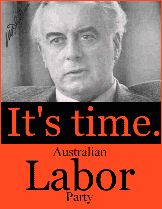
The focus of the two editorials might be summarised as "It's Time." Time for generational change. Time to pass the leadership of the diocese from the baby boomers onto which ever generation comes next. With this call for change comes a warning that the next archbishop must be present in the diocese now. The election of someone from outside the Diocese of Sydney will stand, argues Peter Bolt, not only as a rejection of the past 30 years the diocese trajectory but also as a symbol of the failure of the Baby Boomer leadership to provide training and prepare for the changeover of leadership.
"If the leadership of the last 30 years has failed to train someone who can act as Archbishop for the next generation, then that ‘leadership’ has failed abysmally."Strong words from Peter Bolt. And we can only expect more over the next two years. Even Peter Jensen's Presidential address at CMS Summer School last week felt as though he was starting to establish his legacy - expect a post on this in the future. Do you agree with Bolt's assessment about the Baby Boomers? And is he missing anything from his Archbishops shopping list (which you'll find here)?
The ‘Desacralisation’ Of Politics
"But secular authorities are no longer in the fullest sense mediators of the rule of God. They mediate his judgments only. The power that they exercise in defeating their enemies, the national possessions they safeguard, these are now rendered irrelevant by Christ’s triumph. This is what might properly be meant by that misleading expression, the ‘desacralisation’ of politics by the Gospel. No government has a right to exist, no nation has a right to defend itself. Such claims are overwhelmed by the immediate claim of the Kingdom. There remains simply the rump of political authority which cannot be dispensed with yet, the exercise of judgment." - Oliver O'DonovanThrough Christ's life, death, resurrection and ascension he has been given all power and authority in heaven and earth. And if he has all power and authority, than our governments have been stripped of their power; they have been reduced to providing justice (Romans 13). To do anything else would be a dangerously idolatrous encroachment on Christ's rule.
Friday, December 31, 2010
The Mediator of Faith
"Theology has been the mediator of the primary literature of faith since antiquity. The writers of the psalms, the prophets, the Apostle Paul all interpret core belief--that God is One, the Creator of heaven and earth, and that he has made humankind in his image. Augustine, Chrysostom, Aquinas, Luther and Calvin each gave intellectual, social and artistic form to modes of Christian life which without them are hardly to be imagined. Lately the practice of this ancient tradition has receded into the academy and learned the idiom of specialization, leaving religion increasingly vulnerable to the charge, and the fact, of vacuousness." - Marilynne Robinson
Tuesday, December 28, 2010
Global Warming - What Global Warming?
Thursday, December 23, 2010
Friday, December 17, 2010
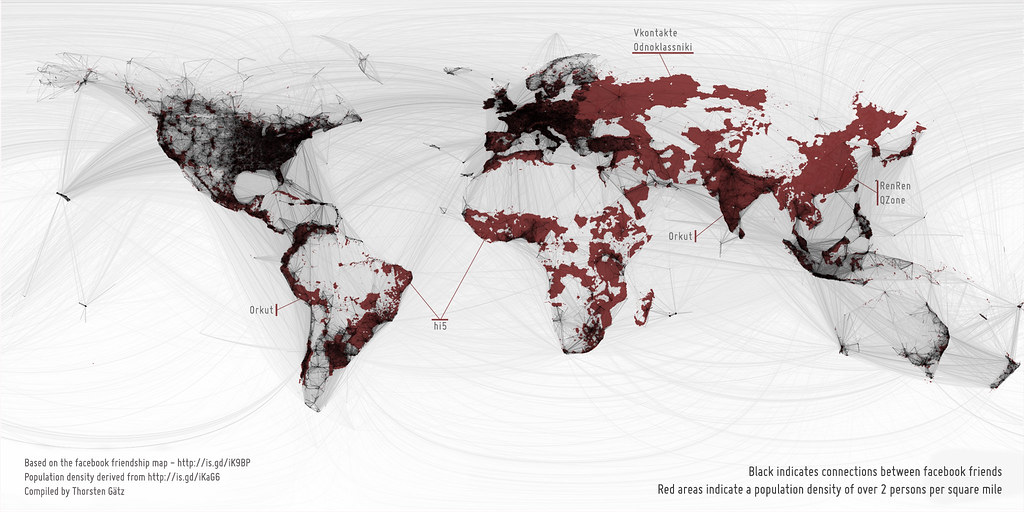
The REAL Facebook World
h/t Alison
Thursday, December 16, 2010
Advent: A Haiku
Day 1 - Genesis
After paradise
not even Lot's wife looks back.
Memory turns round.
Day 2 - Exodus
The bones of Joseph
in their gilt sarcophagus
travel night and day.
Day 3 - Leviticus
If she is too poor
to afford a sheep, she may
offer two pigeons.
Day 4 - Numbers
Dawn in my distance,
the wise watchers will see him,
star of their searching.
Day 5 - Deuteronomy
Moses from Pisgah
overviews all. It is not
space but time he lacks.
Day 6 - Joshua
Going over Jordan
Joshua above all sees
that the ark goes first.
Day 7 - Judges
Said the trees to the
bramble, 'Come, be our ruler!'
'Wait!' said the mustard.
Day 8 - Samuel
Hannah, drunk as an
apostle at Pentecost,
magnifies the Lord.
Day 9 - Kings
She came with riddles.
His more than answers more than
took her breath away.
Day 10 - Isaiah
In the wilderness
a voice cries for centuries
seeking an echo.
Day 11 - Jeremiah
Rachel refuses
to be comforted - even
when we turn the page.
Day 12 - Ezekiel
In the end it is
all in the name of the city:
The Lord is there.
Day 13 - The Twelve Prophets
Then, as before, will
Bethlehem bear the shepherd
of the scattered sheep.
Day 14 - Psalms
If there were glory
only, praise like the last psalms,
would that be the end?
Day 15 - Proverbs
Too clever by half
are the foolish. The wise know
the folly of God
Day 16 - Job
God answered Job but
not his question. Maybe he
will do that again.
Day 17 - Song of Solomon
Yes, he will haste like
a gazelle. Nothing is more
impatient than love.
Day 18 - Ruth
Tough old Naomi
bounces a child on her knee -
her wild hope come home.
Day 19 - Lamentations
Jerusalem hurls
her desperate hopes against
God's forgetfulness.
Day 20 - Ecclesiastes
Whatever God does
and whoever else may be
who knows? The wise wait.
Day 21 - Esther
Probability
counts for nothing when Esther's
G-d is in the plot.
Day 22 - Daniel
Nebuchadnezzar
dreams of the doom of despots
and the wide world wakes.
Day 23 - Ezra-Nehemiah
After the exile
returnees did not look back
more than could be helped.
Day 24 - Chronicles
Adam, Seth, Enoch,
Noah, Abraham, David,
Zerubbabel ...