Wednesday, February 22, 2012

Ash Wednesday

Prayers from the Service of Commination (for Ash Wednesday) from the BCP 1662.
"O LORD, we beseech thee, mercifully hear our prayers, and spare all those who confess their sins unto thee; that they, whose consciences by sin are accused, by thy merciful pardon may be absolved; through Christ our Lord. Amen.

O MOST mighty God, and merciful Father, who hast compassion upon all men, and hatest nothing that thou hast made; who wouldest not the death of a sinner, but that he should rather turn from his sin, and be saved: Mercifully forgive us our trespasses; receive and comfort us, who are grieved and wearied with the burden of our sins. Thy property is always to have mercy; to thee only it appertaineth to forgive sins. Spare us therefore, good Lord, spare thy people, whom thou hast redeemed; enter not into judgement with thy servants, who are vile earth, and miserable sinners; but so turn thine anger from us, who meekly acknowledge our vileness, and truly repent us of our faults, and so make haste to help us in this world, that we may ever live with thee in the world to come; through Jesus Christ our Lord. Amen.

TURN thou us, O good Lord, and so shall we be turned. Be favourable, O Lord, Be favourable to thy people, Who turn to thee in weeping, fasting, and praying. For thou art a merciful God, Full of compassion. Longsuffering, and of great pity. Thou sparest when we deserve punishment, And in thy wrath thinkest upon mercy. Spare thy people, good Lord, spare them, And let not thine heritage be brought to confusion. Hear us, O Lord, for thy mercy is great, And after the multitude of thy mercies look upon us; Through the merits and mediation of thy blessed Son, Jesus Christ our Lord. Amen.

THE Lord bless us, and keep us; the Lord lift up the light of his countenance upon us, and give us peace, now and for evermore. Amen."

Sunday, February 19, 2012

Guest Post: Ideas About Landscape

A Guest Post by Alison Moffitt. Originally Posted Here.

We're home now. During our long drive we saw lots and lots of beautiful landscapes and I spent a lot of time mulling over the things I saw. Link

Often I get sad thinking about how the beautiful landscapes I love now might disappear when Jesus comes back. When he makes the new heavens and the new earth, who's to say it will look like the same?

But then maybe when we are completely and finally sanctified and standing with Christ we won't want to look at these landscapes anymore. We turn a blind eye to it now - it's easy to forget that these beautiful landscapes are marred by sin. How many people have been dispossessed for others to take and shape the landscape? How many workers have been oppressed to clear fields and build the dams that divert the water further up the catchment? How many habitats have been ruined and how extensive the environmental degradation for the sake of turning a profit? When you think about it, many of the beautiful landscapes we revel in now are tainted with the greed and opression of past generations.

I'm sure that in the new creation we will have landscapes which are just as beautiful as the ones we love here, but where no one's blood is crying out from the soil.

For behold, I create new heavens and a new earth,
and the former things shall not be remembered or come into mind.
But be glad and rejoice forever in that which I create;
for behold, I create Jerusalem to be a joy, and her people to be a gladness.
Isaiah 65:17-18

Sunday, February 12, 2012

20 Centuries in 20 Posts Part V a

The Coming of Christendom

Intro | Part I | Part II | Part III | Part IV | Appendix

It is no exaggeration to say that the fourth century had (and continues to have) an impact on the church. For three hundred years Jesus words “If they me persecuted me, they will persecute you” had been a feature in the life of the church inside and outside Roman Empire. Yet, as we saw in the previous post, the more the church was persecuted, the more it grew. “The blood of the martyrs,” declared Tertullian, “was the seed of the church”.

The imperial campaign against the church continued in the fourth century. However, by the close of the fourth century Christianity had moved from being an illegal, “destabilising” movement within the empire to the imperially endorsed religion of the state. The paradigm of how the church had related to society and the government for three hundred years suddenly changed. The coming of Christendom, as we now know it, turned the old realities on their head and created a moment of confusion for the Church. Many readers will be familiar with the theological reverberations this caused; the fourth and fifth centuries witnessed intense and often violent theological debates about the nature of Christianity. Who is Jesus, and how does he relate to the Father? We’ll explore these debates much more fully in the post five. In this post, I want to focus on the impact the fourth century had how the church conceived of government and itself. Firstly, let me set the scene.

Background
When Diocletian died in 311AD, the outlook for Christians within the Roman Empire looked grim. As Emperor, Diocletian had instigated a wide spread campaign persecution against the Christians in 303AD, which continued unabated after his abdication in 304AD. What we now know as the Diocletianic or Great Persecution was the last imperial persecution of Christians. It was also the widest ranging and the most violent.

It is said that Diocletian was inspired to renew the anti-Christian actions of the third century when, on a visit to the prophet in Didyma to obtain a divine oracle, he was told the presence of Christians in the empire had rendered the god silent. Beginning on 23 February 303, the feast of the Terminalia, for Terminus, the god of boundaries, the program to terminate the Christian presence within the empire began. In a series of edicts, Christians gradually lost their rights: churches and Bibles were destroyed, Christian senators and soldiers lost their rank, former slaves were re-enslaved, and Christians lost the right to properly defend themselves before the courts. Christians were also forced to make sacrifices to the Roman gods; those who refused faced imprisonment, torture and even death. The fourth century writer Eusebius records that the Roman prisons could not handle the volume of Christians being arrested and ordinary criminals had to be released from prison.


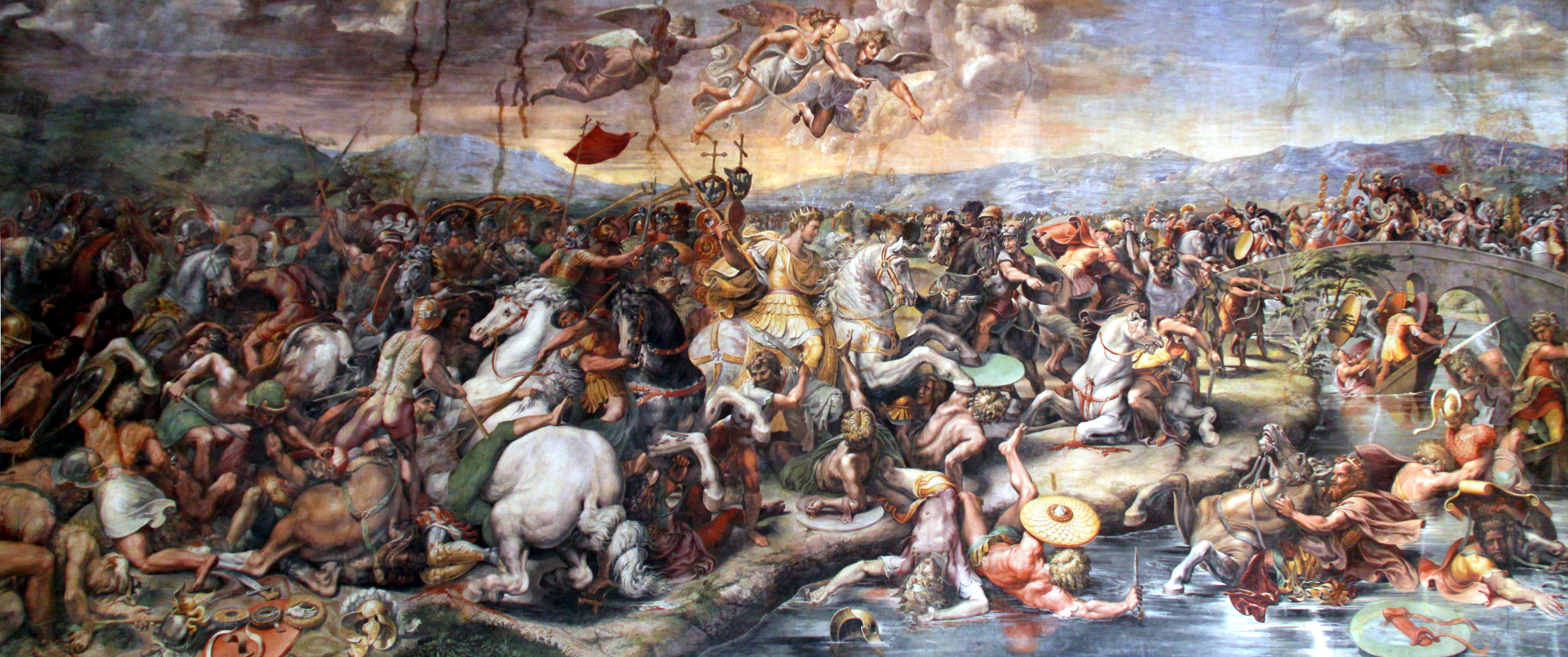
Diocletian’s successors continued to wage war on the Church after his abdication, even through six years of civil war. The decisive moment came in 312AD when the Emperor Constantine defeated Maxentius in the Battle of Milvian Bridge, leaving Constantine as the sole ruler of the western empire. However, Constantine claimed to have freed Rome from the yoke of tyranny in the name of Christ – his soldiers having fought at Milvian Bridge with standards that displayed the "Chi-Rho" symbol ☧, formed from the first two Greek letters of the word Christ.

Over the next 25 years of his reign, Constantine not only made a large impact on Roman politics, uniting the empire under his rule; he has played an important and increasing role in the life of the church: he officially ended the persecution of Christians (in the western empire through the Edict of Milan in 313, and in 324 in the eastern empire); launched a large scale campaign to build churches throughout the empire (such as the Church of the Holy Sepulchre in Jerusalem and the original St Basilica’s in Rome), moved the capital city to Byzantium (dedicating the city as Constantinople solely to Christ and not the ancient gods of Rome); and organised the first ecumenical council to determine the theology of the church at Nicaea in 325.

With one exception, Constantine’s successors continued these policies; in 380 Christianity was effectively declared the state religion of the empire. In 392, with the structure that had supported it for centuries crumbling around it, pagan worship was banned within the empire. Rome – long the persecutor of the church, was now lead by Emperors who not only endorsed but also sought to actively promote the interests of the church.

How would the Christians respond to these new circumstances?


Images:

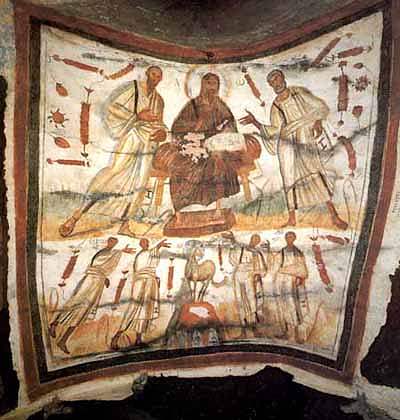
Top: Christ Between Peter and Paul, 4th century; Catacomb of Saints Marcellinus and Peter on the Via Labicana. "Christ with the book of the Gospels is seated between Peter and Paul. Below, the Lamb is standing in the centre on a hill, from which flow out the four symbolic rivers of Scripture. To the sides are the most venerated Martyrs, with their names: Gorgonius, Peter, Marcellinus, Tiburtius, all acclaiming the Lamb" (Christian Catacombs of Rome).

Middle: The Battle of Milvian Bridge, by Giulio Romano. From the Vatican City, Apostolic Palace.

Bottom: A coin of Constantine (c.337) showing a depiction, and on the reverse his labarum with the "Chi-Rho" symbol ☧ spearing a serpent.

Friday, February 10, 2012

Church and the Word


"The community is confronted and created by the Word of God. It is the communion of the saints because it is the gathering of the faithful [believing]. As such it is the confederation of witnesses, who may and must speak because they believe.

The community does not speak with words alone. It speaks by the very fact of its existence in the world; by its characteristic attitude to world problems; and moreover and especially, by its silent service to all the handicapped, weak and needy in the world. It speaks, finally, by the simple fact that it prays for the world.

The community does all this because this is the purpose of its summons [into existence] by the Word of God. It cannot avoid doing these things, since it believes." - Karl Barth, Evangelical Theology

Wednesday, January 25, 2012

Sober Words


"The English evangelicals who arranged for Richard Johnson to be chaplain to the first fleet had envisaged the distant new settlement as a place from which the Christian gospel would emanate. Such a thought was hardly likely to have occupied the attention of the first settlers with the exception, perhaps of Johnson himself. It was no doubt far from the mind of the Christians among the convicts, transported across the world against their will.

Yet, however unwittingly, however imperfectly, however inadequately, they did carry the knowledge of Christ to these shores. But the Christian settlers were few and their light was feeble. It is one of the great tragedies of the recent history if Australia that true Christianity was for so long so very difficult to discern in the life of this outpost of a distant nation which called itself Christan." - John Harris, One Blood.

HGP Relfections II

I recently completed a ministry traineeship at Sydney University with the EU Grads Fund and the Sydney University Evangelical Union. Over the next couple of days I'll be posting some of my reflections on the past two years.

Love the Church

"And he put all things under his feet and gave him as head over all things to the church..."

Over dinner at a conference I recently attended I heard a theological college graduand explain his decision to head into full time student ministry in 2012. He said he wanted to be involved in a ministry where he could pastor people, teach the bible and especially see people transformed by the Spirit of Christ and grow in their faith. And as far as he could see, there was no opportunity at all for this to happen in church-based ministry. Hence his move into student ministry.

It was a conversation that made me quite sad. If Ephesians one is right and the church really is the Jesus' body, than the church is something to be loved, and not despised. Jesus is the head, the church is his body, made up of his people, and so you love his church. And I don't just mean your local congregation you meet with on Sunday. I'm talking about the one true holy catholic and apostolic church, the church that God works through to make his wisdom known to the world (Ephesians 3.1-10), and the church that Jesus died for (Ephesians 5).

One of my peculiarities is that I've spent the past five years working parachurch organizations: three years with CMS and two years with the EU Grads Fund/Sydney University Evangelical Union. During my traineeship I've had time to reflect on both organizations and something that has impressed me about both organizations is that they know who they are. They understand that they are not churches, but as parachurch groups they exist to serve the church. Not every parachurch organization remembers this.

For a long time now I've been impressed by how the SUEU and the EUGF have sought to be a blessing to the church. The students in the EU are exhorted and encouraged to not only belong to, but to also thoughtfully serve their local church. The training they receive as students will hopefully equip them to serve not only during their time at uni, but also for the rest of their lives. And vision of the EUGF is to see hundreds and thousands of Sydney Uni graduates flood the church ready to serve wherever they find themselves. It's all about helping the church be the church.

Love the church, because it's Jesus church.

Wednesday, January 18, 2012

HGP Reflections

I recently completed a ministry traineeship at Sydney University with the EU Grads Fund and the Sydney University Evangelical Union. Over the next couple of days I'll be posting some of my reflections on the past two years.

Jesus is Building his Church

"...I will build my church, and the gates of hades shall not prevail against it."

Jesus promises to build his church. And he does - in two ways. Sometimes it is like the mustard seed in Mark 4. This tiny, most insignificant of seeds, grows into a tree that is so large that there is room for all the birds of the air to nest in its branches (a reference back to Jeremiah and Ezekiel for the Gentiles coming to nest in Israel). Jesus grows his church as more and more people are brought from death to life. And praise be to God, during my two years we saw over 40 university students put their faith in the risen and reigning Lord Jesus.

Jesus builds his church in both size and breadth. He also grows his church in depth. His church grows as people understand him more and more and live out the implications of knowing him. One of the joys of my two years at Sydney University was being apart if people's lives and helping them in submitting every aspect of their life under the Lordship of Jesus Christ. This may have been in helping students develop a "Biblical worldview" and be shaped by a Christian mind. This sometimes looked like helping students think through how the should think or feel about different things. And sometimes this looked like helping students repent of various deeds and take a different course of action. And though it all people were growing in their faith and conviction.

Jesus is building his church. He's on for church growth; and we should be too. Not even death will overcome his church. Jesus builds his church.

Monday, October 10, 2011

A Sign of God's Purpose

An excerpt from a most excellent sermon Archbishop Rowan Williams gave on Sunday in Harare, Zimbawe. Worth checking out:
"This Eucharist is the sign of God's purpose for all of us; it is a feast in which all are fed with Christ's new life, in which there is no distinction of race, tribe or party. In this community there can be no place for violence or for retaliation: we stand together, sinners in need of grace, proclaiming to the world that there is room at God's table for all people equally. What the Church has to say to the society around it, whether here or in Britain, is not to advance a political programme but to point to the fact of this new creation, this fellowship of justice and joy, this universal feast... The message we want to send from this Eucharistic celebration is that we do not have to live like that – in terror, in bloodshed. God has given us another way. He has opened a door of possibility that no-one can shut. He has announced that he will welcome all to the marriage feast of his Son – and so we see that all, even our bitterest enemies, still have a place in his peace if they will only turn and be saved. Did you hear what St Paul said in today's epistle? 'Fill your minds with those things that are good and that deserve praise: things that are noble, right, pure, lovely and honourable.' We need to feed ourselves and most especially to feed our young people with such things, to hold before us that great new possibility opened up by God for our minds to be transformed, to be excited not by the false thrills of violence and bloody conflict, by the overheated language of party conflict, but by the hope of joy and reconciliation." - Rowan Williams

A Rant: The Homogeneous Unit Principle

A rant placed here mainly for my own benefit:

Like attracts like, right? So if you are wanting to reach Transylvanian lumberjacks with the gospel, the most effective way to do it is to start a church for Transylvanian lumberjacks. After all, there are plenty of parachurch organisations that operate on this principle and they seem to have a fruitful ministry in reaching their particular group. So this ministry tactic is naturally transferable to churches?

No! In this instance we can not allow ourselves to be guided by pragmatism. This is a danger we must be on our guard against because it is a denial of the gospel. The church is the place that welcomes everyone: Jew and Greek, slave and free, male and female, the rich, the socially excluded, even the Transylvanian lumberjack. But the vision of the New Testament is that they are welcomed into God's church together:

"May the God of endurance and encouragement grant you to live in such harmony with one another, in accord with Christ Jesus, that together you may with one voice glorify the God and Father of our Lord Jesus Christ. Therefore welcome one another as Christ has welcomed you, for the glory of God. For I tell you that Christ became a servant to the circumcised to show God's truthfulness, in order to confirm the promises given to the patriarchs, and in order that the Gentiles might glorify God for his mercy. As it is written, 'Therefore I will praise you among the Gentiles, and sing to your name.'" Romans 15. 5-9

And again:

"This mystery is that the Gentiles are fellow heirs, members of the same body, and partakers of the promise in Christ Jesus through the gospel." Ephesians 3.6

As the church proclaims Jesus, the Holy Spirit brings different types of people together to form the church, God's new humanity (cf. Ephesians 2.11 ff.). Churches modelled on the homogenous unit principle deny this reality. And yet God uses this reality to declare to the world the wisdom of his plan to unite all things - even Jews and Gentiles - under Christ (Eph.3.10). It is through this that God ends hostility and brings peace to his creation.

Churches modeled on the homogenous unit principle reinforce to the world the exclusions and segmentations the world has created. We are in danger of denying the power of God to bring peace to the world.

Friday, July 15, 2011

A Clear and Present Faith

The old man looked the missionary in the eye: “You keep telling us about how sinful we are and how we need to change, but no one ever says this to the white people who steal our land, our wives and our daughters. No one says this to the men who are killing us..."

I’ve been on holidays for the past fortnight, which has given me the opportunity to read One Blood: John Harris’ seminal work on the history between Indigenous Australians and Christianity. Even twenty years after publication, this is still a magnificent book. I’m not finished yet, but already there has already been a lot to give thanks for, as well as a lot of stories that have made me want to weep and pray for Jesus’ return.

Here is Harris’ assessment of the first 100 years of Christian witness in Australia:
  1. The missionaries often confused conversion to European civilisation with conversion to the gospel of Jesus Christ. They attempted to conform Indigenous Australians to a life of European-style peasant farming and other symbols of European civilisation. This made them slow to recognise signs of genuine regeneration and maturity.
  2. The rhetoric of the Europeans and the Colonial Government made it difficult to distinguish Christianity from the culture around it. It was hard for Indigenous Australians to discern the Christianity preached by the missionaries in the lives of the Europeans who brought death, disease, dispossession, prostitution and alcoholism to their land.
  3. The church forgot to preach the whole gospel. They were very strong on preaching sin and judgment to a people seen by the wider colonial society to be savage and barbaric. But it was rarely accompanied by the hope the gospel of Jesus Christ brings. After the shock being disposed from the land and seeing their culture break down under the European invasion, this message of hope and justice may have been what they needed to hear. It was actually when missionaries in Victoria started to preach the whole gospel that they saw fruit from their labour.
  4. These were accompanied with a lack of interest for Christian work amongst Indigenous Australians that swept through the wider church in Australia and Europe.
The church also played a positive role during this time. Harris points out that it was almost exclusively only the Christians in colonial society who saw Indigenous Australians as humans. Harris recounts some moving testimonies from some Aboriginals in eastern Victoria who said that without the church missions, their people wouldn’t exist today. But overall this all contributes to tragedy of Australia since 1788.

Reading One Blood has reminded me of the need for the church to stand out from its culture and be distinguished and shaped by the gospel of Jesus. Harris writes:
“It is one of the tragedies of the recent history of Australia that true Christianity was for so long so very difficult to discern in the life of this outpost of a distant nation which called itself Christian.”
This reminded me of a quote from Tim Foster that I’ve used before on hebel. I heard it again a few days before I started reading One Blood. Reflecting on the challenge of the Sermon on the Mount for the church, Foster argues:
"The expression of these values (the Sermon on the Mount) by the church is essential to its successful engagement in mission. Just as Torah-obedience was essential for the success of Israel’s mission to the nations, ‘the church’s oddness is essential to its faithfulness.’ The logic of the Sermon on the Mount is that the disciples serve the world by demonstrating that a new society is breaking-in which offers an alternative communal existence shaped by the character and purposes of God.

Because the world is so deeply immerse in the prevailing order "the only way for the world to know it is being redeemed is for the church to point to the Redeemer by being a redeemed people." The anticipated outcome is that others will ‘See your good deeds and praise your Father in heaven’ (Matt.5.16). Just as apostasy destroyed Israel’s capacity to mission, accommodation to the values of them world poses the greatest of dangers to the church, diluting its capacity to bear witness to radical nature of the new order." - Tim Foster, A Vision for the Mission and the Message of the Australian Church After Christendom.
The challenge, now as always, is for the church to be the church. I hope to post again soon with some stories from One Blood.

Tuesday, July 12, 2011

20 Centuries in 20 Posts Part IV

The Unimpressive Church
Intro | Part I
| Part II | Part III | Appendix

The student of ecclesiastical history may often be left with the impression that for three hundred years the story of the church was solely the story of leaders and scholars. The kind of men you’d find being represented in an icon; men like Polycarp and Irenaeus, or Tertullian and Origen. It is easy to tell the story of the leaders of the church. They were the men (for they were mostly men) who took the gospel to new parts of the world, who continued to freshly articulate the significance of Jesus to life and thought, who defended the faith, who taught God’s word, and who would sometimes lose their lives for Jesus’ sake. They were impressive people, and it’s easy to think that by understanding their story you have understood the whole.

Yet that does not give us the full picture. By the third century (200-300AD) there were hundreds of thousands and even millions of Christians spread throughout the Roman world, the Persian empire, in Armenia (the first official Christian state), Arabia, Ethiopia and India. And by focusing on the bishops and scholars can leave us with an all too grand picture of what the early church looked like (particularly when compared to more familiar church history).

The dominant feature of the early church is how utterly unimpressive it was. This might seem strange, given the rapid speed with which Christianity spread around the known world. But as the Apostle Paul reminded the Corinthian church: “not many of you were wise according to worldly standards, not many were powerful, not many were of noble birth”. The church was distinctively ordinary. Although there were Christians from all sections of society, a high proportion of Christians came from what we might call a humble background. And this made the church scandalously ordinary, as men AND women from every class and status would welcome one another. When its critics looked at the church, what they saw was the basest kinds of humans sordidly meeting together for their ‘love feasts’ (an early name for the Eucharist). You can feel this scandal in the writing of Celsus, a second century critic of the church who wrote that it is:
“...only foolish and low individuals, and persons devoid of perception, and slaves, and women, and children, of whom the teachers of the divine word wish to make converts”.
The church became contemptuously known for holding slaves and women in high regard. For this it was seen to be unravelling the very fabrics of society. Inside the church slaves could hold positions of leadership, i.e. deacons, presbyters; even outrageously leading their owners if they too were Christian. And in the Roman world as more and more people became to Christian, they abandoned the ancient gods – the very same gods who ensured the peace and prosperity of the empire. This is one reason why we see such a vitriolic reaction against Christians during the reign of Emperor Diocletian at the end of the third and into the fourth century.

Not only was Christianity unimpressive, it was also dangerously subversive to order and security of the world. But who were the early Christians?

It is no understatement to describe Christianity as an urban movement. The church was so heavily represented in the cities of the Mediterranean, that the word for people who lived in rural areas came to be used to describe anyone who was not a Christian. We know it today in English as pagan.

By the third century an increasing number of new Christians came from a non- Jewish background. It was not typically through the mass conversions we often imagine; people became Christian as their family and friends witnessed to them in both word and deed. New believers would be welcomed into the “family of believers” each year at Easter. They would continue to meet together each Sunday to celebrate the Lord’s Day. And excluded to the margins of society and under the threat of death, the church continued to live by its convictions. The second century Epistle to Diognetus described the early Christians in this way:
For the Christians are distinguished from other men neither by country, nor language, no the customs which they observe. For they neither inhabit cities of their own, nor employ a peculiar form of speech, nor lead a life which is marked out by any singularity... But inhabiting the Greek as well as barbarian cities, according as the lot of each of them has determined, and following the customs of the natives in respect to clothing, food, and the rest of their ordinary conduct, they display to us their wonderful and confessedly striking method of life. They dwell in their own countries, but simply as sojourners. As citizens, they share in all things with others, and yet endure all things as if foreigners. Every foreign land is to them as their native country, and every land of their birth as a land of strangers. They marry, as do all [others]; they beget children; but they do not destroy their offspring. They have a common table, but not a common bed. They are in the flesh, but they do not live after the flesh. They pass their days on earth, but they are citizens of heaven. They obey the prescribed laws, and at the same time surpass the laws by their lives... To sum up all in one word - what the soul is to the body, that are Christians in the world.
As unimpressive as the church was, there was something radically impressive about it as well. According to academics like Rodney Stark and David Bentley Hart, this has to do with the Christian concept of humanity. The church understood itself to be a new humanity. They were a family, the “brethren”, established by Jesus to welcome everyone. So that is what they did. In the words of Hart, the church gave a face to the faceless, welcoming those who technically had no identity in society. Slaves were welcomed and able to participate in the church. Furthermore, the church welcomed and valued women. Throughout the empire, there were a higher proportion of men to women. The affects of female infanticide and abortions that often resulted in the death of the women created this gender imbalance. However, it appears that there was an opposite gender imbalance in the church, with more women than man. The church was the sole community in the empire that condemned these practices and gave women the dignity due to them being created in God’s image.

The church was also known for acting on this conviction outside the Christian community, caring for the poor and sick and the well being of their cities. They became so well know for it that the last “pagan” Emperor Julian, in the fourth century, lamented that:
“These impious Galileans [Christians] not only feed their own poor, but ours also; welcoming them into their agapae [love feasts], they attract them, as children are attracted, with cakes.”
The church proclaimed the gospel of Jesus in both word and deed. This was particularly seen in two epidemics between 250AD and 350AD that devastated the eastern half of the empire. 10,000’s of people died, and whilst the rich and elite “pagans” fled the cities, it was the Christians who stayed and cared for the sick and dying:
“[During the great epidemic] most of our brother Christians showed unbounded love and loyalty, never sparing themselves... Heedless of danger, they took charge of the sick, attending to their every need and ministering to them in Christ... Many, in nursing the curing others, transferred their death to themselves and died in their stead... The [pagans] behaved in the very opposite way. At the first onset of the disease, they pushed the sufferers away and fled even from their dearest, throwing them into the roads before they were dead." - Dionysius, Bishop of Alexandria , circa 260AD.
These were the early Christians. They lived out the gospel in their lives and in their actions. And unlike a lot of Christians today, they didn’t have any hang-ups about what proportion the needed to that they in. They just did it; even if it cost them their lives. In the face of terrible persecution (which we haven’t covered in this post), social exclusion, and death, they lived out the gospel, welcoming everyone who claimed allegiance to Jesus. This was the terribly ordinary, unimpressive church. Not many of them were wise; not many of them were powerful. “But God chose what is foolish in the world to shame the wise; God chose what is weak in the world to shame the strong” (1 Cor 1.27).


For Further Reading:
  • David Bentley Hart, Atheist Delusions: The Christian Revolution and Its Fashionable Enemies, 2009. Winner of the prestigious Michael Ramsay Prize for 2011, Atheist Delusions offers great insight on the early church and the world around it.
  • Rodney Stark, The Rise of Christianity, 1997.
  • Rodney Stark, Cities of God, 2006.
  • Henry Chadwick, The Penguin History of the Church: The Early Church, (revised edition), 1993.

Sunday, July 10, 2011

20 Centuries in 20 Posts: Appendix

Sorry it's been a while since there was any activity on this blog. I was at the EU's Annual Conference, and then Alison and I were on holidays down the south coast. The next post in the church history series: 20 Centuries in 20 Posts will be posted later this week. But until then you might like to check out this video that was made for annual conference by Ben Duffin; Church History in Five Minutes:

Monday, June 20, 2011

20 Centuries in 20 Posts Part III

Making Sense of a Hostile World
Intro | Part I | Part II

“Jesus had fulfilled Israel’s vocation to be a light to the nations; now the nations must be brought into allegiance to him. It was time for the nations to join in God’s promises Abraham.”
In the previous post in this series, we briefly sketched out why the Jewish worldview is important for understanding the early church. It made sense of how the early church understood Jesus (the risen promised King of Israel), and why they launched on an ambitious and frantic mission to proclaim his lordship throughout the Roman Empire, and even beyond imperial borders.

This all made sense with a Jewish worldview. But as the end of the first century approached and the first generation of church leaders died, would we see the worldview of the church begin to morph away from the Jewish-ness of the church’s foundation? This is a question commonly poised in church history – and the assumed answer is often a definitive yes. After all there were more and more gentile converts coming into the church; and in 136 AD Roman armies crushed the last great Jewish rebellion against the Empire (the Bar Kokhba revolt AD 132-136), thereby drawing to a close the world of second temple Judaism. The second century church would belong to the gentiles.

Except that I’m not sure that is quite what happened. From the available evidence it seems as though the church’s mission was still focused on both Jews and Gentiles. And in fact large numbers of Jewish converts were still being well into the third century. Furthermore, as the church dealt with several crises during the second century, it did so in a thoroughly Jewish way. Don’t misunderstand me: the church’s worldview was thoroughly shaped on and around Jesus Christ; it was a distinguishably Christian worldview when contrasted to the rest of Judaism. But it was still Jewish: God was the creator of the world. In response to evil he called Abraham and made promises about his descendants (Israel). Jesus was the climax of this story. And it was this story that enabled the church to negotiate an aggressive and often hostile world around them.

As the apostles died, leadership of the church for the next two generations passed to a group that we know as the apostolic fathers. These men were active from the end of the first century through to the around 150AD, and had been taught and served alongside the apostles. We have the writings of the several of the apostolic fathers, such as Clement of Rome (who wrote an epistle to the Corinthian Church around 90AD), Polycarp of Smyrna (who was martyred in155AD) and Ignatius of Antioch (who wrote several letters to churches in Asia and the church leader Polycarp as he travelled from Antioch to Rome to be martyred in 110AD). There are other apostolic fathers such as Papias, who wrote quite extensively but, except for a few fragments that have survived in other works, are now lost to us. And we have some anonymous documents such as the Didache and the Shepherd of Hermas.

Following the apostolic fathers the middle of the second century was dominated by a group of men we know as the apologists such as Tertullian (the first Christian to write extensively in Latin) and Justin Martyr who wrote quite extensively in defence of Christianity against “pagan” elites”, and often write appeals to the emperors requesting an end to persecution. By the end of the century the church is being lead by a diverse range of bishops and leaders i.e. Irenaeus, Melito of Sardis, and Clement of Alexandria (who taught in the church’s first Catechetical school and started to integrate Greek philosophy with Christianity). Throughout the second century Christianity was focused on the urban areas of Palestine, Syria, Egypt, Asia and the surrounding provinces (Turkey), Greece, Italy, and Mesopotamia. The church had also started to grow throughout Carthage/North Africa and Gaul.


Martyrdom and the Gnostics
Although there had been sporadic localised persecution throughout the first century, by 125AD it became Imperial policy to punish Christians. Largely focused on the church’s leadership, the persecution of the second century was still quite sporadic compared to the large scale martyrdom's of the late third and early fourth centuries. Yet the example of second century martyrs was still so powerful for the church in strengthening the resolve of the flock and winning new believers that Tertullian could write:
“The more you mow us down, the more we grow. The blood of the martyrs is the seed of the Church.”
The Christians were prepared to die for their faith. Ignatius of Antioch even wrote ahead to the Roman Church to ask them not to intervene:
“I am writing to all the Churches and I enjoin all that I am dying willingly for God's sake, if only you do not prevent it. I beg you; do not do me an untimely kindness. Allow me to be eaten by the beasts, which are my way of reaching to God. I am God's wheat, and I am to be ground by the teeth of wild beasts, so that I may become the pure bread of Christ.”
The response by the church to persecution and death made complete sense within a Jewish worldview. The believed that God had been a good world, a world which would, in spite of sin and evil, be restored and freed from these things. The believed that God had power over death, and specifically that they would be given resurrection bodies just like Jesus. God had the power to restore their bodies and free it from sin, even if they were devoured by lions or reduced to ashes. Like the Jewish martyrs in 2 Maccabees 7, the second century martyrs responded to an evil empire by clinging to the promise of resurrection.

What makes this most interesting for the study of early church history is that during the second century Gnosticism arose and began to trouble the church. So around 180AD Irenaeus wrote his famous five volume Adversus Haereses (Against Heresies or On the Detection and Overthrow of Knowledge Falsely So Called) which described and contrasted Gnostic belief against apostolic Christian belief, warning believers of the false teachings. Not a monochrome belief, Gnosticism was “a syncretistic, trans-religious theosophy that drew from Christian, Jewish, Greek, Syrian, Mesopotamian, Egyptian and Persian sources, often simultaneously” (David B. Hart). In contrast to Christianity, it commonly held that the created matter was a result of a fall within the divine world, the result of a lesser being that God. And whereas Christianity believed that the world belong to Jesus, who would restore the world at the resurrection of the dead, Gnosticism taught a salvation/escape from the world for a select few “spiritual” people.

There has been a movement over the past 100 years to portray the Gnostics as the genuine Christians persecuted by the empire and vilified by the catholic church. And yet surprisingly it is hard to find any evidence for this. Perhaps though it is not all that surprising, as NT Wright explains: "Which Roman emperor would persecute anyone for reading the Gospel of Thomas [since it so closely reflected Greek thinking]?....It should be clear that the talk about a spiritual ‘resurrection’ in the sense used by [the Gnostic writings] could not be anything other than a late, drastic modification of Christian language." It was the radical doctrine of the resurrection that brought the wrath of the Roman Empire down not on Gnosticism, but on Christianity.

Authority
As the life of Jesus and the Apostles faded out of the church’s living memory, it was confronted with a new issue of authority. From around 100AD the Apostolic Fathers Clement and Ignatius began to empahaise the important role of the local bishop as a source of unity and order:
"Wherever the bishop appears, there let the people be; as wherever Jesus Christ is, there is the Catholic Church." Ignatius, Letter to the Smyrnaeans.
However by the middle of the scond century the church had begun to wrestle with the question of scriptural authority. The Apostles had left the church a collection of writings that bore their authority – gospels, epistles and revelations that were written by the apostles or people closely associated with the apostles. But there was no uniform agreement on what works actually constituted the apostolic witness. The works of Clement and Ignatius reference or allude to almost all the books of the New Testament as we now have it, as well as the Old Testament, but there was no actual list. And not every church had access to this apostolic collection.

What spurred the church into action was the Pontian Bishop Marcion of Sinope (c. 85-160AD), who made his way from Pontus to Rome in 142AD. It was at this point that he caused a massive disturbance in the Roman church, publishing the first Christian Canon. Marcion refused to accept the Old Testament as scripture, arguing that its Jewish-ness was incompatible with the teaching of Jesus. He understood that God the Father of Christ and the God of Israel were different, which lead him to publish a truncated New Testament canon. Marcion’s canon was composed exclusively of just Luke (the Evangelikon) and ten of Paul’s letters (the Apostolikon), both of which were purged of references of Jesus' relationship with Israel.

Marcion was excommunicated from the Roman church in 144AD. The church’s response was to define the canon. The process began with the affirmation of the fourfold gospel canon of Matthew, Mark, Luke and John (the Tetramorph); gospels received from the Apostles or their close associates. The other gospel which emerged later, such as Thomas, differed from the Tetramorph in two important ways. Firstly, they were not Jewish and disdained a connection to Israel. Secondly, they were not gospels; rather than being a narrative of events they were for the most part a collection of sayings. Again the criterion for the epistles was evidence of apostolic association (the letter had to authored by an apostle or shown to have been written by a close colleague – which led to the exclusion of works such as The Shepherd of Hermas and the Didache which had sometimes been considered the equivalent of scripture). The process of clarifying the canon continued during the later half of the second century; the earliest evidence we have of this is a damaged and thus incomplete, bad Latin translation of the Muratorian Canon from the late 200’s:
“The third book of the Gospel is that according to Luke… The fourth… is that of John… the acts of all the apostles… As for the Epistles of Paul… To the Corinthians first, to the Ephesians second, to the Philippians third, to the Colossians fourth, to the Galatians fifth, to the Thessalonians sixth, to the Romans seventh… once more to the Corinthians and to the Thessalonians… one to Philemon, one to Titus, and two to Timothy… to the Laodiceans, [and] another to the Alexandrians, [both] forged in Paul's name to [further] the heresy of Marcion… the epistle of Jude and two of the above-mentioned (or, bearing the name of) John… and [the book of] Wisdom… We receive only the apocalypses of John and Peter, though some of us are not willing that the latter be read in church. But Hermas wrote the Shepherd very recently… And therefore it ought indeed to be read; but it cannot be read publicly to the people in church.”
The Canon was formalised in the third and fourth centuries at various Synods and Ecumenical Councils around the Mediterranean world. Yet what these councils did was to formalise a canon that was already largely agreed upon and in place by 200AD. Marcion would not be the first time that heresy would push the church towards clarity.

Reflections
As we’ve seen, the first and second century churches life and praxis was grounded in the story of Israel and Jesus. 20 Centuries later, is this the case for you and your church?

I always find the writing of the apostolic fathers and second century church to be encouraging and uplifting. Take for example Melito of Sardis homily on the Passover, written around 160AD:
"This is the one who like a lamb was carried off and like a sheep was sacrificed. He redeemed us from slavery to the cosmos as from the land of Egypt and loosed us from slavery to the devil as from the hand of Pharaoh. And he sealed us from our souls with his own Spirit and the lambs of our body with the his own blood. This is the one who covered death with his shame and made a mourner of the devil, just as Moses did Pharaoh. This is the one who struck lawlessness a blow and made injustice childless, as Moses did Egypt. This is the one who rescued us from slavery into liberty, from darkness into light, from death into life, from a tyranny into an eternal kingdom (and made us a new priesthood and a peculiar, eternal people)."
I can think of nothing better than to recommend that you acquaint with our brothers and sisters from this time by reading what they wrote themselves. Most of their writings are available on line, and I’ll mention them under the recommend reading below.

Recommend Reading
  • Early Christian Writings, translated by Maxwell Stamforth, edited Betty Radice, Penguin Books, 1968.
  • The Christological Controversy, translated and edited by Richard A. Norris, Fortress Press, 1980.
  • Jesus and the Eyewitnesses, Richard Bauckham, Eerdmans, 2008.
  • Judas and the Gospel of Jesus, NT Wright, SPCK, 2006.
  • The Early Church – Revised Edition, Henry Chadwick, Penguin Books, 1993.

Wednesday, May 11, 2011

20 Centuries in 20 Posts Part II

Coming to Terms With Jesus
Intro | Part I

How do you explain the rapid spread of Christianity? Within the world of academia, litres of ink are spent trying to explain, understand and justify this phenomenon. In articulating the enormity of what took place, Tom Wright writes:
“The single most striking thing about early Christianity is the speed of its growth. In A.D. 25 there is no such thing as Christianity; merely a young hermit in the Judean wilderness, and his somewhat younger cousin who dreams dreams and sees visions. By A.D. 125 the Roman emperor has established an official policy in relation to the punishment of Christians…”
Christianity exploded into the Greco-Roman world. What had started in Jerusalem had, within 100 years spread as far as southern France, Ethiopia and possibly even India. This is quite remarkable, given what we said about Jesus in the previous post. Jesus saw himself as the pinnacle of God and Israel’s story, limiting his ministry almost exclusively to Israel. What he offered, and what he embodied, was a new way forward for Israel. So how did we end up with the church? Although the church’s praxis in 125AD bore some continuity with Israel, the church’s shape and life was also looked quite different from Israel.

Various reasons have been suggested to explain this. For instance, was this the work of the Apostle Paul, distilling Jesus’ call to Israel into a more palatable message for non-Jews? Or perhaps the fourth century ‘pagan’ Roman Emperor Julian was right when he argued the church grew because of their love and hospitality:
“These impious Galileans not only feed their own poor, but ours also; welcoming them into their agape, they attract them, as children are attracted, with cakes.”
There’s some truth in this, and we’ll explore Julian’s raison d’être for the growth of the church more in a future post. However, I want to suggest that the answer lies in a major shift in the worldview of the Apostles and the early church. They came from a Jewish background, and held a worldview consistent with first century Judaism. Yet for some reason their worldview had totally changed. I want to suggest that the resurrection of Jesus was a complete shift in the first century Jewish worldview.

That the early Christians believed in the resurrection is unsurprising – it was part of the standard Jewish worldview. However, what stood at the periphery of the Jewish worldview was now front and centre of the Christian hope. The conviction of the early church was that the resurrection had happened, not at the end of history as the Jewish worldview believed, but now in the middle of history. The resurrection of Jesus changed everything. We can trace what this meant for the early church in Paul’s letter to the Roman church (see Romans 1.1-6). The resurrection of Jesus declared that he was the Son of God, the Messiah; the true descendant of David and hence Israel’s true King.

The resurrection showed that Jesus was Israel-in-person, Israel’s representative, the one in whom Israel’s destiny had reached its climax. He was Israel’s King – raised from the dead. And if he was Israel’s King, then the Psalms and the prophets insisted he was also the world’s true Lord:
“Jesus Christ our Lord, through whom we have received grace and apostleship to bring about the obedience of faith for the sake of his name among all the nations.” Romans 1.5-6
This is why Christianity developed new practices and symbols apart from Judaism. The early Christians understood that Israel’s story had come to fruition in Jesus. The old symbols of God’s people would have to find new meaning in him. So the church started meeting on Sunday’s to celebrate his resurrection. They broke bread and drank wine together to commemorate his death and remind each other that they belonged together in him. The prayed and sang to him, because the story of Israel and the world was now focused around Jesus. And they were now on a mission. Jesus had fulfilled Israel’s vocation to be a light to the nations; now the nations must be brought into allegiance to him. It was time for the nations to join in God’s promises Abraham.
“For I tell you that Christ became a servant to the circumcised to show God's truthfulness, in order to confirm the promises given to the patriarchs, and in order that the Gentiles might glorify God for his mercy.” Romans 15.8-9
This raised questions about the continuing connection between the church and Israel, and the place of the law and Israel’s symbols in the life of the church. The early Christians only started to answer this question as they came to terms with who Jesus is and what that means for the world. The church grew first and fore mostly because they understood themselves to be on mission. Jesus has been raised, and he is the King, of both Jews and Gentiles.

________
I feel that it’s all too easy for us to underestimate how big an issue this was for the early church. Yet this was the major issue in the first century church, that the gentiles could be “fellow heirs, members of the same body, and partakers of the promise in Christ Jesus”. We do ourselves a disservice when we screen this issue out of our reading of the New Testament.

My other reflection on this post is that mission and theology need to be more closely held together than is often case today. From what I’ve seen, the two ‘disciplines’ are often at arm’s length of each other. Yet, in one sense, it was because of theological reflection that the early church launched into mission. I wonder what would happen if our missionaries, church planters, evangelists etc. spent more time talking to theologians, and vice versa because the theological reflection in Acts often happened after the Holy Spirit took the initiative to bring gentiles to Christ.

For Further Reading:
  • NT Wright: The Resurrection of the Son of God, 2003. RSG is a tour de force. Read this if you want to understand more fully how the resurrection of Jesus changed the worldview of the Apostles and the early church. If 800+ pages isn't your cup of tea, try Wright's Surprised by Hope, 2008.
  • James Dunn, Jesus Remembered, 2003 and Beginning from Jerusalem, 2008. I've only just managed to look through these. Massive and magnificent!
  • Rodney Stark, The Rise of Christianity, 1997. Stark isn't a historian by training, and is a little bit sketchy when he moves away from history. Nevertheless, this is a important book. Helpful to have a sociologist's perspective.

Saturday, April 30, 2011

20 Centuries in 20 Posts Part I

20 Centuries in 20 Posts Part I: The Genesis of Church History

Church history matters because the Church matters. It was with such a grandiose statement that I launched the ambitious 20 centuries in 20 posts project. History has always played an important role in the Christian story. From the writers of the Gospel narratives and Acts, through Eusebius and Bede down to today, reflecting on and understanding the past has played an important role in Christianity. And this is because of a distinctly Christian understanding of the past. Church history matters because history itself matters. Central to the Christian worldview is not a timeless, sapiential philosophy; what is central is the conviction that God acts and has made himself known in our space/time universe. And God has ultimately does this in Jesus Christ.

The Christian story begins starts with the in the life, death and resurrection of Jesus. This is where most church histories will start their narrative. Yet there is something wrong about this, both historically and theologically. Jesus did not just walk in out of nowhere and start proclaiming the Kingdom of God (Mark 1.1-15); he had a context, and saw himself as part of the long story of God’s dealings with Israel. I think that liberal theologian Marcus Borg is on to something when he says:
“We commonly think of Jesus as the founder of Christianity. But strictly speaking, this is not historically true. Instead, his concern was the renewal of Israel.” - Marcus Borg, Jesus: A New Vision, p. 125
To do church history well, I suggest that we need to integrate Israel into our narrative, as some historians have started to do. When we do this, it helps us as Christians to read the Old Testament and what the New Testament says about God’s covenant. It helps you understand the first 200 years of Christianity – which was largely a Jewish movement for the first two centuries of its existence – and in particular the context and issues the apostles write about in the New Testament. But most importantly, grounding Christian history in Israel’s history helps we make sense of Jesus, and what he was doing. He saw himself as the climax of a story that involved Adam and Eve, Abraham and the patriarchs, Moses, Joshua, David/Solomon and the kings down to Zedekiah, and the aftermath of exile. It’s by understanding God’s history with Israel and by plotting Jesus on the map of his own particular context – Second Temple Judaism – that we can understand how Jesus interpreted his mission. Briefly, this is what his mission looked like:
  1. Jesus focused exclusively on Israel: “I was sent only to the lost sheep of the house of Israel” Matt 15.24, and “Go nowhere among the Gentiles and enter no town of the Samaritans, but go rather to the lost sheep of the house of Israel" Matt 10.5. Except for three exceptions, Jesus ministered only to Israelites, because his mission was to restore the lost in Israel and renew the nation.

  2. Jesus announced the nearness of the kingdom: “The time is fulfilled, and the kingdom of God has come near; repent and believe in the gospel!” Mark 1.15. The Kingdom of God is where God's climatic authority is known and done on earth as in heaven (see Isaiah 40).

  3. Jesus performed acts of power: "But if it is by the Spirit of God that I cast out demons, then the kingdom of God has come upon you" Matt 12.28. Jesus enforced the Kingdom through his miracles. He taught that the Roman occupiers weren't Israel’s real enemy, but the spiritual forces that had enslaved the nation in darkness and sin (see Mark 3.23-28).

  4. Jesus called and sent twelve: “You are those who have stayed with me in my trials, and I assign to you, as my Father assigned to me, a kingdom, that we may eat and drink at my table in my kingdom and sit on thrones judging the twelve tribes of Israel" Luke 22.28-30. Jesus gathers twelve Apostles, a parallel of the twelve tribes of Israel. These twelve are connected to Jesus, and through him the renewal of Israel that they longed for would happen.

  5. Jesus ate with sinners and outcasts: "And the scribes of the Pharisees, when they saw that he was eating with sinners and tax collectors, said to his disciples, 'Why does he eat with tax collectors and sinners?' And when Jesus heard it, he said to them, 'Those who are well have no need of a physician, but those who are sick. I came not to call the righteous, but sinners.'" (Mark 2.16-17). Jesus welcomed the lost of Israel, those generally despised and referred to as "sinners", whilst exposing the hypocrisy of Israel’s leaders.

  6. Jesus announced God's grace (especially for the destitute): “Blessed are we who are poor, for theirs is the kingdom of God." (Luke 6.20).

  7. Jesus taught a new way of living as God's people: “But love your enemies, and do good, and lend, expecting nothing in return, and your reward will be great, and you will be sons of the Most High, for he is kind to the ungrateful and the evil. Be merciful, even as your Father is merciful” Luke 6.35-36).
Jesus saw himself as the pinnacle of God and Israel’s story. So what he offered, and what he embodied, was a new way forward for Israel; a profound movement of renewal of Israel in the light of the coming climax of God's dealing with his people. We need to understand this to understand Jesus. Without Israel there is no Jesus.


Church history matters only because history matters. At the heart of Christianity is history: that God promised a Middle Eastern shepherd that through him his family and indeed the whole world would be blessed. At the heart of Christianity is an event that is interpreted as fulfilling that promise: that Jesus, the Jewish King, was killed for the sins the people; that he was raised from the dead, and now reigns as the Lord over all, the first-born of the new creation. This is church history; this is the gospel.


For Further Reading:
  • Diarmaid MacCulloch, A History of Christianity, 2009. MacCulloch is an eminent church historian, and his epic book/BBC series helpfully locates the church's history in Israel's history.
  • NT Wright, Jesus and the Victory of God, 1996. Wright offers rigorous scholarship, reconstructing the worldview of Second Temple Judaism, making sense of Jesus' aims and self-understanding within that world. A great piece of historical scholarship. Simply put, this book changed my life.