"Theology has been the mediator of the primary literature of faith since antiquity. The writers of the psalms, the prophets, the Apostle Paul all interpret core belief--that God is One, the Creator of heaven and earth, and that he has made humankind in his image. Augustine, Chrysostom, Aquinas, Luther and Calvin each gave intellectual, social and artistic form to modes of Christian life which without them are hardly to be imagined. Lately the practice of this ancient tradition has receded into the academy and learned the idiom of specialization, leaving religion increasingly vulnerable to the charge, and the fact, of vacuousness." - Marilynne Robinson
Friday, December 31, 2010
The Mediator of Faith
Here Marilynne Robinson talks about the role of theology in forming peoples minds and lives.


Tuesday, December 28, 2010
Global Warming - What Global Warming?
Colder summers and winters disprove global warming right? Wrong, as Byron explains here. And this is why climate change in Europe is affecting your summer in Australia:
Thursday, December 23, 2010
Friday, December 17, 2010
The REAL Facebook World
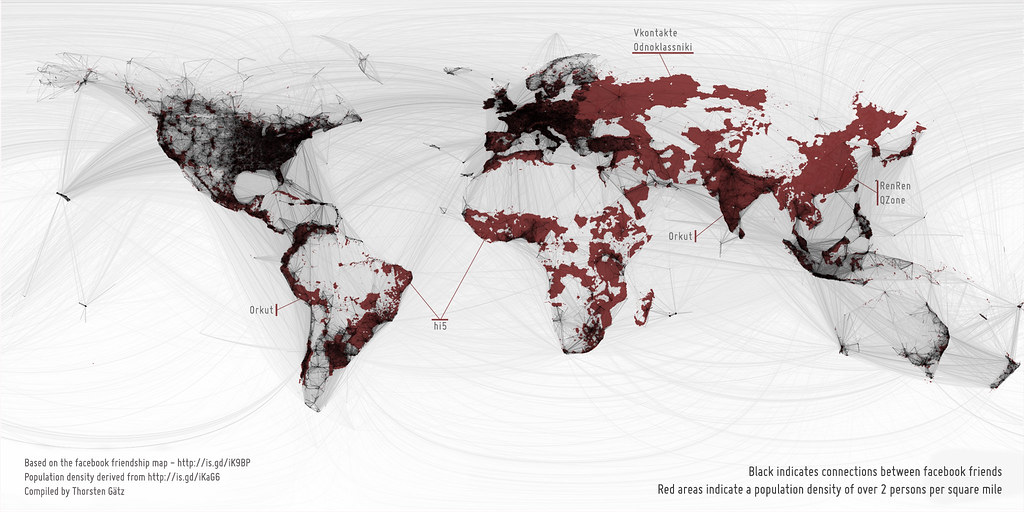
On Wednesday I posted a map showing the connections of Facebook friends around the world. Whilst facebook's coverage seemed quite extensive, there where lots of areas that weren't lit up. You might assume that there is no people in there - no Facebook no people right? I'm pretty sure Africa and Asia have substantial numbers of people. So here is another map that sets Facebook's spread in context. What you get is a view of where social networks other than Facebook like Orkut and RenRen lead the market:
 h/t Alison
 h/t Alison
Thursday, December 16, 2010
Advent: A Haiku
 This haiku was written by Richard Bauckham to complement an Advent Calendar. The sequence is that of the twenty-four biblical books in the Hebrew Bible. These verses are haiku in form (5-7-5 syllables), but not content.
Day 1 - Genesis
After paradise
not even Lot's wife looks back.
Memory turns round.
Day 2 - Exodus
The bones of Joseph
in their gilt sarcophagus
travel night and day.
Day 3 - Leviticus
If she is too poor
to afford a sheep, she may
offer two pigeons.
Day 4 - Numbers
Dawn in my distance,
the wise watchers will see him,
star of their searching.
Day 5 - Deuteronomy
Moses from Pisgah
overviews all. It is not
space but time he lacks.
Day 6 - Joshua
Going over Jordan
Joshua above all sees
that the ark goes first.
Day 7 - Judges
Said the trees to the
bramble, 'Come, be our ruler!'
'Wait!' said the mustard.
Day 8 - Samuel
Hannah, drunk as an
apostle at Pentecost,
magnifies the Lord.
Day 9 - Kings
She came with riddles.
His more than answers more than
took her breath away.
Day 10 - Isaiah
In the wilderness
a voice cries for centuries
seeking an echo.
Day 11 - Jeremiah
Rachel refuses
to be comforted - even
when we turn the page.
Day 12 - Ezekiel
In the end it is
all in the name of the city:
The Lord is there.
Day 13 - The Twelve Prophets
Then, as before, will
Bethlehem bear the shepherd
of the scattered sheep.
Day 14 - Psalms
If there were glory
only, praise like the last psalms,
would that be the end?
Day 15 - Proverbs
Too clever by half
are the foolish. The wise know
the folly of God
Day 16 - Job
God answered Job but
not his question. Maybe he
will do that again.
Day 17 - Song of Solomon
Yes, he will haste like
a gazelle. Nothing is more
impatient than love.
Day 18 - Ruth
Tough old Naomi
bounces a child on her knee -
her wild hope come home.
Day 19 - Lamentations
Jerusalem hurls
her desperate hopes against
God's forgetfulness.
Day 20 - Ecclesiastes
Whatever God does
and whoever else may be
who knows? The wise wait.
Day 21 - Esther
Probability
counts for nothing when Esther's
G-d is in the plot.
Day 22 - Daniel
Nebuchadnezzar
dreams of the doom of despots
and the wide world wakes.
Day 23 - Ezra-Nehemiah
After the exile
returnees did not look back
more than could be helped.
Day 24 - Chronicles
Adam, Seth, Enoch,
Noah, Abraham, David,
Zerubbabel ...
Wednesday, December 15, 2010

To The Nations

"Jesus told his apostles to disciple all the nations. The way his words are often translated, “to make disciples of all nations”, allows for a misconception to arise. It is the nations that are to be discipled, baptized and taught, not merely individuals out of the nations. The gospel will heal the nations and in the book of Revelation the nations shall walk in the light of the glory of God and bring their treasures to the heavenly Jerusalem (Rev 21:24, 26; 22:2). This glorious result of the exaltation of the Messiah had been prophesied in the Old Testament (Isa 11:10, 12; 25:7; 49:6, 7; 52:15). All the nations, that is the peoples and their cultures, are to be Christianized by the knowledge of the triune God. Christ’s commission to his followers is to baptize the nations, to bring them under his leadership, as their Lord and their teacher." - D B Knox, D.Broughton Knox Selected Works Volume II - Church and Ministry; ed. K. Birkett p.277-282. h/t Michael
Tuesday, December 14, 2010
History is Precedent and Permission
"...[L]acking curiosity and the habit of study and any general grasp of history, we have entered a period of nostalgia and reaction. We want the past back, though we have no idea what it was. Things do not go so well for us as they once did. We feel we have lost our way. Most of us know that religion was once very important to our national life, and believe, whether we ourselves are religious or not, that we were much the better for its influence. Many of us know that Calvinism was a very important tradition among us. Yet all we know about John Calvin was that he was an eighteenth-century Scotsman, a prude and obscurantist with a buckle on his hat, possibly a burner of witches, certainly the very spirit of capitalism. Our ignorant parody of history affirms our ignorant parody of religious or 'traditional' values. This matters, because history is precedent and permission, and in this important instance, as in many others, we have lost plain accuracy, not to speak of complexity, substance, and human inflection. We want to return to the past, and we have made our past a demonology and not a human narrative." - Marilynne Robinson, Marguerite de Navarre, The Death of Adam, p. 206.
Wednesday, December 01, 2010
At the Margins of Morality

"The Church exists today as resident aliens, an adventurous colony in a society of unbelief."
- Hauerwas & Willimon, Resident Aliens, 1989, p. 49.
"The church in the West may have to get used to the idea that its own centre in God, from which it goes out to others in proclamation and compassion, is actually a position of social and cultural marginality. This may improve its witness to the Christ who was himself usually also found at the margins." - Bauckham, Mission as Hermeneutic, 2010, p. 7.Chris recently blogged about Christianity being at the margins of society. As western society continues to sojourn further and further away from Christendom, the Church is decreasingly at the centre of society. The Church's social and political powerless position not only mirrors the first three centuries of Christian history; it also may help the Church be faithful to it's life and mission.
This is not an easy process for the Church. Not that it should be - we do follow a crucified Messiah. But of interest to me recently has been the way public perception has shifted when it comes to the Church and morality. Whereas once the Church was seen as a moral guardian of society (and it's members were mock for being wowsers and holy), it is now seen as an immoral, corrupting force on society. The Church - and Christians more generally - are seen to have started wars, indoctrinated children, thwarted intellectual progress and destroyed cultures the world over. The Church has constantly been on the back foot for at least the past 50 years over issues of sexuality; in debates in Australia and around the world, it is the Christians are portrayed as immoral and out of touch.
For the early church it was their refusal to observe their civic duties that landed them in hot water (sometimes literally). Like our brothers and sisters 2000 years ago, we find ourselves at the margins of morality. And like them, we are disciples of the same crucified and resurrected Lord. But what will it look like for us to cling to him in our own position of "social and cultural marginality"?
Photo: Alison Moffitt
Saturday, November 27, 2010
Why Karl Barth?
 So my box set of Church Dogmatics arrived this week - appropriately on my birthday.
There is a lot to admire about Karl Barth and his massive, unfinished project. I recently had the joyful experience of explaining who Barth was to someone in Manning Bar who had never heard of him. He was a theologian who called his readers to focus on Jesus. His opposition to liberalism, Nazism, and Cold War's partianship was because of what Barth knew God had done in and through Jesus Christ. When asked by a reporter how he would summarise his work after all his years of study, Barth replied "Jesus loves me, this I know, for the Bible tells me so."
Maybe I should have shown them this video:
The impact of Barth's scholarship during and after his life time has been far reaching. Yet far more influential than the volumes of his writing was his commitment to the gospel. After Barth died in 1968, the translators of Church Dogmatics into English - TF Torrance and GW Bromiley - made reference to this in their preface to CD IV.4:
"When the proofs of this book were still in our hands, new came in that Karl Barth was dead. God took him to his rest in the early hours of December 10, 1968, the great Church Father of Evangelical Christendom, the one genuine Doctor of the universal Church the modern era has known. It is in the Church Dogmatics above all that we must look for the grandeur of this humble servant of Jesus Christ, for the work he was given to accomplish in it will endure to bless the word for many centuries to come. Only Athanasius, Augustine, Aquinas and Calvin have performed comparable service in the past, in the search for a unified and comprehensive basis for all theology in the grace of God.If this has whet your appetite, you might like to check out the highlight package of Church Dogmatics at Faith and Theology: Church Dogmatics in a Week. And remember to love God and keep your pipe lit.
The Church Dogmatics represents an immense struggle for the understanding of the eternal Word of God and its rational articulation in the modern world in which the thought-forms of man are obediently and pliantly yielded to the self-revelation of God in Jesus Christ according to the Holy Scriptures."
Wednesday, November 24, 2010
The Brain Drain?
 In case you missed it, Southern Cross (the Sydney Anglican mag) ran a two page feature this month on higher education and the Wesley Institute. Bryan Cowling argued that the newly envisioned Wesley Institute might help fill the gap of "well-informed Christian educators in the university". What Cowling imagines for the university is very similar to what I've come to see this year as I've served alongside Christian academics at Sydney University:
 "We need lots of intelligent, mature articulate Christian philosophers of education who are equally skilled and knowledgeable in their academic discipline as in applied biblical doctrine and theology. We need hundreds of these academics in our public universities and colleges to nurture the next generation of visionary educational leaders (you could say the same about about each of the gatekeeping, public-policy shaping professions)." - Bryan Cowling, The Hole in Higher Education, Southern Cross: November 2010, pp 28-29.As I've argued elsewhere, the university offers a unique opportunity to affect the world. I do have some misgivings about Cowling's conclusion (which you might like to ask me about in the comments), but I'm genuinely glad that I'm not alone in praying that the hearts and minds of academics would be shaped by Christ.
However, there is one sentiment in particular that I do find concerning. After calling for a hundred of thought-out academics in the university, Cowling goes on to argue:
"There needs to be career paths in public universities and colleges in this country if we are to avoid losing our best Christian minds to leadership positions in other countries."Lose our best Christian minds to other countries? I find this to be unbelievably short-sighted and parochial. Instead of worrying about a brain drain, we should be encouraging our best Christian minds to use their opportunity in the academy to leave. For eu postgrads and staff, our vision is that when Christian academics finish at Sydney University, they'll go to other universities in less reached and less resourced parts of Australia in the world. Our vision is that they'll be people who - with all the energy that God powerfully works within them (Col 1.29) - will be shaping peoples lives in Christ. They'll be academics who can engage and speak the gospel into public policy and discourse. They'll be academics who know how to support campus ministry. And if they find themselves in a university where there is none, then they'll know how to start it.
Hording our academic minds is not the right response to the "marginalising of respectable Christian thinking in Australian society."* Taking every thought captive to obey Christ can't stop at the Australian coastline.
__*Is marginalisation the problem? For more thoughts on marginalisation see this from Chris.
Wednesday, November 17, 2010
Guest Post: High Culture
 By Alison Moffitt. Also available here.
Within the last week, Matt and I have done three particularly cultured things:
- We saw Bell Shakespeare's performance of Twelfth Night at the Opera House.
- We visited Sculpture by the Sea.
- We went to the Opera House again to see the Australian Ballet's Edge of Night.

What a great week it was, but it has also got Matt and I thinking a lot about how consumerist high culture is. It's a hidden thing - when I think of consumerism, I think of things like Coke and Barbie dolls and ipods. But Shakespeare plays, ballet and other arts are products for consumption too, especially when they are marketed as an essential experience for the upper middle class.
I find great pleasure in these kinds of performances - dance and music performances especially. I love watching and interpreting and I love being moved by it all. I love crying when things are beautiful. I have cried at the beauty of a live performance of Handel's Zadok the Priest and I have bawled my eyes out watching the Prokofiev's Romeo and Juliet ballet. But sometimes I feel almost guilty that I experience these kinds of moments so frequently. Seeing a beautiful performance is one thing, but it's never that alone. It's a night out in a glittering city - lit by thousands of fossil fuel burning lights. It's an overpriced meal beforehand, served up by underpaid kitchen hands and waitstaff. We eat food that has travelled thousands of kilometres to sit on my plate. Are the farmers who produced this food in foreign countries getting paid enough to take their family to see Shakespeare? Is this foreign food depriving local farmers of a decent income? Can local farmers take their families to the Opera House? The curtain goes up and the stage lights turn on. Who says that this form of dancing is the highest form of dancing? What about dancing from other cultures? Would this many people pay this much money to see dancing from a different culture?
These high culture nights always seem to go the same way for me: the indulgence of a good meal, the elation of an indescribable performance and then the gnawing sensation as I leave the theatre: how sustainable is this thing that I have just done?

Even with these sobering thoughts, I don't think I want to stop going and enjoying these things. But I definitely don't want to stop thinking of the bigger ethical picture behind it all. At the moment, feeling the weight of each performance I see makes me appreciate these moments as a blessing. Maybe for now it is just a case of being thankful that I get to enjoy these things now, to acknowledge that they are not essential experiences to be a human (not even an upper-middle class human!) and to remember that they are not to be taken for granted.
Twelfth Night photo from Bell Shakespeare, Molto Vivace photo from the Australian Ballet.
Tuesday, November 16, 2010
Sunday, November 14, 2010
A Model Academic
 Dietrich Bonhoeffer is a lot of things. A martyr. A resistance fighter. The hero of a fallen leader. He is an inspiring writer who cared about Christ and his church. Yet for all this, we rarely see Bonhoeffer as a model academic. Unless of course you are Marilynne Robinson.
Robinson's Bonhoeffer is more than this of course. But to understand Bonhoeffer you need to understand him as an academic. Earning a doctorate in theology by the age of 21, Bonhoeffer started to lecture in the University of Berlin by the time he was 22. He would go onto to teach in some of Germany's finest academic institutions of the time. And yet, unlike so many other academic contemproaries, Bonhoeffer understand the danger posed by Hitler's National Socialism. As a Christian in academia, Bonhoeffer was prepared to let his beliefs shape every part of his life, even if it lead him to the hangman's noose. Having read Robinson's homage to Bonhoeffer in The Death of Adam, I want to suggest three reasons why Bonhoeffer stands out as a model academic.
- Christ at the Centre. The central focus point of Bonhoeffer's academic career, and indeed his life, was the Lordship of Jesus. He is the one with full authority. He is the one who is to be obeyed and trusted - in life and in death. It was his commitment to Christ at the centre that lead Bonhoeffer to shape everything around this reality. It was this reality that prevented Bonhoeffer from submitting to any other authority.
- Religionless Christianity. I have to admit that although I've heard this phrase thrown around quite a bit, it's baffled me. Until I realized what it actually means. Often used as an excuse to stop 'stuffy, anachronistic liturgy' etc. Bonhoeffer used this phrase to challenge his culture. In a nation where everyone and everything assumed Christianity, Bonhoeffer used his place as an academic - in the university and the seminary - to call the assumed a priori of god in German society hypocrisy. His vocation as a scholar was to call Germany to denounce the Fuhrer and follow the true lord.
- Christ at Gethsemane. These two points made Bonhoeffer an academic who was well thought-out and integrated in his faith and study, and willing to let this shape his dialogue with the world.
"By this-worldliness I mean living unreservedly in life's duties, problems, successes and failures, experiences and perplexities. In so doing we throw ourselves completely into the arms of God, taking seriously, not our own sufferings, but those of God in the world - watching with Christ in Gethsemane...How can success make us arrogant, or failure lead us astray, when we share in God's suffering through a life of this kind?"
The scion of German aristocracy and one of the greatest minds of his generation, Bonhoeffer could have stayed quiet in the ivory tower of academia. He could of, but he didn't, because Christ went to Gethsemane. He would be an integrated scholar who would get involved in the world's mess. As a disciple of Christ, Bonhoeffer would stay true to his convictions. "When Christ calls a man, he bids him come and die."
Monday, November 08, 2010
Peter Adam: When Sorry Isn't Sorry
Here a short interview calling Melbourne Anglicans to be a prophetic voice to Australia and why sorry isn't sorry without restitution. H/T Stephen Gardner.
Subscribe to:
Posts (Atom)